

Originally published: August 2021 | Updated: June 2026
Family mediation in Melbourne, FL, is a confidential process in which family members resolve disputes — such as custody, parenting plans, child support, elder care decisions, and estate disagreements — with a neutral mediator rather than a judge.
A contested family case in Brevard County family court takes 12–18 months to reach trial; a mediated agreement typically resolves in two to four hours.
Kim W. Torres, Florida Bar member since 1985 and Chair of the Florida Bar’s ADR Section in 2019–20, has mediated 3,000+ disputes since 2000.
Stuck in a custody disagreement that has been dragging through Brevard County family court for months? Kim Torres has resolved 3,000+ disputes since 2000 — most in a single session. Schedule a free telephone consultation.
Family mediation costs $350 per hour. Virtual sessions carry a two-hour minimum; in-person sessions carry a three-hour minimum. Most family disputes — including parenting plans, child support modifications, and time-sharing disagreements — resolve in a single session of two to four hours.
| Service | Cost (2026) |
| Mediation session (virtual) | $350/hour, 2-hour minimum |
| Mediation session (in-person) | $350/hour, 3-hour minimum |
| Preparation of an enforceable settlement agreement | $700 flat |
| Preparation of court filing documents (parenting plan or divorce) | $750 flat |
| Court filing fee (paid directly to clerk) | $409 (2026 Brevard County) |
Both parties typically split the fee equally, though any cost-sharing arrangement you agree to works. Kim accepts cash, check, credit card, Venmo, PayPal, and Zelle. Each step is paid at the start of that step, not all at once.
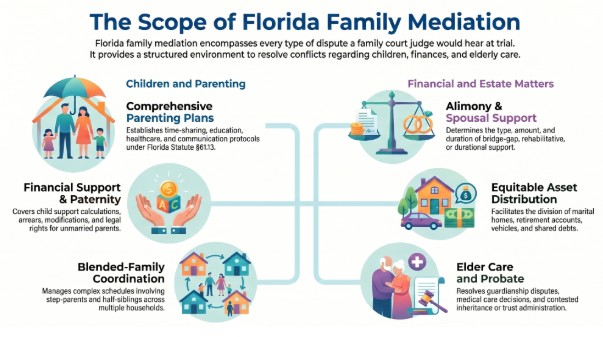
Family mediation covers every dispute type that a Brevard County family court judge would hear at trial. Kim mediates the following categories regularly, with or without attorneys present:
Mediation requires both parties to participate voluntarily and negotiate on equal footing. The process does not work in every family dispute.
Family mediation is not recommended when one party is afraid of the other, when a restraining order prohibits contact between the parties (unless both are represented by counsel who attend the session), or when one party cannot express themselves freely due to a power imbalance.
Domestic violence, active substance abuse that impairs decision-making, and refusal to disclose financial information all make voluntary mediation unsafe or ineffective.
Kim will tell you during the free telephone consultation if your situation falls outside the scope of mediation. She does not proceed when the conditions for a fair process are not present.
Not sure whether your family dispute qualifies for mediation or requires court intervention? Kim Torres offers a free telephone consultation to assess your options — call (321) 821-9995.
The process follows four steps: consultation, session, agreement, and filing.
Free telephone consultation — both parties speak with the mediator by phone to understand the process, discuss fees, and determine whether mediation is appropriate for their dispute. Once a date is scheduled, each party receives a confirmation letter and a financial affidavit to complete before the session.
Mediation session — most sessions run via Zoom for scheduling flexibility and comfort, though in-person sessions are available at the Melbourne office. The session opens with both parties present to establish ground rules.
When needed, she moves to a caucus — a private conversation with each party separately — to explore positions the other side may not be ready to hear. Kim bills sessions in quarter-hour increments, with a two-hour minimum for virtual sessions and a three-hour minimum for in-person sessions.
Settlement agreement preparation — when both parties reach an agreement, she prepares a written settlement document (parenting plan, marital settlement agreement, or both) and sends a draft via email for review.
Either party may take the draft to an attorney or financial planner before signing. The draft includes any revisions needed to clarify or correct the terms.
Court filing document preparation — as an optional flat-fee service, the practice prepares the complete filing package for submission to the Brevard County Clerk of Court. After filing, the clerk assigns a judge and schedules a final hearing, typically within two to three weeks.
Most family mediations resolve in a single session of two to four hours. Complex disputes — blended-family parenting arrangements with multiple households, contested estate disagreements, or cases involving both custody and significant property division — may require four to six hours across one or two sessions.
The full timeline from first phone call to final court order typically runs six to eight weeks: two to three weeks to schedule and mediate, two to three weeks to prepare and execute the agreement, and two to three weeks for the court hearing after filing.
Contested litigation over the same family law disputes in Brevard County family court averages 12–18 months, according to scheduling data from the 18th Judicial Circuit.
Preparation shortens your session and reduces your total cost. Before attending, each party should review and bring the following:
You do not need to bring a lawyer, though you may have one attend or review the agreement afterward.
Is family mediation required before trial in Brevard County?
Yes. Florida courts require mediation in most family law cases before scheduling a trial under Florida Statute § 44.102. You can also mediate voluntarily before either party files a petition, which typically resolves disputes faster and at lower total cost.
Can I mediate a parenting plan without hiring a lawyer?
Yes. Pro se family mediation — without attorneys — is a significant part of the practice. She guides unrepresented parents through time-sharing, decision-making, child support, and holiday schedules, then prepares a parenting plan that meets Florida court requirements.
How much does family mediation cost in Brevard County?
Sessions run $350 per hour (2026 rate) with a two-hour virtual minimum and a three-hour in-person minimum. Most family disputes are resolved in two to four hours. Settlement agreement preparation costs $700 flat, and filing document preparation costs $750.
What is the difference between family mediation and family court?
Family mediation is a voluntary, confidential process in which both parties make decisions with a neutral mediator facilitating the process. Family court is adversarial — a judge reviews evidence and imposes a ruling. Mediation typically costs under $2,000; litigation runs $15,000–$40,000+ per person.
Can family mediation handle elder care and guardianship disputes?
Yes. The practice serves the 18th Judicial Circuit’s Eldercaring Coordination pilot program, mediating disputes over elderly relatives’ medical care, living arrangements, and financial management. Elder care mediation can prevent the costs and family damage associated with formal guardianship proceedings.
Do both parties have to be in the same room during mediation?
No. Most sessions run via Zoom, and either party can request separate rooms for the entire session. The mediator moves between parties in caucus — a private session with each side separately — so direct confrontation is not required at any point.
Can I bring a family member or partner to my mediation session?
Third parties are not recommended unless both named participants agree to their presence. If either party objects, the decision of the named participant controls. The mediator reserves the right to remove any third party whose presence becomes counterproductive to the process.
How long does it take to finalize a parenting plan through mediation?
The full timeline from initial consultation to final court order typically runs six to eight weeks. The mediation session itself usually takes two to four hours. Agreement preparation requires two to three weeks, and the court schedules a hearing within three weeks after filing.
Dealing with a custody dispute, a blended-family parenting arrangement, or an elder care disagreement that has divided your family for months? Kim Torres has mediated 3,000+ disputes since 2000 — because you own the resolution, not a judge. Schedule your free telephone consultation.
Kim W. Torres, Esq. is a Florida Supreme Court Certified Mediator in Circuit Civil, Family, County Court, and Appellate matters and a member of The Florida Bar since 1985. Practicing exclusively as a mediator since 2000, she has resolved more than 2,000 cases — from complex multi-party disputes to high-emotion matters with self-represented parties. A past Chair of the Florida Bar’s ADR Section and Brevard County’s Circuit Civil Mediator of the Year, Kim mediates throughout Florida, in person and virtually.