

Originally published: November 2025

Employment mediation in Austin gives small businesses a fast, confidential way to settle wage, discrimination, termination, and contract disputes under Texas law—without the cost and publicity of public litigation.
Employment dispute mediation gives Austin small businesses a faster, more affordable way to resolve workplace conflicts. It also helps preserve relationships and protect the company’s reputation.
Mediation, unlike traditional litigation, allows both employers and employees to retain control over the outcome. Business mediation resolves disputes more quickly and cost-effectively than traditional litigation.
That’s a big deal for small businesses with tight legal budgets. The confidential nature of mediation also keeps sensitive business info private and stops internal conflicts from going public.
This approach fits right in with the city’s collaborative business vibe. It lets small businesses focus on growth rather than getting bogged down in court battles.

The most frequent Austin small-business disputes involve wages/overtime, discrimination or harassment, wrongful termination, and contract or non-compete disagreements. Mediation resolves these early, privately, and affordably.
Small businesses in Austin often struggle with wage and overtime compliance. Many employers misclassify employees as exempt from overtime pay when they should actually get time-and-a-half for hours over 40 each week.
Common wage violations include:
Restaurant, retail, and service workers often encounter these problems. Small business owners sometimes just don’t know all the wage laws and make honest mistakes.
Texas follows the federal Fair Labor Standards Act. Employees must receive overtime pay unless they qualify for an exemption under the executive, administrative, or professional categories.
Workplace discrimination affects small businesses across all industries in Austin. Employees file complaints based on race, gender, age, religion, disability, or sexual orientation.
Frequent discrimination issues involve:
Small businesses with fewer than 15 employees face different legal requirements than bigger companies. But they still need to maintain respectful workplaces free from harassment.
Harassment claims often come from inappropriate comments, unwanted advances, or a hostile work environment. Many small business owners don’t have formal HR to handle these situations well.
Texas runs on at-will employment laws. Employers can fire employees for almost any reason—or no reason at all. Still, some exceptions lead to wrongful termination claims.
Protected termination scenarios include:
Some small business owners think that at-will employment gives them total freedom to fire anyone. This misconception leads to costly employment law disputes when terminations cross protected lines.
Employers need clear records showing legitimate business reasons for dismissals. Good documentation can make or break a wrongful termination dispute.
Employment contracts create binding obligations for both sides. Austin small businesses often run into trouble over contract terms, especially with non-compete agreements and confidentiality clauses.
Common contract conflicts include:
Texas courts look closely at non-compete agreements. These contracts have to protect real business interests without unfairly limiting employee mobility.
Small businesses that invest in employee training or share trade secrets need solid contracts. Poorly written agreements end up unenforceable and leave the business exposed.
Torres Mediation helps Austin small businesses handle workplace conflicts quickly and confidentially, so you can focus on growth—not legal battles. Protect your team—Contact us today.
If you’re ready to get started, call us now!
Texas is an at-will state, but federal/state protections still apply. Mediation aligns expectations with legal realities and typical outcomes, reducing risk for both sides. Mediators help both sides see what’s realistic under current legal standards.
Texas follows at-will employment. Employers can fire employees for any reason or no reason at all. That creates a challenging landscape for wrongful termination claims.
Key At-Will Exceptions:
During mediation, employees often learn that their termination was legal under Texas law. That changes the whole settlement conversation.
Employers get some protection from at-will laws in mediation. They can argue that the firing was within their rights unless an exception applies.
Small business owners shouldn’t assume at-will employment covers discrimination claims. Those cases can still have strong settlement value in mediation.
Federal Laws Governing Texas Employment:
The Texas Labor Code addresses state-specific issues, including final paychecks and workers’ compensation. These laws give the foundation for real employment claims.
Wage and hour violations under FLSA can get expensive. Employers might owe back wages, extra damages, and attorney fees.
Discrimination cases under Title VII can involve emotional distress and punitive damages. That puts pressure on both sides to settle during mediation.
Common Settlement Ranges by Claim Type:
Experienced mediators use “reality testing” by applying current Texas employment law to each party’s position. They help people see what courts would probably do based on past cases.
Mediator Techniques for Legal Reality Testing:
Mediators often spot gaps in documentation that weaken cases. They show employers when they didn’t follow their own policies.
For employees, mediators explain the burden of proof. Many discrimination cases require proving that the employer’s reason was just a cover story.
Expert employment mediators blend legal knowledge with practical experience. They know how Texas courts usually rule on similar disputes.
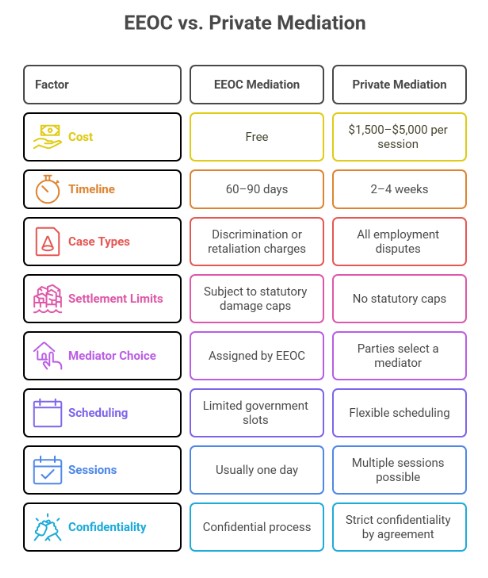
EEOC mediation is free and tied to discrimination charges; private mediation is faster, highly confidential, and fits broader employment disputes
EEOC mediation offers a free government process, while private mediation gives both sides more control and flexibility.
EEOC mediation is a voluntary process where a neutral mediator helps employers and employees resolve discrimination charges. The process usually takes one day and doesn’t cost either party anything.
Key advantages include:
Notable disadvantages:
The EEOC process works best for straightforward discrimination cases. Austin businesses often find it helpful for harassment or retaliation claims.
Private mediation offers a more informal and flexible way to resolve disputes than EEOC processes. Austin businesses can pick their mediator and set up sessions when it works for everyone.
Major benefits include:
Private mediation costs run about $200-$500 per hour in Austin. Both parties usually split the fees.
The process allows for multiple sessions if needed. Complex cases, like contract disputes or wrongful termination, often benefit from this approach.
| Factor | EEOC Mediation | Private Mediation |
| Cost | Free | $1,500–$5,000 per session (usually split) |
| Timeline | 60–90 days | 2–4 weeks (often sooner) |
| Case Types | Discrimination or retaliation charges | All employment disputes (wage, contracts, termination, discrimination) |
| Settlement Limits | Subject to statutory damage caps (varies by claim and employer size) | No statutory caps; business-driven outcomes |
| Mediator Choice | Assigned by EEOC | Parties select a mediator |
| Scheduling | Limited government slots | Flexible scheduling, including urgent sessions |
| Sessions | Usually one day | Multiple sessions are possible if needed |
| Confidentiality | Confidential process | Strict confidentiality by agreement |
If you run a small business in Austin, you’ve got to weigh your specific situation before picking a mediation option. EEOC mediation tends to fit straightforward discrimination cases with limited damages.
Private mediation, on the other hand, works better for messier disputes or when you’re aiming for higher compensation. Sure, it’s pricier, but the speed and flexibility might make up for it.
Employment disputes can really put a dent in a business’s reputation if they spill out into public court.
Mediation offers a private, more discreet alternative to court proceedings, where details become public record.
Business owners know employment disputes often involve sensitive information about company operations, personnel moves, or internal policies.
Maintaining confidentiality through ADR processes protects sensitive information and avoids negative publicity.
Once a dispute hits the courts, the records go public. That means competitors, customers, and even future hires can dig through:
Mediation is a beneficial mechanism for maintaining confidentiality in the workplace. The private nature of these sessions keeps discussions, settlements, and case details between just the parties involved.
For small business owners, this confidentiality is especially valuable. They usually have closer ties to their community and customers.
When employment disputes go public, they create tension and uncertainty for everyone left at the company. People start worrying about job security and whether the company will survive the drama.
ADR methods prioritize collaboration, the preservation of professional relationships, and the fostering of trust with stakeholders. Mediation gives both sides a chance to talk things through in a structured setting.
When employees see their company handling disputes calmly and fairly, they feel more secure. It sends the message that the company prefers problem-solving over public fights.
Benefits for team morale include:
Quietly resolving issues lets everyone get back to work faster than if the dispute drags out in court.
Business relationships really hinge on a company’s stability and reputation. Investors and customers pay close attention to legal disputes—they see them as a sign of how well management runs the show.
Mediation resolves disputes quickly, preventing prolonged public legal battles that can harm a business’s reputation. Wrapping things up fast reassures stakeholders that the company can handle bumps in the road.
Customers sometimes get spooked by public employment lawsuits. They might wonder if it’s worth sticking around, especially if they’re worried about service disruptions or how the company treats people.
Key reputation benefits:
Small businesses, in particular, need to keep their public records clean. They rely heavily on their local reputation and word of mouth to grow.
In Austin’s fast-moving business environment, Torres Mediation gives small businesses practical solutions for employee disputes without damaging morale or reputation. Resolve conflicts on your terms—Schedule your appointment now.
If you’re ready to get started, call us now!
Mediation follows a pretty set structure. Each phase nudges both sides toward a settlement and, hopefully, keeps everyone out of court.
Preparation really sets the stage for successful employment dispute mediation. Both sides need to gather documents and figure out what they want before the session even starts.
The employer should pull together personnel files, contracts, and company policies. It’s important to know the full story and any legal risks involved.
The employee should collect emails, reviews, and a witness statement or two. They also need to clarify what they want out of mediation.
Key preparation steps include:
Clear objectives help both sides—and the mediator—understand where everyone stands.
Mediation usually kicks off with everyone in the same room. The mediator lays out the ground rules and covers confidentiality.
Each side shares its opening statement. No interruptions allowed. The employer explains their view and the relevant policies.
The employee then tells their side and how things affected them. This exchange gives everyone a fuller sense of the dispute.
The mediator jumps in with questions to clarify the main issues. They’re always scanning for common ground.
This part can get emotional, but the mediator keeps things on track and focused on solutions.
The mediator then meets with each party in private—these are called caucuses. People can talk honestly here about what really matters to them.
Employers might raise budget constraints or worry about setting a precedent. Employees can share their priorities without feeling exposed.
The mediator floats different settlement ideas and checks whether anyone has a hard no. They look for creative ways to break a deadlock.
Common trade-offs explored:
The mediator goes back and forth, carrying offers and counter-offers. They help both sides see the strengths and weaknesses of their positions.
Usually, this involves a few rounds of negotiation. The mediator tries to keep everyone realistic and focused on workable solutions.
Once both sides agree, the mediator helps write up a settlement memorandum. This spells out the terms everyone has accepted.
The memo covers financial terms, confidentiality, and any ongoing responsibilities. Both sides need to read it carefully before signing.
Essential elements often include:
Once signed, the agreement becomes legally binding. Neither party can back out or bring up the same issues in court later.
If mediation doesn’t lead to a deal, everyone can still pursue other legal options—maybe even a lawsuit or arbitration.

| Document | Why It Matters | Who Brings |
| Employment contract/offer | Terms, duties, and severance | Employer/Employee |
| Payroll & timesheets | Wage/overtime evidence | Employer |
| HR policies & complaints | Policy compliance, notice | Employer |
| Emails/texts | Timeline, intent | Both |
| Performance reviews | Legitimate business reasons | Employer |
Organize documents in order by date. It helps the mediator see the timeline and spot key moments in the dispute.
Having all your paperwork handy makes decision-making easier during negotiations. Missing documents can slow things down or limit your options.
The outcome of mediation depends heavily on choosing the right mediator—someone who understands both employment law and the realities of running a small business.
Austin has plenty of experienced mediators specializing in employment disputes, but you have to check their qualifications first.
A mediator who understands employment law can spot legit legal claims and weed out the nonsense. They ask sharper questions and keep the sessions productive.
Key qualifications to look for:
Many Austin mediators have extensive backgrounds in labor and employment law. They bring real courtroom experience, which helps them explain legal risks clearly.
Ask potential mediators about their experience in employment law. Find out if they’ve handled similar cases lately. The right expertise helps them suggest realistic settlement ranges.
Small businesses face challenges that big companies just don’t. They might not have an HR team or a lawyer on speed dial. A good mediator understands these limits and adapts their approach.
Small business considerations include:
Austin’s collaborative entrepreneurial culture makes mediation particularly effective for local small business conflicts. Mediators who know this scene understand what’s at stake. They realize small businesses need solutions that protect legal rights and keep the doors open.
The right mediator won’t push small business owners into deals they can’t afford. Instead, they’ll look for creative solutions that address employee concerns and keep the business afloat.
Employment disputes can blow up fast and wreck morale before you know it. Small businesses really need mediators who’ll jump in and schedule sessions quickly.
If you wait too long, things usually get messier and costlier. Most employment mediation cases work out better when someone intervenes early.
While everyone waits, workplace tension continues to simmer. Sometimes, productivity drops, and other employees get pulled into the drama.
Business mediation services in Austin usually offer flexible scheduling. Some mediators will even meet in the evening or on weekends so they don’t disrupt your operations.
Others offer virtual mediation to help avoid scheduling headaches. It’s worth asking about these options right away.
Business owners should get clear about timelines from the start. Don’t be shy—ask about emergency scheduling if things feel urgent.
If a mediator responds quickly when you first reach out, that’s a good sign they’ll stay available and committed as things move forward.
Employment disputes can really damage small businesses in Austin. They mess with workplace relationships and eat up money fast.
Business mediation resolves disputes more quickly and cost-effectively than traditional litigation. It’s a relief to have options that don’t involve endless court battles.
Small business owners shouldn’t have to handle these headaches alone. Professional mediators step in and help resolve conflicts before things spiral.
Austin’s collaborative entrepreneurial culture makes mediation particularly effective for resolving local small-business conflicts. Business owners here can really take advantage of that supportive vibe.
Mediators familiar with Texas employment matters, small-business constraints, and virtual scheduling help Austin employers resolve issues with minimal disruption.
Employment disputes will pop up in any growing business. The smart move? Have a plan ready. Mediation puts business owners in the driver’s seat.
Torres Mediation supports Austin’s small businesses with affordable, confidential mediation that safeguards your reputation and restores workplace harmony. Don’t let disputes escalate—Contact us today to book your mediation.
What types of disputes can employment mediation resolve in Austin?
Mediation resolves wage and overtime issues, harassment claims, wrongful termination, contract disagreements, and non-compete conflicts for Austin small businesses without going to court.
How much does employment mediation cost in Austin?
Private employment mediation in Austin typically costs $1,500–$5,000 per session, split between the parties. This is far less than drawn-out litigation.
How long does employment mediation take compared to litigation?
Most disputes settle in a single 4–8-hour session. By contrast, litigation may last months or years and significantly increase legal costs.
Is a mediation agreement legally binding in Texas?
Yes. Once both sides sign, the settlement is enforceable under Texas law. Attorneys usually finalize the terms in a written agreement.
Can we mediate if an EEOC charge is already filed?
Yes. EEOC mediation is free and available for discrimination cases. Private mediation can also be used during or after an EEOC charge for faster resolution.
Do I need a lawyer during mediation?
Lawyers aren’t required but are recommended. Legal counsel protects your rights, reviews agreements, and ensures compliance with Texas and federal employment law.
How confidential is employment mediation in Austin?
Mediation sessions are private. Unlike the court, records and discussions remain confidential, safeguarding your reputation, employee trust, and customer confidence.
Kim W. Torres, Esq. is a Florida Supreme Court Certified Mediator in Circuit Civil, Family, County Court, and Appellate matters and a member of The Florida Bar since 1985. Practicing exclusively as a mediator since 2000, she has resolved more than 2,000 cases — from complex multi-party disputes to high-emotion matters with self-represented parties. A past Chair of the Florida Bar’s ADR Section and Brevard County’s Circuit Civil Mediator of the Year, Kim mediates throughout Florida, in person and virtually.