

Originally published: April 2026

Data last verified: March 2026
Preparing for divorce mediation in Florida requires gathering financial documents, defining parenting priorities, reviewing marital assets, and entering sessions with realistic settlement goals.
Florida couples who prepare thoroughly before their first mediation session resolve disputes faster, reach more durable agreements, and spend significantly less on total mediation time than couples who arrive unprepared.
Schedule your first mediation session with Torres Mediation. Kim Torres guides Florida couples through every stage of preparation, so your first session moves toward resolution from the opening hour.
A Florida divorce mediation session begins with the mediator explaining the process, ground rules, and confidentiality protections under Florida Statutes Section 44.405. Both spouses present positions on contested issues. The mediator guides structured negotiation through joint sessions, private caucuses, or both until the parties reach a signed agreement or declare impasse.
Florida Supreme Court Certified Mediator Kim Torres of Torres Mediation opens each session by establishing the agenda, identifying contested issues, and confirming that both parties understand mediation is voluntary and confidential.
Sessions run four to eight hours for straightforward cases. Complex cases involving significant assets or contested custody may require two to four sessions.
The mediator does not issue rulings or provide legal advice. At the conclusion of a successful session, both parties sign a written mediated settlement agreement that a Florida family court judge reviews and, upon approval, converts into a binding final judgment of dissolution of marriage.
Torres Mediation’s overview of Florida mediation preparation provides a session-by-session breakdown for first-time participants.
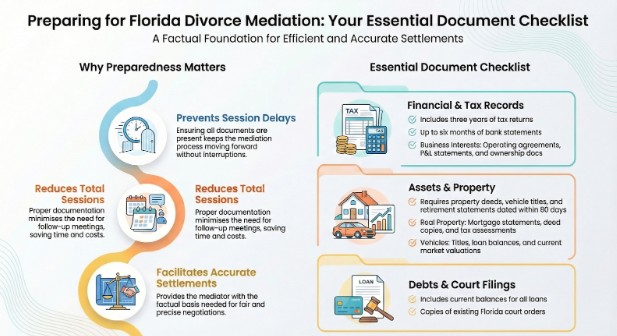
Florida divorce mediation requires both spouses to bring documentation covering marital assets, liabilities, income, real property, and existing court filings.
Complete documentation prevents session delays, reduces the total number of sessions needed, and provides the mediator with a factual foundation to facilitate accurate settlement negotiations.
| Document Category | Specific Items Required |
| Tax Records | Federal and state returns, last 3 years |
| Bank Accounts | Statements for all accounts, last 3–6 months |
| Real Property | Mortgage statements, deed copies, tax assessments |
| Retirement & Investments | Account statements dated within 90 days |
| Vehicles | Titles, loan balances, and current market valuations |
| Business Interests | Operating agreements, P&L statements, ownership docs |
| Insurance | Life insurance declarations showing current cash value |
| Debts | Credit cards, loans, and student debt with current balances |
| Court Documents | Any existing Florida orders, dissolution petition, and filed responses |
Organizing documents into labeled folders by category before the session saves mediator time and reduces total billable hours.
Torres Mediation recommends separate folders for real property, financial accounts, income documentation, debt obligations, and existing court orders.
If you’re ready to get started, call us now!
Florida equitable distribution law under Florida Statutes Section 61.075 requires both spouses to disclose all marital assets and liabilities before a Florida family court approves any dissolution agreement.
Preparing a complete financial picture before mediation allows both parties to negotiate from verified data rather than incomplete estimates.
Florida child support calculations under Florida Statutes Section 61.30 use each parent’s gross monthly income as the primary input, so accurate income documentation is essential before any support discussion begins.
Florida spousal support analysis under Florida Statutes Section 61.08 considers each spouse’s financial need and the other’s ability to pay, both of which require verified monthly expense data.
Retirement account transfers that do not comply withIRS requirements for qualified domestic relations orders (QDROs) can result in immediate tax liability and penalties, so both spouses should obtain current account statements and consult a CPA before agreeing to any division of retirement assets.
Florida couples navigating complex financial disclosures can review the Florida pro se divorce financial guide for a complete disclosure checklist.
Florida law requires all divorcing parents with minor children to submit a parenting plan for court approval under Florida Statutes Section 61.29.
A Florida-approved parenting plan must address the division of daily parenting responsibilities, a detailed time-sharing schedule, and the designation of which parent will make decisions regarding education, healthcare, and extracurricular activities.
Florida courts apply the best interests of the child standard under Florida Statutes Section 61.13 when evaluating any proposed parenting plan.
Mediated plans reflecting both parents’ genuine input are more likely to satisfy that standard and receive judicial approval without modification.
The table below shows the parenting plan elements Florida courts require versus elements couples can customize through mediation:
| Parenting Plan Element | Court-Required | Customizable in Mediation |
| Time-sharing schedule (school year) | Yes | Yes — customize days, transitions, pickups |
| Holiday and school break rotation | Yes | Yes — define specific dates and alternating years |
| Decision-making authority (education) | Yes | Yes — shared or designated parent |
| Decision-making authority (healthcare) | Yes | Yes — shared or designated parent |
| Co-parent communication method | Yes | Yes — app, email, text, or co-parenting platform |
| Out-of-state travel notification | Yes | Yes — define notice period and consent process |
| Relocation restrictions | Yes | Yes — define geographic boundaries |
| Extracurricular activity approval | No | Yes — address in mediation to prevent future disputes |
Torres Mediation’s resource on preparing for custody mediation provides a comprehensive parenting plan preparation checklist for Florida parents entering their first custody mediation session.
Florida divorce mediation produces stronger outcomes when both spouses arrive with defined answers to the core financial and parenting questions the mediator will raise.
Spouses who have thought through priorities in advance negotiate more efficiently, make fewer reactive concessions under time pressure, and produce agreements with lower post-divorce modification rates.
Florida couples who review the questions to ask a divorce mediator before their first session consistently report feeling more prepared and less reactive during negotiations.
If you’re ready to get started, call us now!
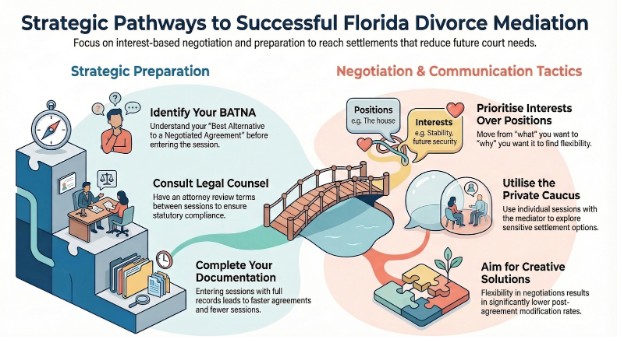
Florida divorce mediation success depends on preparation, emotional regulation, and interest-based negotiation rather than positional bargaining.
Couples who enter sessions with complete documentation, defined priorities, and a willingness to generate creative solutions reach agreements in fewer sessions and with lower post-agreement modification rates.
Separate positions from interests. A position is what you say you want. An interest is why you want it. A spouse who insists on keeping the marital home may actually prioritize stability for the children, an interest that a structured buyout or deferred sale agreement can also satisfy.
Prepare your BATNA. BATNA stands for Best Alternative to a Negotiated Agreement. Knowing what your realistic outcome would be if mediation fails and the case proceeds to a Florida circuit court prevents you from rejecting reasonable mediated settlements in favor of unpredictable litigation outcomes.
Use the private caucus. Florida divorce mediators offer private sessions in which each spouse meets individually with the mediator. Use private caucus time to communicate sensitive priorities or explore settlement options you are not ready to propose jointly.
Consult your attorney between sessions. A Florida family law attorney reviewing proposed terms between sessions can identify provisions that may not survive Florida court approval and advise whether proposed support or custody terms align with Florida statutory guidelines.
Torres Mediation’s article on signs you are ready for mediation helps Florida couples assess their readiness before scheduling mediation.
The most common Florida divorce mediation mistakes are arriving without complete financial documentation, making concessions under emotional pressure, ignoring tax consequences of asset transfers, and signing a mediated agreement without independent attorney review.
Each mistake increases the likelihood of post-agreement disputes, modification petitions, or enforcement proceedings.
Kim Torres, Florida Supreme Court Certified Mediator, guides couples through preparation, negotiation, and agreement drafting so every session moves toward a durable resolution. Schedule your confidential consultation today.
What should I bring to my first divorce mediation session in Florida?
Bring three years of tax returns, three to six months of bank statements, retirement account statements, mortgage documents, vehicle titles, a complete debt list, and any existing Florida court orders. Organized financial documentation prevents session delays and reduces total mediation hours, lowering your overall cost.
How long does a divorce mediation session last in Florida?
A Florida divorce mediation session typically runs four to eight hours for straightforward cases. Complex cases may require two to four sessions over several weeks. Most Florida couples reach a signed mediated settlement agreement within one to three months of their first session.
What happens if we do not reach an agreement in mediation?
If both spouses declare impasse, the Florida mediator files a report with the court indicating mediation was unsuccessful. The case then proceeds to a contested hearing before a Florida circuit court judge. Torres Mediation’s article on no agreement in divorce mediation explains the next steps Florida couples face after an impasse.
How do I prepare emotionally for divorce mediation?
Prepare by identifying your three highest-priority outcomes before the session, consulting a therapist in advance if needed, and separating your emotional needs from your negotiating positions so session discussions stay focused on resolution rather than conflict.
Kim W. Torres, Esq. is a Florida Supreme Court Certified Mediator in Circuit Civil, Family, County Court, and Appellate matters and a member of The Florida Bar since 1985. Practicing exclusively as a mediator since 2000, she has resolved more than 2,000 cases — from complex multi-party disputes to high-emotion matters with self-represented parties. A past Chair of the Florida Bar’s ADR Section and Brevard County’s Circuit Civil Mediator of the Year, Kim mediates throughout Florida, in person and virtually.