

Originally published: April 2026
Data last verified: March 2026
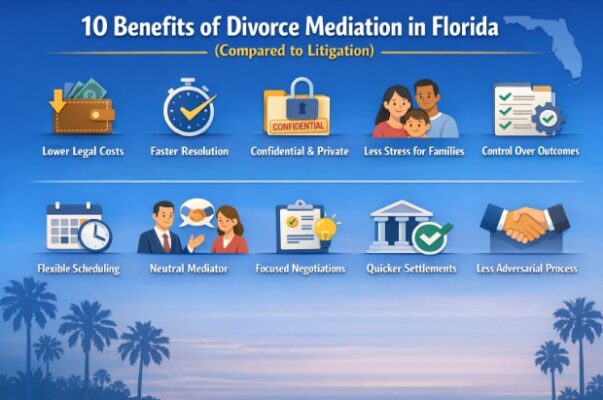
Divorce mediation in Florida offers 10 measurable advantages over litigation: lower total costs, faster resolution times, greater decision-making control, reduced emotional stress, stronger co-parenting outcomes, full confidentiality, scheduling flexibility, legal enforceability, higher post-agreement compliance rates, and long-term relationship preservation.
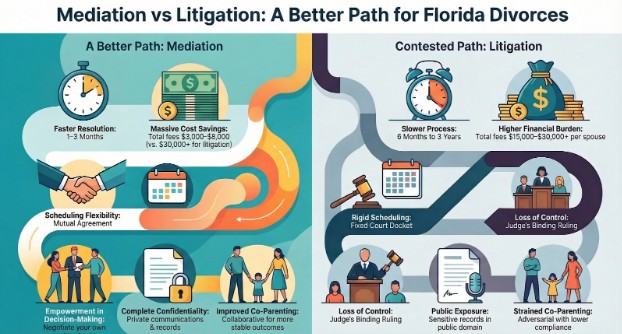
Most Florida couples complete mediation within one to three months, at a total cost of $3,000 to $8,000, compared to $15,000 to $30,000 or more in contested litigation.
Schedule a confidential mediation consultation with Torres Mediation to determine whether mediation is the right path for your Florida divorce.
Divorce mediation in Florida is a voluntary, confidential dispute resolution process in which a Florida Supreme Court Certified Mediator helps two spouses negotiate all terms of their dissolution of marriage, including asset division, child custody, and support obligations.
The mediator facilitates agreement but does not impose decisions. Florida Family Law Rules of Procedure Rule 12.740 requires mediation before most contested divorce trials.
Florida’s mediation framework operates under Chapter 44 of the Florida Statutes, which establishes certification requirements and ethical standards for all practicing mediators.
A Florida-certified family mediator must complete a 40-hour state-approved training program and fulfill continuing professional education requirements.
Kim Torres of Torres Mediation holds Florida Supreme Court Certification as both a Family Mediator and Circuit Mediator, with documented experience in contested property, custody, and support disputes.
A Florida divorce mediator facilitates structured negotiation but cannot provide independent legal advice to either spouse. Both parties retain the right to consult separate attorneys before signing any mediated settlement agreement.
Once both spouses sign and a Florida family court judge approves the agreement, it becomes an enforceable final judgment of dissolution of marriage.
If you’re ready to get started, call us now!
Mediation and litigation differ across five measurable dimensions: total cost, timeline, privacy, decision-making control, and co-parenting impact. Mediation costs $3,000 to $8,000 total and resolves in one to three months.
Contested Florida litigation costs $15,000 to $30,000 or more per spouse and takes six months to three years. In mediation, both spouses control the outcome. In litigation, a circuit court judge decides.
The table below compares the two processes across the factors that Florida divorcing couples identify as most important.
| Category | Mediation | Litigation |
| Average Cost | $3,000–$8,000 total | $15,000–$30,000+ total |
| Timeline | Weeks to 3 months | 6 months to 3 years |
| Privacy | Private and confidential | Public court record |
| Control | Parties decide the outcome | The judge decides the outcome |
| Co-Parenting Impact | Collaborative and constructive | Often adversarial |
| Emotional Stress | Lower, solution-focused | Higher, conflict-driven |
Florida couples seeking a detailed, case-by-case breakdown can review the mediation vs. court divorce analysis published by Torres Mediation.
Each benefit below reflects documented outcomes for Florida couples who chose mediation over contested litigation.
Divorce mediation in Florida costs $3,000 to $8,000 in total fees for the mediator and attorney. Contested litigation typically costs $15,000 to $30,000 per spouse, or more. Mediation eliminates the three primary litigation cost drivers: extended discovery, depositions, and multiple courtroom hearings.
Mediator fees in Florida range from $150 to $400 per hour and are split equally between both spouses.
Most Florida divorce mediations conclude in one to three sessions, limiting total mediator time to eight to sixteen hours.
Attorney involvement is limited to pre-session preparation and agreement review rather than courtroom representation, reducing per-spouse legal fees by thousands of dollars compared to a fully litigated dissolution.
Most Florida divorce mediations resolve within one to three months from the first session to a signed agreement. Contested litigation in Florida takes six months to three years from filing to final judgment, depending on circuit court docket congestion and case complexity. Mediation schedules sessions based on both parties’ availability, not on the court calendar.
Litigation timelines are controlled by mandatory waiting periods, opposing counsel scheduling, and court docket backlogs. Mediation removes all three constraints. Florida couples can schedule a first mediation session within days of engaging a mediator.
Torres Mediation’s article on timing divorce mediation explains how early engagement with a mediator compresses the total dissolution timeline.
In Florida divorce mediation, both spouses negotiate and approve every term of the dissolution agreement, including property division, parenting schedules, and support amounts.
In contested litigation, a Florida circuit court judge applies statutory guidelines and issues binding rulings on non-negotiable preferences without input from either party.
Florida circuit court judges apply the equitable distribution standard under Florida Statutes Section 61.075 and child support guidelines under Section 61.30 uniformly, without accounting for individual family priorities.
Mediation allows couples to structure custom arrangements, including graduated parenting-time schedules, business succession transfers, or asset-exchange agreements, that a court would be unlikely to order on its own.
Florida parents who negotiate custody agreements through mediation report higher voluntary compliance rates and more cooperative post-divorce communication than parents subject to court-ordered parenting plans.
Active participation in the negotiation process increases both parents’ commitment to the agreed schedule.
Family law research consistently demonstrates that mediated parenting agreements reduce post-divorce conflict and produce more stable developmental outcomes for children.
The collaborative negotiation structure also establishes the communication framework that effective long-term co-parenting requires.
Torres Mediation’s guide on preparing for custody mediation helps Florida parents enter sessions with defined priorities and realistic settlement expectations.
Florida divorce mediation replaces adversarial courtroom confrontation with structured, solution-focused negotiation.
Mediation participants report significantly lower stress levels than litigation participants, whose process is structured around conflict, cross-examination, and public testimony.
A Florida Supreme Court Certified Mediator actively manages session dynamics to keep both parties focused on resolution.
Contested litigation requires both spouses to build legal arguments against each other, which can entrench post-divorce hostility and make co-parenting cooperation significantly harder to sustain.
Mediation reframes the dissolution process around shared objectives, protecting children’s stability, preserving financial security, and reaching equitable agreements, rather than around adversarial positioning. For Florida families with minor children, that structural difference produces measurable long-term benefits.
Florida Statutes Section 44.405 classifies all communications made during divorce mediation as confidential and inadmissible in court proceedings. No statements, settlement proposals, or financial disclosures made during mediation sessions can be introduced as evidence in subsequent litigation. Florida court proceedings are part of the public record and accessible to anyone.
Florida business owners, licensed professionals, and public figures frequently choose mediation specifically because confidentiality protects sensitive financial disclosures and asset valuations from public exposure.
In contested litigation, financial records, deposition transcripts, and courtroom testimony become permanent public documents. Mediation eliminates that exposure entirely.
If you’re ready to get started, call us now!
Florida divorce mediation sessions are scheduled by mutual agreement between both spouses and the mediator, not by court calendar.
Couples can schedule sessions on evenings and weekends, or via secure video conferencing platforms, accommodating work schedules, childcare obligations, and geographic distance.
Florida circuit courts operate on fixed docket schedules that routinely push hearings out by weeks or months.
Virtual mediation platforms have expanded access for Florida residents in rural counties and for spouses separated by geographic distance. Torres Mediation provides both in-person and online sessions for couples throughout Florida, eliminating travel as a scheduling barrier.
Scheduling on mutually agreed terms reduces the total elapsed time between the mediation engagement and the final signed agreement.
Florida divorce parties who actively negotiate their own settlement terms comply with those terms at higher rates than parties subject to court-imposed judgments. Spouses who agree on support amounts, custody schedules, and property transfers during mediation are statistically less likely to require post-judgment enforcement actions.
Post-judgment enforcement proceedings, including contempt motions and modification petitions, generate additional attorney fees and court costs for both parties.
Mediated agreements reduce the frequency of enforcement because both spouses participate in structuring the terms.
Torres Mediation’s article on child support enforcement in Florida documents the legal remedies available when court orders go unenforced, a scenario that mediation measurably reduces.
A mediated divorce settlement agreement signed by both Florida spouses and approved by a Florida family court judge is fully enforceable as a final court order. Mediation does not produce informal or advisory-only arrangements.
The approved agreement carries the same legal weight as a judgment issued after a contested trial.
A common misconception holds that mediated agreements are less enforceable than litigated judgments.
Under Florida law, a mediated settlement agreement incorporated into a final judgment of dissolution of marriage is subject to the same enforcement mechanisms as any other court order, including contempt proceedings, wage garnishment, and asset seizure for non-compliance.
Florida divorce mediation is structured to minimize interpersonal conflict, which produces measurable long-term benefits for co-parenting relationships, extended family dynamics, and shared professional or business interests.
The collaborative negotiation process reduces post-divorce resentment and establishes a functional communication framework for separated families.
Contested litigation generates adversarial pressure that damages not only the spousal relationship but also extended family connections, mutual friendships, and shared professional networks.
Mediation limits collateral damage by keeping negotiation focused on resolution rather than conflict.
Torres Mediation’s analysis of co-parenting challenges in Florida demonstrates how the divorce process itself shapes the quality of the co-parenting relationship that follows.
Torres Mediation offers a confidential initial consultation to help Florida couples assess whether mediation is a good fit for their situation before committing to any dissolution process.
Divorce mediation is the optimal choice for most Florida couples, particularly those with minor children, significant shared assets, active business interests, or a need to keep financial information out of the public record.
Mediation is effective even when both spouses currently disagree on all terms, provided both parties are willing to negotiate in good faith with a trained neutral mediator.
Mediation produces the strongest outcomes in the following circumstances:
Mediation is less appropriate when a documented history of domestic violence exists, when a significant power imbalance between spouses prevents good-faith negotiation, or when one spouse is actively concealing marital assets.
Florida couples in those circumstances should consult a Florida family law attorney before scheduling mediation sessions.
Torres Mediation, led by Florida Supreme Court Certified Mediator Kim Torres, provides divorce and family mediation services to couples throughout Florida.
Kim Torres holds dual certifications as a Florida Family Mediator and Circuit Mediator and has guided hundreds of Florida couples through contested property division, custody, support, elder care, HOA, and small-business disputes. Sessions are available in person and via secure video conferencing statewide.
Kim Torres built Torres Mediation on the documented principle that a structured, neutral negotiation process produces better financial outcomes, stronger co-parenting relationships, and lower post-divorce conflict than adversarial litigation.
Torres Mediation handles the full range of Florida dissolution disputes:
Contact Torres Mediation to schedule a confidential divorce consultation. Kim Torres serves Florida couples in person and virtually. Florida residents can take the first step toward a faster, lower-cost, and less adversarial dissolution process today.
How much does divorce mediation cost in Florida?
Divorce mediation in Florida costs between $3,000 and $8,000 in total fees, depending on session length and case complexity. Florida mediators charge $150 to $400 per hour, with fees split equally between both spouses. That total is 60–80% less than contested litigation, which commonly costs $15,000 to $30,000 or more per spouse.
Is divorce mediation legally binding in Florida?
Yes. A mediated settlement agreement signed by both Florida spouses and approved by a Florida family court judge becomes a legally binding and fully enforceable court order. Neither party can unilaterally modify the terms after judicial approval without returning to court or renegotiating through a subsequent mediation session.
How long does divorce mediation take in Florida?
Most Florida divorce mediations resolve within one to three months from the first session to a signed agreement. Straightforward cases may conclude in a single four-to-eight-hour session. Complex cases involving substantial assets or contested custody arrangements may require two to four sessions scheduled across several weeks.
Can mediation work if my spouse and I disagree on everything?
Yes. Divorce mediation is specifically designed for couples who currently disagree on all aspects of the dissolution. A Florida Supreme Court Certified Mediator does not favor either party but provides a structured negotiation framework that moves both spouses from entrenched positions toward a workable agreement. The majority of Florida couples who enter mediation with full disagreement leave with a signed settlement.
Do I need an attorney for divorce mediation in Florida?
Florida law does not require an attorney to be present during mediation sessions. However, consulting an independent family law attorney before and after sessions is strongly recommended.
A Florida family law attorney can review any proposed mediated agreement before signing to confirm it protects the client’s legal rights and satisfies Florida court approval requirements.
Kim W. Torres, Esq. is a Florida Supreme Court Certified Mediator in Circuit Civil, Family, County Court, and Appellate matters and a member of The Florida Bar since 1985. Practicing exclusively as a mediator since 2000, she has resolved more than 2,000 cases — from complex multi-party disputes to high-emotion matters with self-represented parties. A past Chair of the Florida Bar’s ADR Section and Brevard County’s Circuit Civil Mediator of the Year, Kim mediates throughout Florida, in person and virtually.