

Originally published: May 2026

Some families don’t arrive at mediation because of a single breaking point. They arrive because of a hundred small ones — missed signals, misread intentions, and conversations that kept ending the same way. For one South Florida family navigating the end of a fifteen-year marriage, that pattern had become the whole story.
Three children. Two parents who both loved their kids deeply and were doing their best under real strain. And a communication breakdown so complete that a routine weekend exchange had recently spiraled into a threat to leave the state with the children.
What this family needed wasn’t a courtroom battle. They needed space — a calm, neutral place where both parents could finally be heard, and where the focus could return to what mattered most: raising their children well, together, even apart.
On paper, the separation had structure. One parent had moved out and was staying with family. The children — teenage twins and a younger daughter — spent weekdays with their mother and weekends with their father. An informal agreement kept communication limited to topics about the house and the children.
But structure on paper only goes so far when two people are hurting.
Both parents were carrying real personal burdens. One was navigating significant changes in their physical and mental health, and working steadily with a therapist to manage anxiety — a process that was showing genuine progress.
The other had been diagnosed with ADD and was finding it hard to engage consistently with treatment, leading to moments of emotional unpredictability that neither parent knew how to navigate.
They weren’t bad people. They were exhausted people, trying to hold things together for three children who needed them both.
Without a formal agreement or legal framework to lean on, there was nothing to absorb the pressure as it built. The gap became visible during one difficult drop-off that escalated into a threat of interstate relocation.
The threat was walked back that same evening — but the damage to trust was real, and the pattern was impossible to ignore. Escalation. Retraction. A few days of quiet. Then reset.
Neither parent had legal representation. Neither had the financial means for a courtroom process. What they needed was someone steady — a neutral voice with no agenda, no side, and no stake in the outcome.
If you’re ready to get started, call us now!
Kim Torres, Esq., Florida Supreme Court Certified Mediator in Family and Circuit Civil matters, scheduled an initial session within days of the family’s first contact.
She began where high-conflict family cases almost always need to begin — not with paperwork or legal positioning, but with the people in the room. Before any agreement could take shape, both parents needed to feel safe enough to listen and grounded enough to hear.
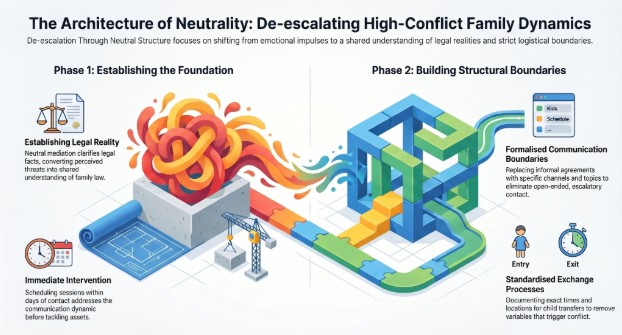
Putting the Legal Picture in Perspective. Threatening to relocate children out of state without a court order carries serious legal consequences. Hearing that from a calm, neutral mediator — rather than from a frustrated co-parent — made it land as information rather than an accusation.
The fear and anger behind the threat began to give way to a clearer understanding of what the law allows and what it protects.
Creating Boundaries That Both Parents Could Live With. The informal agreement that had been guiding the family was replaced by a defined framework — specific channels for communication, clear topics, and boundaries that removed the ambiguity quietly fueling most of the conflict.
Both parents knew exactly how and when they were expected to be in contact, which took away the open-ended access that had been feeding the cycle.
Making the Exchange Feel Safe for Everyone. The drop-off had become the moment everything fell apart, week after week. A written plan for exchanges changed that. It removed uncertainty, created consistency, and kept the focus where it belonged — on the children, and on making the transition as smooth and reassuring as possible for them. What had been a flashpoint became a routine.
Showing What a Different Conversation Could Look Like. Perhaps the most quietly powerful part of the process was this: Kim modeled, in every session, how to talk about hard things without making them harder. Both parents experienced — maybe for the first time in a long while — that a calm, respectful conversation between them was genuinely possible. That experience didn’t leave the room when the sessions ended. It went home with them.
The mediation didn’t make the conflict disappear. It was never meant to. What it did was break the cycle — the exhausting, repetitive loop that had kept both parents stuck and prevented the family from finding its footing.
Both parents left feeling heard. The issues that had felt overwhelming and permanent turned out to be workable. The formal parenting plan gave each of them something they hadn’t had in a long time — certainty.
Certainty about when they would be with their children, how decisions would be made, and that neither parent could simply uproot the family without consequence.
With communication boundaries in place, escalation became the exception rather than the weekly rhythm. Each parent gained the breathing room to focus on their own healing — and on being present for their kids.
For the three children at the center of it all, the weekend exchange became ordinary. Unremarkable. Safe. Exactly what it was always supposed to be.
And that shift — from crisis to routine, from reactive to steady — ripples forward. It shows up at school pickups and holiday tables. It shows up at graduations and milestone birthdays, and in the hundred quiet moments in between, where children learn what it looks like when the adults in their lives choose to do things differently. This family now has a foundation — not a perfect one, but a real one — to build those years on.
If your family is caught in a cycle that keeps resetting without resolution, structured mediation can help break it.
Kim Torres, Esq. at Torres Mediation works with separating parents — including high-conflict cases involving mental health challenges, life transitions, and communication breakdown — to build agreements that hold and relationships that can grow.
Sessions are available within 2 to 7 days of your first contact. Reach out to Torres Mediation to schedule your confidential consultation.
Kim W. Torres, Esq. is a Florida Supreme Court Certified Mediator in Circuit Civil, Family, County Court, and Appellate matters and a member of The Florida Bar since 1985. Practicing exclusively as a mediator since 2000, she has resolved more than 2,000 cases — from complex multi-party disputes to high-emotion matters with self-represented parties. A past Chair of the Florida Bar’s ADR Section and Brevard County’s Circuit Civil Mediator of the Year, Kim mediates throughout Florida, in person and virtually.