575 S. Wickham Rd., Ste F, PMB 334, Melbourne, FL 32904
info@torresmediation.com

Call Now For Service!

Originally published: April 2026

Divorce in Florida is a major emotional and financial transition for most spouses. Many Florida couples now choose a more respectful and cooperative approach to ending their marriages.
A peaceful divorce in Florida relies on open communication, financial transparency, and practical problem-solving between spouses. With guidance from a professional Florida divorce mediator, many couples resolve disputes without prolonged court battles in the family court system.
This guide explains:
A Florida divorce is a legal “dissolution of marriage” under Florida family law.
The Florida dissolution of marriage process allows spouses to legally end their marriage while resolving property division, parenting plans, time-sharing schedules, child support, and alimony.
The typical Florida divorce process includes five core steps so spouses can move from filing to a final judgment:
Florida couples who cooperate or use divorce mediation in Florida often complete the divorce process faster, with less stress and lower legal expenses than couples who rely solely on litigation.
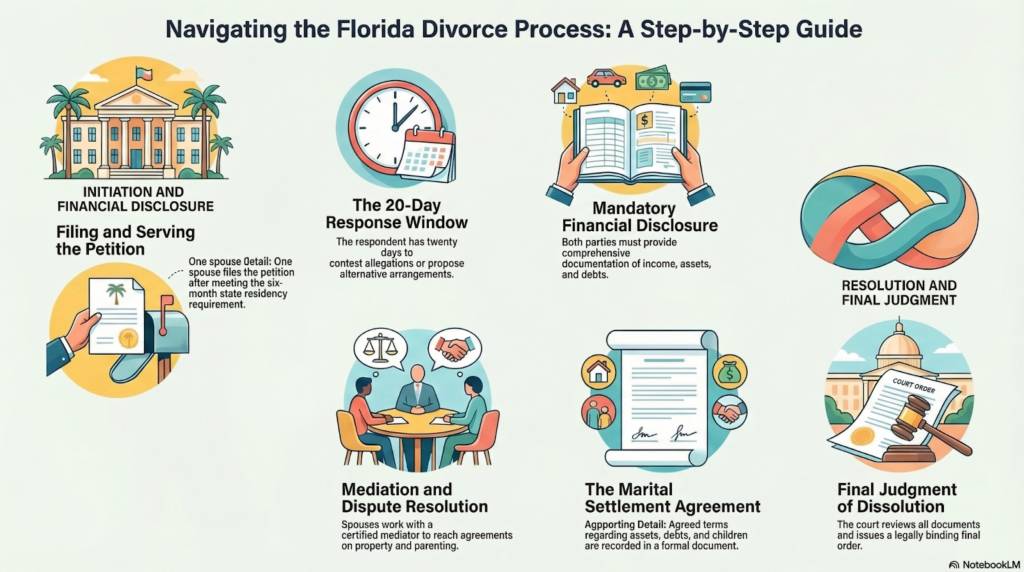
The Florida divorce process begins when one spouse files a Petition for Dissolution of Marriage with the appropriate Florida family court.
At least one spouse must live in Florida for a minimum of six months before filing for a dissolution of marriage under Florida Statute section 61.021.
A standard Florida divorce petition typically includes:
The spouse who files the petition is the petitioner, and the other spouse is the respondent under Florida procedure.
After filing, the petitioner must arrange for the petition and related documents to be formally served on the respondent under the Florida Rules of Civil Procedure.
After service of the divorce petition, the responding spouse has 20 days under Florida law to file an official response with the court.
In the response, the respondent may:
The response stage defines the key issues the Florida court and the spouses must resolve, including property division, parenting plans, time-sharing, child support, and spousal support.
If you’re ready to get started, call us now!
Florida law requires both spouses to complete mandatory financial disclosure, often referred to as mandatory disclosure under Florida Family Law Rule 12.285.
Mandatory financial disclosure in a Florida divorce promotes transparency, enabling both spouses to make informed decisions about equitable distribution and support.
Typical Florida financial disclosures include:
The financial disclosure stage creates a clear financial picture before negotiation, mediation, or trial in a Florida divorce case.
Many Florida courts encourage or require divorce mediation before a contested divorce proceeds to trial.
Divorce mediation in Florida is a structured negotiation process in which a neutral Florida Supreme Court–certified mediator helps spouses resolve divorce disputes and reach mutually acceptable agreements.
During Florida divorce mediation, spouses can address:
Because mediation emphasizes cooperation, communication, and problem-solving, Florida divorce mediation often helps couples reach agreements more efficiently and privately than courtroom litigation.
Once the spouses reach an agreement, the terms are recorded in a Marital Settlement Agreement and, when children are involved, an agreed parenting plan.
The Florida family court reviews the settlement documents and then issues a Final Judgment of Dissolution of Marriage, which legally ends the marriage under Florida law.
The Final Judgment of Dissolution of Marriage typically addresses:
After the judge signs the Final Judgment of Dissolution of Marriage, the Florida divorce becomes legally binding and enforceable.
Communication style between spouses strongly influences whether a Florida divorce becomes high-conflict or remains cooperative.
Spouses who communicate respectfully and clearly are more likely to reach agreements quickly, lower emotional stress, and support a peaceful divorce process.
The following strategies support a peaceful divorce in Florida and increase the effectiveness of Florida divorce mediation sessions.
A businesslike communication style during divorce helps spouses stay focused on practical solutions rather than emotional conflict.
Spouses who treat divorce conversations like professional discussions can separate past emotional issues from current problem-solving about parenting, housing, and finances.
Helpful Mindset Shift:
Think of divorce conversations as two partners dissolving a business relationship while preserving long-term family stability, especially when children are involved.
This mindset encourages:
Revisiting old arguments rarely helps resolve current divorce issues in Florida.
Productive divorce conversations focus on:
Future-focused dialogue reduces tension and helps both spouses move toward resolution and post-divorce stability.
Written communication can make Florida divorce discussions more organized and less emotionally charged.
Benefits of written communication in a Florida divorce include:
Common written communication tools for divorcing parents include:
Spouses should assume that written communication may be reviewed by Florida mediators, attorneys, or the court if disputes arise.
Many divorce conflicts arise when one spouse feels ignored or misunderstood.
Active listening techniques can transform divorce negotiations by showing respect and validating concerns.
Active listening tips for Florida divorce discussions include:
Example of active listening in a divorce conversation:
“What I am hearing is that you feel concerned about the weekday parenting schedule. Let us explore options that give both of us meaningful time with the children.”
Active listening helps both spouses feel respected and opens the door to creative solutions in mediation.
The language spouses choose during divorce directly affects whether discussions remain productive or become confrontational.
Avoid:
Use instead:
Example of a communication shift:
If you’re ready to get started, call us now!
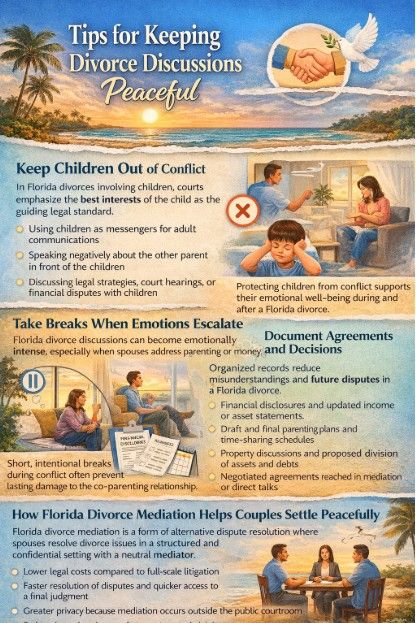
In Florida divorces involving children, courts emphasize the best interests of the child as the guiding legal standard.
Children should remain outside of adult disputes so they can maintain healthy relationships with both parents.
Parents should avoid:
Protecting children from conflict supports their emotional well-being during and after a Florida divorce.
Florida divorce discussions can become emotionally intense, especially when spouses address parenting or money.
When conversations escalate, spouses can:
Short, intentional breaks during conflict often prevent lasting damage to the co-parenting relationship.
Organized records reduce misunderstandings and future disputes in a Florida divorce.
Spouses should document key items such as:
Clear documentation supports transparency and makes the Florida divorce process smoother for the court, the mediator, and both spouses.
Florida divorce mediation is a form of alternative dispute resolution that allows spouses to resolve divorce issues in a structured, confidential setting with a neutral mediator.
A Florida divorce mediator facilitates discussions, keeps negotiations focused, and helps spouses generate options without taking sides or making decisions for them.
Key benefits of divorce mediation in Florida include:
For many Florida couples, mediation transforms divorce from a courtroom battle into a cooperative problem-solving process.
Many Florida couples assume divorce must involve multiple court hearings, long timelines, and high legal fees.
Divorce mediation in Florida offers a cooperative and efficient alternative that allows spouses to design their own solutions with professional guidance.
Instead of asking a judge to decide every issue, spouses in mediation work with a neutral mediator to reach mutually beneficial agreements on parenting, property, and support.
Florida courts frequently encourage or require mediation because mediation can:
For couples seeking a peaceful divorce in Florida, mediation often provides one of the most effective and family-centered paths forward.
Divorce mediation in Florida is a strong fit for spouses who want more control, privacy, and cooperation in their divorce process.
Mediation works well for couples who:
Even spouses who disagree on specific issues often resolve disputes successfully with the help of an experienced Florida divorce mediator.
Understanding the difference between mediation and litigation helps Florida couples choose the right divorce path.
| Divorce Mediation in Florida | Divorce Litigation in Florida |
| Collaborative problem-solving between spouses | Adversarial court process driven by legal strategy |
| Lower legal costs and fewer court appearances | Higher legal fees and multiple court hearings |
| Faster resolution and more predictable timeline | Longer timelines due to crowded court dockets |
| Private discussions in a confidential setting | Public court proceedings and records |
| Couples control decisions and outcomes | The judge makes final decisions under Florida law |
For many Florida families, mediation provides a less stressful and more constructive way to move forward after divorce while preserving working relationships.
The duration of a Florida divorce depends on the case’s complexity and whether the spouses reach an agreement on major issues.
An uncontested Florida divorce may take approximately 4–8 weeks, while a contested divorce can last several months or longer, especially when parenting or business assets are in dispute. Couples who use divorce mediation in Florida often resolve their cases faster than those who rely solely on traditional litigation.
Many Florida circuit courts require mediation before a divorce case can proceed to a full trial on contested issues.
Court-ordered mediation gives couples a structured opportunity to resolve disagreements before asking a judge to decide parenting, property, or support.
Mediation frequently leads to comprehensive settlements, allowing couples to avoid the time, cost, and uncertainty of a trial.
Florida uses the principle of equitable distribution, which means marital property is divided fairly, though not necessarily in a 50/50 split.
Florida courts consider factors such as:
Spouses who use mediation can often design customized asset division plans that better match their specific needs than a strictly litigated outcome.
Florida law prioritizes the best interests of the child when deciding parenting plans and time-sharing in a divorce.
Parents must create a parenting plan that specifies:
Mediation helps parents craft detailed parenting plans that support healthy co-parenting relationships and consistent routines for children.
In most cases, divorce mediation costs significantly less than full-scale divorce litigation in Florida.
Because mediation focuses on cooperative problem-solving rather than courtroom battles, couples typically resolve disputes more quickly and reduce billable attorney hours and court fees.
A Florida divorce does not have to become a long, hostile legal battle in the courthouse.
With the right guidance, many Florida couples resolve divorce issues respectfully and move forward with financial clarity and parenting stability.
Torres Mediation is a Florida mediation practice that helps couples navigate divorce with a calm, solution-focused approach.
At Torres Mediation, Florida couples receive support to:
If you are considering divorce and want a calm, solution-focused approach, mediation may be the right next step to protect your family and your future.
Contact Torres Mediation today to schedule a consultation and learn how Florida divorce mediation can help you move forward with confidence and dignity.
Kim W. Torres, Esq. is a Florida Supreme Court Certified Mediator in Circuit Civil, Family, County Court, and Appellate matters and a member of The Florida Bar since 1985. Practicing exclusively as a mediator since 2000, she has resolved more than 2,000 cases — from complex multi-party disputes to high-emotion matters with self-represented parties. A past Chair of the Florida Bar’s ADR Section and Brevard County’s Circuit Civil Mediator of the Year, Kim mediates throughout Florida, in person and virtually.