

Originally published: April 2026

Data last verified: March 2026
A Florida parenting plan is a legally required written document that governs every aspect of a child’s post-divorce care, including time-sharing schedules, parental decision-making authority, and co-parent communication protocols.
Florida circuit courts approve no dissolution of marriage involving minor children without a court-approved parenting plan on file.
Florida parents who negotiate parenting terms through family mediation produce more durable agreements and experience lower post-judgment modification rates than parents whose plans are imposed by a circuit court judge.
Schedule a parenting plan consultation with Torres Mediation. Kim Torres, Florida Supreme Court Certified Mediator, helps Florida parents build enforceable time-sharing agreements that protect children and satisfy circuit court approval requirements.
A Florida parenting plan is a court-approved legal instrument that establishes how two divorced or separated parents divide daily caregiving responsibilities, physical time with the child, and decision-making authority over education, healthcare, and religious upbringing.
Florida Statutes Section 61.29 makes a parenting plan mandatory in every Florida dissolution of marriage case involving minor children, regardless of whether both parents agree or the case proceeds to an evidentiary trial.
Florida eliminated the legal terms “custody” and “visitation” through the 2008 amendments to Florida family law and replaced them with two distinct designations: parental responsibility and time-sharing. Parental responsibility is the legal authority to make major decisions affecting a child’s education, medical treatment, and religious upbringing.
Time-sharing is the court-approved physical schedule specifying when the child resides with each parent.
Florida circuit courts default to shared parental responsibility, granting both parents equal decision-making authority unless one parent presents evidence that shared responsibility would harm the child’s welfare.
A Florida parenting plan becomes a binding court order when a Florida circuit court judge signs it and incorporates it into the final judgment of dissolution of marriage.
Neither parent can unilaterally modify a court-approved Florida parenting plan without filing a supplemental petition and proving a substantial, material, and unanticipated change in circumstances under Florida Statutes Section 61.13(3).
If you’re ready to get started, call us now!
Florida time-sharing is the court-approved residential schedule that determines when a minor child lives with each parent following the dissolution of a marriage.
Florida law establishes no presumption of equal 50/50 time-sharing. Florida circuit court judges determine each child’s time-sharing arrangement by weighing 20 statutory best-interests factors enumerated in Florida Statutes Section 61.13(3).
Florida time-sharing structures range from equal 50/50 residential arrangements to a primary residence with one parent and scheduled contact with the other parent.
The appropriate structure depends on the child’s age, the child’s school enrollment location, established daily routines, each parent’s work schedule, and the geographic distance between the parents’ residences.
| Time-Sharing Structure | Schedule | Best For |
| Equal 50/50 | Week on/week off or 2-2-3 rotation | Parents near the same school zone |
| Primary/Secondary (70/30) | Child resides primarily with one parent | Significant geographic distance between parents |
| Extended Primary (80/20) | Structured contact with the secondary parent | Young children or high-conflict situations |
| Nesting Arrangement | Child stays in marital home; parents rotate | Short-term post-separation transition |
| Long-Distance Schedule | School year with primary parent, extended summers with other | Parents in different cities or states |
Florida parents who negotiate customized time-sharing arrangements through mediation avoid generic court-ordered schedules that do not account for their child’s specific routines, school location, or extracurricular commitments.
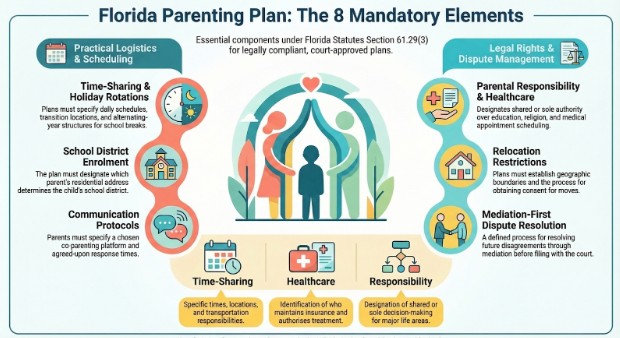
Florida Statutes Section 61.29(3) requires every court-approved Florida parenting plan to address eight core elements: a detailed time-sharing schedule, a parental responsibility designation, a healthcare decision-making protocol, a school enrollment designation, a co-parent communication method, a holiday and school break rotation, a relocation restriction clause, and a future dispute resolution process.
| Required Element | What Florida Circuit Courts Look For |
| Time-sharing schedule | Specific days, times, transition locations, and transportation responsibilities |
| Parental responsibility | Shared or sole designation for education, healthcare, and religious decisions |
| Healthcare protocol | Which parent schedules appointments, maintains insurance, and authorizes treatment |
| School designation | Which parent’s residential address determines the child’s school enrollment district |
| Communication method | Specified co-parenting platform and expected response time between parents |
| Holiday rotation | Named holidays, alternating-year structure, and pickup/dropoff logistics |
| Relocation restriction | Geographic boundary and written consent or court approval process for moves |
| Dispute resolution | Mediation-first process for resolving future disagreements before court filing |
Florida parenting plans that omit any element required under Florida Statutes Section 61.29(3) will be judicially rejected and require revision before a Florida circuit court will finalize the dissolution.
Florida parents can identify the provisions most frequently rejected during circuit court review before drafting their agreement.
Florida family mediation provides both parents a structured, neutral negotiation environment in which a Florida Supreme Court Certified Mediator facilitates agreement on every parenting plan element without adversarial courtroom pressure.
Mediated parenting plans generate higher voluntary compliance rates and lower post-judgment modification petition rates than court-ordered plans because both parents actively shaped every term.
Florida courts mandate mediation before most contested family law proceedings under Florida Family Law Rules of Procedure Rule 12.740.
Mediation resolves parenting disputes more effectively than litigation because a trained neutral separates each contested issue, allowing parents to build agreement on straightforward terms first and carry that momentum into more difficult negotiations.
Florida Supreme Court Certified Mediator Kim Torres of Torres Mediation structures every parenting plan session around each child’s documented circumstances rather than generic scheduling templates.
Florida parents who clarify their custody preparation priorities before the first session negotiate more efficiently and reach signed agreements in fewer total billable hours.
Florida parents who want to understand what happens when sessions do not produce a full agreement can review the mediation impasse process before deciding whether to proceed.
If you’re ready to get started, call us now!
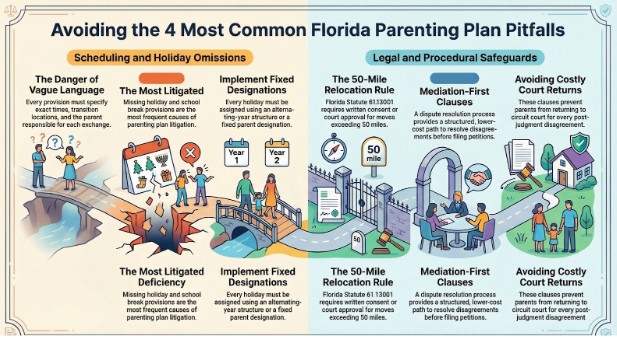
The four most common Florida parenting plan mistakes are vague scheduling language, missing holiday and school break provisions, a lack of a relocation-restriction clause, and a lack of a designated dispute-resolution process.
Each omission generates post-judgment modification petitions that impose additional attorney fees and court filing costs on both parents, as well as months of litigation.
Vague time-sharing language generates disputes over school pickups, transition times, and holiday interpretations. Every time-sharing provision must specify the exact day, time, transition location, and responsible parent for every scheduled exchange.
Missing holiday provisions represent the most frequently litigated parenting plan deficiency in Florida circuit courts. Every named holiday, school break, and special occasion must appear in the plan with an alternating-year structure or a fixed parent designation.
No relocation restriction clause exposes the non-moving parent to unilateral moves that disrupt the approved time-sharing schedule. Florida’s parental relocation statute, Florida Statutes Section 61.13001, governs all moves of 50 miles or more and requires either written parental consent or circuit court approval before the relocating parent may move with the child.
No dispute resolution process forces both parents back to circuit court for every post-judgment disagreement. A mediation-first clause embedded in the parenting plan gives both parents a structured, lower-cost path to resolving future disputes before filing modification petitions.
Florida parents managing post-divorce co-parenting conflict consistently identify vague plan language as the primary driver of post-judgment litigation.
Successful Florida co-parenting after dissolution of marriage requires three consistent practices: adhering to the written parenting plan, using a documented communication platform, and separating adult conflict from the child’s relationship with both parents.
Florida parents who follow their mediated parenting plan without seeking informal modifications produce measurably more stable post-divorce family environments and lower post-judgment modification rates.
Follow the parenting plan as written. Undocumented informal schedule changes create legal ambiguity and erode the enforceability of the court-approved plan. Both parents must document all agreed temporary modifications in writing to preserve the plan’s legal integrity.
Use a dedicated co-parenting communication platform. OurFamilyWizard and TalkingParents generate timestamped, archived communication records that protect both parents if disputes escalate to circuit court. Florida family court judges weigh documented co-parent communication records when evaluating modification petitions and contempt motions.
Protect the child’s relationship with both parents. Florida circuit courts weigh each parent’s demonstrated willingness to support the child’s relationship with the other parent as one of the 20 best-interests factors under Florida Statutes Section 61.13. A parent who actively undermines that relationship risks judicial modification of the existing time-sharing arrangement.
Return to mediation before filing a modification petition. Florida circuit courts expect parents to attempt informal resolution before accepting a modification petition for hearing.
A focused post-judgment parenting session with Kim Torres resolves most co-parenting disputes in a single session at a fraction of contested modification litigation costs.
Schedule a confidential parenting consultation to define your time-sharing and custody goals before your first Florida circuit court date.
What is the difference between custody and time-sharing in Florida?
Florida eliminated the legal term “custody” through 2008 amendments to Florida family law and replaced it with two distinct designations: parental responsibility and time-sharing. Parental responsibility governs decision-making authority over education, healthcare, and religious upbringing. Time-sharing governs the physical residential schedule specifying when the child lives with each parent.
Does Florida favor 50/50 time-sharing?
Florida law establishes no presumption of equal 50/50 time-sharing. Florida circuit court judges determine each child’s time-sharing structure by applying 20 best-interests factors under Florida Statutes Section 61.13, including each parent’s work schedule, the child’s school enrollment location, established caregiving routines, and each parent’s documented history of active involvement in the child’s daily life.
Can a parent refuse to follow a Florida parenting plan?
No. A court-approved Florida parenting plan is a binding legal order enforceable through contempt-of-court proceedings. A parent who refuses to comply faces fines, court-ordered makeup time-sharing for the aggrieved parent, and in severe or repeated cases, judicial modification of the existing time-sharing arrangement in favor of the complying parent.
How do I modify a parenting plan in Florida?
A Florida parenting plan modification requires the petitioning parent to file a supplemental petition demonstrating a substantial, material, and unanticipated change in circumstances since the plan was originally approved. The petitioning parent must also demonstrate that the proposed modification serves the child’s best interests. Florida circuit court judges require evidence of a prior mediation attempt before scheduling most modification hearings.
What happens if parents cannot agree on a parenting plan in Florida?
When Florida parents fail to produce a mediated parenting plan, a Florida circuit court judge schedules an evidentiary hearing and imposes a parenting plan based on the 20 best-interest factors set forth in Florida Statutes Section 61.13. A court-imposed parenting plan removes both parents’ ability to customize time-sharing schedules, communication protocols, and decision-making structures to fit their family’s specific needs.
At what age can a child choose which parent to live with in Florida?
Florida law establishes no minimum age at which a child may independently select a residential parent. Florida circuit courts may consider a child’s stated preference as one of the 20 best-interests factors under Florida Statutes Section 61.13, assigning greater evidentiary weight to the preferences of older, more mature children.
Does a Florida parenting plan cover child support?
No. A Florida parenting plan governs only time-sharing schedules and parental responsibility designations. Child support is calculated as a separate legal instrument under Florida Statutes Section 61.30, using both parents’ verified gross monthly income figures and the court-approved time-sharing percentages from the parenting plan. Florida courts finalize both documents simultaneously during dissolution proceedings but treat each as a legally independent instrument.
How long does it take to create a parenting plan through mediation in Florida?
Most Florida parents complete a full parenting plan through mediation in one to two sessions totaling four to eight hours of structured negotiation. Cases involving parental relocation disputes, children with special needs, or documented high-conflict co-parenting dynamics typically require two to three sessions. Mediation produces a signed Florida parenting plan significantly faster than a contested circuit court hearing, which Florida circuit courts schedule weeks to months out, depending on current docket availability.
Kim W. Torres, Esq. is a Florida Supreme Court Certified Mediator in Circuit Civil, Family, County Court, and Appellate matters and a member of The Florida Bar since 1985. Practicing exclusively as a mediator since 2000, she has resolved more than 2,000 cases — from complex multi-party disputes to high-emotion matters with self-represented parties. A past Chair of the Florida Bar’s ADR Section and Brevard County’s Circuit Civil Mediator of the Year, Kim mediates throughout Florida, in person and virtually.