1600 Sarno Road, Ste. 9 Melbourne, FL 32935
info@torresmediation.com

Call Now For Service!
Originally published: September 2025 | Reviewed by Kim Torres

HOA disputes can quickly turn peaceful neighborhoods into battlegrounds. Residents simply want to enjoy their homes, but conflicts over parking, landscaping, noise, and architectural rules are increasingly emerging in Austin’s fast-growing communities.
Mediation offers HOA disputes a faster, less expensive, and, honestly, a more effective path to resolution than those never-ending legal battles.
Austin’s collaborative culture makes mediation particularly effective for resolving community disputes, since most folks here would rather work together than fight it out in court.
When HOA conflicts arise, residents must choose between escalating the issue through litigation or seeking peaceful solutions that preserve neighborly relationships. The right approach can save a significant amount of money and headaches, and it often leads to agreements that actually hold up.

Austin’s rapid growth has brought some unique headaches for homeowner associations. Disputes often center on rising fees, unclear maintenance standards, and the challenges of modern living—such as short-term rentals and shifting community norms.
With real estate booming, HOAs in Austin are under pressure to raise assessments and fees. Many residents get blindsided by special assessments for things like infrastructure fixes or emergency repairs.
Common fee disputes include:
Newcomers often discover hidden costs only after they have moved in. Sometimes, it’s not clear what’s a regular due and what’s a special assessment.
Some HOAs struggle with HOA dispute resolution when homeowners refuse to pay disputed fees. That can quickly spiral into liens or legal action.
Transparency with fees is crucial when disputes arise. Homeowners have the right to see HOA financial records and budgets, and honestly, they should exercise that right.
Austin’s neighborhoods are pretty diverse, so people often clash over property maintenance standards. HOAs establish rules for landscaping, exterior painting, and structural modifications.
Frequent maintenance disputes involve:
Water conservation efforts and HOA landscaping rules sometimes don’t mix. Homeowners might get violations for brown lawns even when the city restricts watering.
Architectural review committees can be tough on requests for solar panels or modern upgrades, which frustrates folks trying to go green.
Some HOAs send violation notices without solid proof. If that happens, homeowners should ask for photos and specific rule citations.
Austin’s tech boom and tourism scene have made parking, noise, and Airbnb-style rentals hot issues. These problems really affect daily life in the suburbs.
Major residential conflicts include:
Many HOAs now ban or restrict short-term rentals. Homeowners who bought properties for rental income often push back hard against these bans.
Noise complaints spike during major Austin events, such as SXSW and ACL. Out-of-town visitors staying in neighborhood rentals usually don’t know the local rules.
Parking gets tight when residents own multiple vehicles. Some HOAs limit the number of cars per household or crack down on street parking.
Enforcement can differ a lot. Some HOAs hire security personnel, while others rely solely on neighbor complaints or board members making rounds.
Torres Mediation offers HOA conflict resolution in Austin designed to restore neighbor relationships and avoid costly lawsuits. Build harmony in your community—contact us today to schedule.
If you’re ready to get started, call us now!

Austin’s community-focused mindset creates the perfect conditions for resolving HOA disputes through mediation.
The city’s emphasis on neighborly cooperation and shared values makes it easier for people to find common ground—even when they don’t agree on everything.
Austin folks really value cooperation over conflict. This attitude makes people more willing to listen to each other during HOA disputes.
The city’s “Keep Austin Weird” mentality promotes the acceptance of diverse perspectives. Homeowners often come to mediation with more open minds, especially when it involves property maintenance or architectural disagreements.
Civic engagement runs deep here. Many residents participate in community events and volunteer work, not just fulfilling the minimum requirements for their HOA.
These connections make a difference. When disputes happen, people see each other as community members—not just opponents.
Austin’s collaborative approach extends beyond neighborhoods as well. Folks expect the same spirit from their HOAs, so mediation and alternative dispute resolution feel more natural than dragging things through court.
Austin homeowners know that HOA disputes can hurt long-term relationships. Mediation allows both sides to discuss their concerns while maintaining respect as a top priority.
In close-knit communities, you’ll run into the same neighbors at coffee shops, schools, and events. Legal fights just create tension that lingers.
Mediation sessions aim for solutions that work for everyone. Neighbors can openly air their concerns and work together to reach agreements that last.
Key relationship benefits of mediation include:
Austin’s focus on community building motivates residents to resolve conflicts peacefully. They get that strong neighborhood bonds help everyone’s property values and quality of life.
HOA mediation employs a structured yet flexible approach that prioritizes communication and mutual agreement.
Litigation, on the other hand, drags people through formal court procedures, long timelines, and decisions that often leave everyone frustrated.
The process starts when both the homeowner and HOA agree to try mediation. A neutral mediator typically sets up the first session within 2-3 weeks.
Pre-Mediation Preparation
Opening Session: The mediator lays out the ground rules and confidentiality agreements. Each party gets 10-15 minutes to share their side without interruptions.
Private Caucuses: The mediator meets one-on-one with each side to delve into what truly matters to them. These chats help uncover solutions that address the root issues.
Joint Problem-Solving: Everyone comes back together to brainstorm options. The mediator helps sort through ideas and see what’s actually practical.
Agreement Drafting: If they resolve, the mediator helps put it in writing. Once both sides sign, it’s binding.
Time and Cost Comparison
| Aspect | Mediation | Litigation |
| Duration | 1-3 sessions over 4-6 weeks | 6-18 months |
| Attorney fees | $2,000-$5,000 | $15,000-$50,000+ |
| Court costs | None | $1,500-$3,000 |
Control and Outcomes In mediation, both parties keep control over the outcome. Nothing gets decided unless both sides agree to it.
Litigation takes that control away. A judge makes the final decision, often based on legal precedent rather than what works best for the community.
Privacy Considerations: Mediation services stay completely confidential. Court cases become public record and can permanently damage neighborhood relationships.
Relationship Preservation Mediation focuses on rebuilding communication between neighbors who still have to live side by side. Litigation often creates adversaries and can exacerbate issues over time.
The collaborative nature of mediation helps maintain property values by avoiding public disputes that might deter potential buyers.
When HOA disputes escalate, Torres Mediation provides structured HOA mediation services across Central Texas. Protect your home and community relationships—reach out now to schedule.
If you’re ready to get started, call us now!
Texas Property Code Section 209 lays out specific rules for HOA dispute resolution. The law requires homeowners and HOAs to attempt mediation before proceeding to court in most cases.
Section 209.0056 of the Texas Property Code requires alternative dispute resolution for HOA conflicts. This law covers most residential subdivisions with deed restrictions.
The law governs disputes related to the enforcement of deed restrictions and decisions made by architectural control committees. It also applies to property maintenance violations.
Homeowners get 30 days to respond to violation notices. They can request mediation during that time, and the HOA has to participate in good faith.
Texas courts want proof that you tried mediation. Judges sometimes dismiss cases if you skip this step.
Kim Torres focuses on disputes that arise in families, small businesses, elder care conflicts, divorce, HOA disputes, and problems involving debt or contract issues.
Benefits of following the legal process:
The mediation needs to happen within 30 days of the request. Both parties pick a mediator together.
If they can’t agree, the court steps in and appoints one.
When mediation is successful, both parties sign a written agreement. That document becomes legally binding.
If someone breaks the terms, the courts can enforce the agreement.
If mediation fails, it still meets the legal requirement for attempting alternative dispute resolution. Homeowners can proceed with their case in court.
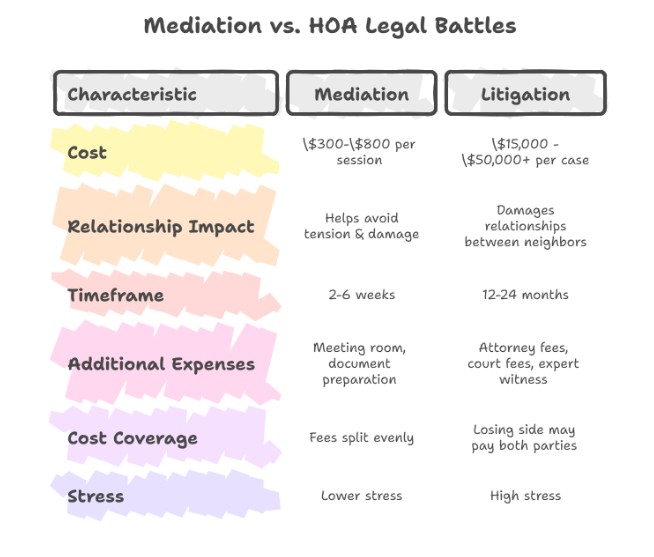
HOA mediation typically costs $300-$ 800 per session. Litigation, on the other hand, can cost $15,000 to $ 50,000 or more.
Legal disputes also stir up tension and damage relationships within the community—something mediation helps to avoid.
HOA dispute mediation costs typically range from $300 to $800 per session. Most disputes wrap up within one to three sessions.
Total costs typically land between $600 and $2,400. Both sides usually split the fees evenly.
Mediation includes:
Plenty of mediators offer payment plans. Some HOAs even budget for mediation, as disputes arise regularly.
The entire process typically takes 2 to 6 weeks. That’s a huge time-saver compared to dragging things through the court.
HOA litigation costs start at $15,000 and can easily top $50,000 per case. Legal fees add up fast with all the court hearings and paperwork.
Common litigation expenses include:
Court cases often drag on for 12 to 24 months. The losing side may even have to pay the legal fees of both parties.
Litigation can really damage relationships between neighbors. Property values sometimes drop when legal fights linger in a community.
Even if you win, you rarely get back all your legal costs. The stress can stick around for years, affecting everyone nearby.
Austin-area HOA communities have successfully resolved complex disputes through mediation. They’ve saved thousands in legal fees and managed to keep neighborhood relationships intact.
Both financial disagreements and property rights conflicts have been resolved through collaborative approaches.
A Cedar Park community hit a rough patch with a heated dispute over special assessments for pool renovations. The total came to $85,000.
Half of the residents refused to pay, claiming they had not been adequately notified about the vote.
Mediation brought the two sides together for structured talks. Residents learned about the right way to notify everyone, and the board explained why the pool repairs were urgent.
Key outcomes included:
Instead of a lawsuit that could have dragged on for two years, the community reached an agreement in just three mediation sessions over six weeks.
Another example: a Pflugerville HOA resolved budget disputes after residents questioned $40,000 in landscaping expenses.
Torres Mediation’s approach to HOA disputes helped both sides understand their financial responsibilities and the need for transparency.
An Austin suburb successfully mediated a parking violation dispute between neighbors and their HOA board. Several families faced daily fines for street parking, which stirred up tension in the neighborhood.
The mediation process uncovered that enforcement varied from street to street. Some blocks had ample driveway space, but others didn’t.
Solutions implemented:
A Round Rock community finally settled a months-long fence height disagreement that had neighbors at odds. The rules were unclear about corner lot requirements, so seven homeowners received violation notices.
Residents worked together through mediation and developed clear guidelines for each lot type. The new rules strike a balance between safety concerns and the need for privacy—perhaps not perfect, but significantly better than before.
HOA mediation gives Austin families and associations a practical alternative to costly lawsuits.
By addressing disputes through open dialogue, communities preserve trust, save money, and maintain harmony.
Torres Mediation is committed to helping Central Texas neighborhoods resolve conflicts with fairness and compassion—contact us today to schedule your HOA mediation session.
Keep your Austin neighborhood peaceful with Torres Mediation’s HOA dispute resolution services. Resolve conflicts fairly and affordably—contact us today to schedule your mediation session.
What is HOA mediation, and how does it work in Austin?
HOA mediation is a voluntary process where a neutral mediator helps Austin homeowners and associations resolve disputes. Instead of going to court, both sides meet in a confidential setting to discuss issues, explore options, and reach agreements that balance community rules with homeowner rights.
What types of disputes can be resolved through HOA mediation?
HOA mediation in Austin typically addresses issues such as fee collection, property maintenance, parking, noise complaints, and conflicts related to short-term rentals. Mediation can also help resolve disagreements over architectural approval, board governance issues, and rule enforcement.
How much does HOA mediation cost in Austin?
The cost of HOA mediation in Austin typically ranges from $300 to $400 per hour, with fees usually split between the association and homeowners. Compared to litigation, where costs can exceed tens of thousands, mediation is far more affordable, helping communities resolve disputes efficiently while preserving their financial resources.
Is HOA mediation legally binding in Texas?
Yes. If both parties reach an agreement during mediation, the outcome is put into writing and signed. In Texas, these agreements are legally enforceable contracts. Courts generally honor HOA mediation agreements, making them a reliable alternative to prolonged litigation.
Who pays for HOA mediation—homeowners or the association?
In most cases, both parties share mediation costs equally. However, an HOA board may choose to cover the full fee as part of its community budget, or homeowners may volunteer to pay more if it ensures a faster resolution. Payment responsibilities can also be negotiated during mediation.
How long does an HOA mediation session usually last?
A typical HOA mediation session in Austin lasts two to four hours, depending on the complexity of the dispute. Straightforward issues, such as parking conflicts, can often be resolved quickly, while financial or governance disputes typically require more time—or multiple sessions—to reach a workable agreement.
Can mediation prevent an HOA from filing a lawsuit?
Yes. Mediation often resolves disputes before they escalate into litigation. In fact, many Austin HOAs and courts encourage mediation as a first step. By addressing issues early, mediation saves communities significant legal costs and prevents neighborly relationships from deteriorating in court.
Do homeowners need an attorney during HOA mediation?
Attorneys are not required for HOA mediation in Austin, but homeowners and associations may choose to involve one for legal guidance. Most mediations are successful without formal legal representation, as the mediator ensures that both parties understand the process and work toward a fair agreement.
What happens if mediation fails?
If HOA mediation does not result in an agreement, the parties may still pursue litigation or arbitration. However, mediation typically narrows the issues and improves communication, making subsequent steps easier to manage.
Why choose Torres Mediation for HOA disputes in Central Texas?
Torres Mediation offers confidential and cost-effective solutions for HOA conflicts in Austin, Cedar Park, Round Rock, and Georgetown. With decades of mediation experience, the practice helps communities resolve disputes without litigation, preserve relationships, and restore neighborhood harmony.