1600 Sarno Road, Ste. 9 Melbourne, FL 32935
info@torresmediation.com

Call Now For Service!
Originally published: December 2025 | Reviewed by Kim Torres

Navigating a custody dispute is challenging. You want what’s best for your child, but the legal process can feel overwhelming.
Child custody mediation in Florida gives you a chance to work with the other parent to create a plan that fits your family’s needs without going to court.
Preparing for mediation means gathering the right documents, drafting a parenting plan beforehand, and focusing your communication on your child’s best interests rather than past conflicts.
The courts often require mediation in Florida before your case can go to trial. The goal is to reach an agreement that works for everyone while avoiding the stress and cost of a courtroom battle.
This guide will walk you through what to do before, during, and after your mediation session. You’ll see what to bring, how to put together a solid parenting plan, and how to talk things out in the room.

The final moments before your child custody mediation session can set the tone for everything that follows. Having the right items and avoiding common missteps helps you stay focused on reaching agreements that work for your children.
Bring your calendar—on your phone or printed. Most sessions get stuck when parents can’t agree on specific dates for holidays, vacations, or regular exchanges.
Have your work schedule on hand as well. You don’t want to be caught off guard when someone asks about your availability.
Bring a list of your child’s current activities and commitments. This includes school schedules, sports, medical appointments, and therapy sessions.
When you have these details in front of you, it’s just easier to build a realistic parenting plan that fits your kid’s actual life.
Have key financial info ready. Know the basic costs, such as childcare, health insurance, and activity fees. You don’t need every receipt, but knowing the general amounts helps you talk about support and expenses without guessing.
Finally, bring a notebook or some paper. Taking notes demonstrates your investment and helps you remember what you agree to during the session.
Don’t bring family or friends into the waiting area. If you need support, have them wait in the parking lot or lobby. You don’t want the other parent to feel outnumbered before you even start.
Try not to arrive angry or immediately dig into old fights. The mediator isn’t there to judge which spouse was better. Your job is to focus on creating a workable parenting schedule, not to win arguments about the past.
Don’t check your phone constantly during breaks or scroll through social media. That just signals you aren’t taking this seriously. Turn off notifications and give the process your full attention.

Mediation puts you and the other parent in a room with a neutral third party to work out custody decisions together. The mediator guides the conversation but doesn’t make decisions for you or provide legal advice.
Your mediator acts as a neutral facilitator to help you and the other parent communicate and find common ground. They manage the discussion, ask questions, and sometimes suggest options you might not have thought about.
The mediator doesn’t take sides or tell you what’s best for your child.
What the mediator does:
What the mediator doesn’t do:
Bring your own lawyer to review any agreement before you sign it. The mediator’s job is to keep the conversation moving, not to protect your legal interests. If you need advice about Florida custody laws or your rights, talk to your attorney.
Florida child custody mediation is confidential, so most of what you say during sessions stays private. You can speak openly without worrying that your words will be used against you in court later.
The mediator can’t be called as a witness to testify about what happened in your sessions. What you discuss in mediation doesn’t become part of the public record, allowing you to negotiate candidly.
What stays confidential:
What becomes part of your case:
If you reach an agreement, the court reviews and approves it. Once approved, it becomes a legally binding court order.
When custody talks turn into fights, Torres Mediation helps you prepare a clear parenting plan and negotiation checklist to protect your child’s routine. Schedule an appointment.
If you’re ready to get started, call us now!
Breaking preparation into clear time blocks helps you stay organized. Each phase builds on the last, moving from gathering facts to practicing what you’ll actually say in the room.
Start by collecting all documents that show your involvement in your child’s life. You need school records, medical appointments, extracurricular schedules, and work calendars.
Print text messages or emails that document your communication with your co-parent regarding the child. Create a draft of a basic parenting plan that reflects your ideal schedule.
Write down which days you want physical custody, how you’ll handle holidays, and where your child will spend spring break and summer. Be specific about pickup and drop-off times and locations.
Essential documents to gather:
Review your child’s current routine. What time do they wake up? Who makes breakfast? Who helps with homework?
Write this down. Mediators want to know what’s working today, not just what you wish would happen.
Look at your draft plan and create two backup versions. Your first plan might not work for your co-parent, so having alternatives shows flexibility.
Think about what matters most to you and where you can compromise. Review common custody schedules, such as the 2-2-5-5 arrangement, to understand realistic options.
Some parents alternate weeks, while others split the week. Each schedule has pros and cons depending on your work schedule, school location, and your child’s age.
Make a trade-off list. If you want every Sunday, you could offer flexibility on Wednesday evenings. If summer vacation matters more than spring break, write that down.
Going into the mediation process with clear priorities helps you make faster decisions. Calculate actual costs for everything child-related—daycare, insurance, sports fees, and school supplies.
Bring receipts and bank statements showing your current payments. The more details, the better.
Print three copies of every document you gathered. One for you, one for your co-parent, one for the mediator.
Organize them in folders with labeled tabs to find information quickly during the session. Write out responses to topics that might upset you.
If your co-parent brings up past mistakes, practice saying, “I’m here to focus on what’s best for our child moving forward.” Keep these phrases simple and repeat them until they feel natural.
Your calm script should include:
Pack a folder with pens, a notepad, water, and snacks. Mediation sessions often run 2-4 hours. You need to stay focused and comfortable throughout.
Set up childcare for the day of mediation. You can’t bring your child to the session, and you don’t want to rush because of pickup times.
Arrive 15 minutes early. This gives you time to find parking, use the restroom, and settle your nerves before walking in.
Dress like you would for a job interview—clean, neat, and respectful. Eat a real meal before you go.
Low blood sugar can make you irritable and cloud your judgment. Avoid caffeine if it makes you jittery or anxious.
Turn off your phone or put it on silent. Checking messages during mediation sends the wrong signal. The mediator notices everything about your behavior and attitude.
Bring a notebook to record agreements as they occur. Don’t rely on memory for specific dates and dollar amounts.
If your co-parent suggests a schedule change, write it down and ask clarifying questions before agreeing. Expect to feel uncomfortable or frustrated at some point—it’s normal.
Take deep breaths between topics. Ask for short breaks if you need to step outside and reset. The mediator wants both parents to make clear, not emotional, decisions.
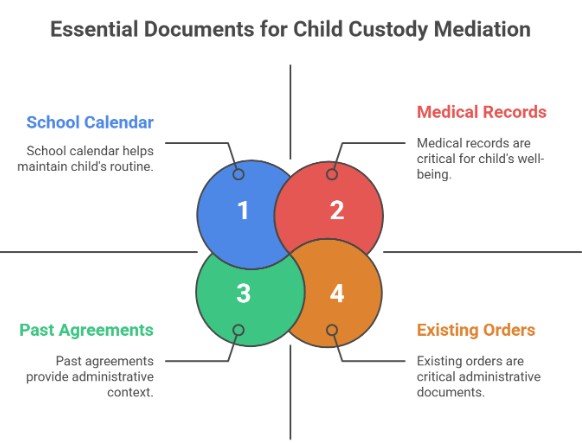
When you attend mediation, bring organized documentation. It helps you present a clear picture of your child’s routine and needs.
Gather records showing your child’s current schedule, health info, education details, and any legal documents you already have.
Bring a detailed calendar that outlines your child’s daily and weekly routine. Include school start and end times, after-school programs, sports, music lessons, tutoring, and anything else your child does regularly.
Jot down current childcare arrangements too. Who picks up your child from school? Which days do they go to daycare? List backup care options you use in a pinch.
Show how you currently split time with the other parent. List which days your child stays at each home, holiday setups, and summer schedules.
This way, the mediator gets a real sense of what’s working now and what might need to change.
Bring documentation of costs for these activities. Receipts for registration fees, equipment, and childcare expenses come in handy when discussing child support and how you’ll divide these costs going forward.
Gather medical records with your child’s doctor’s names, appointment schedules, medications, allergies, and any ongoing health conditions. Immunization records and a list of upcoming appointments are also helpful.
School records matter a lot. Bring report cards, teacher contact info, IEP or 504 plans if your child needs them, and notes from parent-teacher conferences.
If your child receives therapy or counseling or has special needs, bring documentation of those services.
Include provider names, frequency of visits, and notes on progress or concerns. These details help shape a custody agreement that fits your child’s needs.
Bring copies of any current court orders about custody, visitation, child support, or spousal support—even temporary orders from earlier in your case matter.
If you and the other parent have informal agreements about parenting time or financial responsibilities, write them down and bring them with you. They aren’t legally binding, but they show what you’ve tried so far.
If the other parent hasn’t complied with court orders, include documentation of the violations. Keep it simple and factual—dates, what happened, no extra drama. This helps the mediator identify the problems.
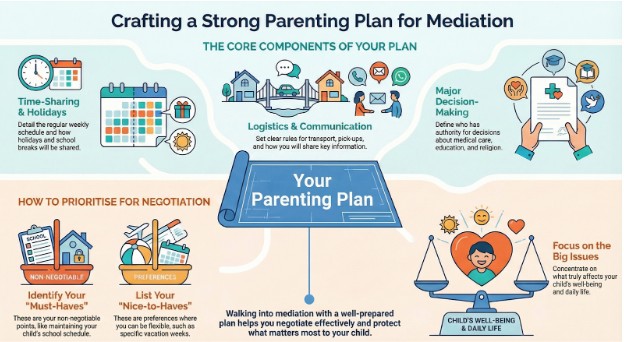
Entering mediation with your own parenting plan provides a clear starting point. It demonstrates you’ve considered what your child needs.
You’ll negotiate faster and protect what matters most if you already know your priorities.
Cover where your child spends time throughout the year. Start with a regular weekly schedule that shows which parent the child is with on specific days and times.
List major holidays, school breaks, and summer vacation. Spell out Thanksgiving, Christmas, spring break, and other important dates. Decide if you’ll alternate each year or split the day.
Transportation arrangements need details—who picks up and drops off, and where. Write down exact spots like school, home, or a neutral place. Think about what happens if someone runs late.
Add communication rules for you and the other parent. How will you share info about doctor appointments, school events, and emergencies? Include how your child can reach the other parent during time-sharing.
Don’t forget decision-making authority for medical care, education, and religious activities. These details matter more than you think.
Before mediation starts, figure out which parts of your parenting plan you can’t compromise on.
Your must-haves include maintaining your child’s school schedule, keeping them in their current activities, and ensuring they see both parents regularly.
Nice-to-haves are things you want but could bend on. You prefer Wednesday overnights but could accept Thursday. Or you want first pick on vacation weeks, but could be flexible on the dates.
Write both lists down so you know where you can give ground. This preparation helps you reach a workable solution without sacrificing what truly matters for your child.
Don’t get too hung up on the small stuff. Focus your energy on the big issues that actually affect your relationship with your child and their daily life.
Your words during mediation can build bridges or burn them. Having ready-to-use phrases and clear boundaries helps you stay focused on your child’s best interests rather than old arguments.
Write down a couple of short phrases you can repeat when things get tense. These scripts help you stay grounded if your emotions start to take over.
Try statements such as: “I want what helps our child feel safe and loved,” or “Let’s focus on making this work for our kids.” Say them out loud before your mediation session—maybe in the mirror or to a friend.
If your co-parent brings up past mistakes or tries to start an argument, fall back on your calm script. It gives you something to say instead of reacting with anger or hurt feelings. Your script reminds everyone you’re here for your child, not to rehash old problems.
Keep your scripts honest and straightforward. Skip anything that sounds fake or too formal. The mediator will notice if you’re genuinely trying to focus on co-parenting.
Set clear rules for yourself about what you won’t do during mediation. These boundaries keep things moving and protect your co-parenting relationship.
Never do these things:
When you notice a topic isn’t helpful, steer clear. If your co-parent starts blaming you, don’t fight back. Say something like, “That’s not what we’re here to solve today.”
Mediators want to see parents who can work together. If you demonstrate strong communication during custody mediation, you demonstrate that you can handle future parenting decisions together.
Your boundaries also teach your co-parent how to interact with you going forward. When you stay calm and child-focused, your co-parent often matches that energy—at least some of the time.
If you’re losing sleep over exchanges, school nights, and constant schedule changes, get structured support from Torres Mediation—in person or via Zoom. Contact us.
If you’re ready to get started, call us now!
Mediation works well for many custody disputes, but it doesn’t work when abuse, fear, or control issues are present.
Knowing when mediation is inappropriate in situations involving domestic violence protects you and your kids from harm.
Don’t participate in mediation if you feel afraid of the other parent. Fear keeps you from speaking honestly about your needs and your children’s best interests.
Warning signs that mediation may not be safe:
Mediation isn’t appropriate when there’s a major power imbalance or a history of abuse.
An abusive relationship creates an unfair dynamic where one parent holds too much control. That makes it impossible to negotiate on equal terms during your custody dispute.
If any of these red flags sound familiar, talk to your attorney about alternatives. Sometimes, a custody hearing before a judge keeps you safer than mediation ever could.
If you have concerns about power imbalances but still need to mediate, you can request protective measures. Florida mediators can adjust the format to make things safer for you.
Options that may help:
These changes help address power imbalances in conflict resolution mediation during custody disputes. Separate sessions reduce confrontation. Virtual formats create distance that can help you feel safer.
Talk to your attorney before your session about which format makes sense for you. Let the mediator know in advance about any safety concerns so they can arrange appropriate accommodations.
Brevard County spans more than 70 miles from Titusville to Palm Bay, which can complicate co-parenting schedules.
Torres Mediation, based in Melbourne, helps families design realistic parenting plans that actually work within local travel times, school hours, and traffic realities.
Florida courts now allow virtual mediation in most family law cases—a major benefit for Space Coast families spread across Brevard County.
Driving from Titusville to Melbourne during rush hour can take nearly an hour, so online sessions often make more sense.
When virtual mediation helps most:
Video mediation can ease tension, reduce travel time, and fit around work or childcare. You can join from home or your attorney’s office, and most mediators use secure platforms like Zoom to share and edit documents in real time.
In-person sessions still work best when you need to review physical paperwork or read subtle body language. Many families use a hybrid format—meeting face-to-face for key topics while keeping follow-ups online.
The mediation session usually follows a set format. Opening statements, private negotiations, and documenting any agreements are the main steps.
The mediator begins by reviewing the process and ground rules. Everyone introduces themselves, and the mediator confirms they’re neutral—no one’s on anyone’s side.
You’ll look over the agenda together. Usually, this covers things like physical custody, visitation schedules, holidays, and who gets to decide on your child’s education, healthcare, and religious stuff.
The mediator asks each parent to share their main concerns. This isn’t the time to argue or jump in. It’s just your moment to say what matters to you and maybe a little bit of why.
Based on what both parents say, the mediator makes a list of issues to resolve. They’ll usually start with easier topics and save the tough ones for later, which sometimes helps keep things moving.
Negotiation is just back-and-forth talks about each custody issue. The mediator keeps things on track, asks questions, and helps you find options that work for your child.
If talks stall, the mediator might suggest caucusing—meeting with each parent separately. You’ll get some privacy to talk about your concerns, your limits, and any compromises you might be okay with.
The mediator moves between rooms, bringing offers and counteroffers, but won’t spill everything you say. These private sessions can really help people cool off and think more clearly.
If you’re still stuck, the mediator might throw out some creative ideas you hadn’t thought of. They won’t make you decide, but they’ll help you see the pros and cons of each choice. Sometimes, that’s all you need to get unstuck.
When you reach an agreement, the mediator writes down every detail in a settlement agreement. This includes your parenting plan with specific custody and visitation schedules.
The agreement specifies where your child lives and the exact pickup and drop-off times. It also covers how you’ll split holidays and school breaks, as well as who will make significant decisions.
The more specific you get, the less you’ll argue later. You and the other parent should take your time reviewing the written agreement before signing anything.
Once you both sign, the mediator sends it off to the court. A judge will review it to ensure it works for your child.
Once the court approves, your settlement agreement becomes a legally binding court order. Both parents must adhere to it, or there could be legal trouble down the road.
Don’t walk into custody mediation feeling unprepared or outnumbered—let Torres Mediation help you organize documents, priorities, and proposals first. Schedule an appointment.
What should I bring to child custody mediation in Florida?
Bring your proposed parenting plan, personal calendar, your child’s school and activity calendars, any existing orders, and key child records (medical or school notes). Having shared dates and facts prevents stalling and keeps the discussion child-focused.
Should I draft a parenting plan before mediation?
Yes. Florida requires a Parenting Plan in cases involving time-sharing, and a draft helps you negotiate specifics instead of arguing in circles. Include weekday overnights, exchanges, holidays, decision-making, communication rules, and transportation responsibilities.
Is child custody mediation confidential in Florida?
Mostly, yes. Florida law makes mediation communications confidential and privileged, with limited exceptions. However, a signed written agreement reached in mediation is generally not confidential unless the parties agree otherwise. Read it before signing.
Can child custody mediation be done virtually in Florida?
Virtual custody mediation is widely available and can reduce travel, conflict, and scheduling stress. For example, the 18th Judicial Circuit’s Brevard County program notes that family mediations are currently conducted online via video conference. s
How long does a custody mediation session usually take?
Set aside at least a few hours. Florida court programs commonly schedule family mediation in multi-hour blocks; the Eighth Judicial Circuit notes a typical session is three hours, and other circuits set sessions up to three hours.
Do I need a lawyer for child custody mediation in Florida?
Not necessarily. Many people attend mediation without an attorney, but mediators can’t give legal advice. If you have counsel, they may attend; it’s also smart to have any agreement reviewed before filing.
What happens if we don’t reach an agreement in custody mediation?
If you don’t reach an agreement, the mediator reports an impasse to the court without sharing details. Your case is proceeding toward hearings or trial. If you sign a deal, it’s submitted for approval and added to the case file.