

Originally published: June 2025 | Updated: November 2025

Divorce in Travis County can feel like navigating a maze of paperwork, emotions, and legal terms. But understanding each step makes the path clearer—and far less overwhelming.
From filing the correct forms with the district clerk to understanding how property or child custody is handled, each step matters in reaching a fair outcome.
Many people have questions about what sets Travis County apart, what paperwork needs to be filed, how to schedule court hearings, and what to expect if the divorce is contested or uncontested.
To file for divorce in Travis County, at least one spouse must have lived in Texas for six months and in Travis County for 90 days before filing.
The process includes filing a petition, serving your spouse, waiting 60 days, and attending a final hearing.
From completing the right court forms to navigating child custody or property division, each decision affects your peace of mind—and your future stability.

To file in Travis County, one spouse must live in Texas for 6 months and in Travis County for 90 days before filing; grounds and a 60-day waiting period apply.
Key requirements include the length of time a person has lived in Texas, the grounds for divorce, and the minimum waiting period before a divorce can be finalized.
To file for divorce in Travis County, either person in the marriage must meet Texas residency rules.
At least one spouse must have lived in Texas for six consecutive months and in Travis County for at least 90 days before filing.
If only one person meets these requirements, that is enough for the court to hear the case. This is stated clearly in the Texas Family Code and is strictly enforced.
People should not file in a county or state where they do not meet these requirements, as it could delay the case or result in its dismissal.
Texas law allows for both no-fault and fault-based divorces.
The most common reason is insupportability, which means the marriage can no longer work due to differences that cannot be resolved.
There is no need to prove that anyone did something wrong on this ground.
Other legal reasons, called fault-based grounds, include adultery, cruelty, abandonment, and felony conviction.
Each has its specific legal meaning under the Texas Family Code.
The choice between no-fault and fault-based divorce can affect property division and other outcomes in some cases.
Texas requires a 60-day waiting period from the filing date before a judge can finalize a divorce, unless a family-violence exception applies. Most cases cannot be finalized sooner, even if both parties agree.
The waiting period is designed to give families time to consider their choices and resolve disagreements before the divorce becomes final.
This waiting period applies to all cases, including those in Austin and all other counties in Texas.
People filing should plan for this step and not expect to finish the process immediately.

The process: file the petition, serve your spouse, complete any required disclosures, attend mediation if required, observe the 60-day waiting period, and appear for the final hearing.
The first step requires the person seeking a divorce to prepare a legal petition.
This document explains why the parties are seeking a divorce and includes essential details, such as children, property, and requested custody arrangements.
It is essential to use the most recent divorce forms for Travis County to ensure all required information is included.
Forms are available online or at the Travis County Law Library.
People should review forms carefully, double-check their contact information, and determine whether their case is uncontested or contested.
Accuracy now helps avoid delays later.
Once the petition is complete, it should be filed with the Travis County District Clerk.
Filing means taking the paperwork to the courthouse in Austin or submitting it through the eFileTexas system.
The clerk assigns a case number to the case.
After filing, the court provides copies of your documents with an official stamp and updates you on the next steps.
Prompt submission ensures the divorce process begins legally and sets important deadlines in motion.
Note: Travis County standing orders may apply automatically at filing and restrict certain actions (e.g., moving children, disposing of property). Read them carefully.
Torres Mediation helps Austin families avoid courtroom chaos and costly errors—gain clarity, calm, and a clear plan forward. Schedule your confidential appointment.
If you’re ready to get started, call us now!
Paying the Travis County divorce filing fee is required at the time of filing.
The standard fee depends on factors like whether children are involved.
For those with limited income, a fee waiver can be requested through the court.
This involves additional paperwork, specifically a Statement of Inability to Afford Payment of Court Costs.
Filing fees must be paid before the case moves forward, unless the court approves a waiver.
After the petition is filed, the other spouse (the respondent) must be legally notified—this is called service.
Service is typically completed by a constable or certified process server; follow local rules for any alternative service methods.
Texas law requires strict procedures, so it is important to follow them exactly.
If the service is not completed correctly, the case may not proceed or could be dismissed.
The respondent has the right to reply to the divorce petition, known as an “answer.”
Texas rules give the responding spouse a set number of days—usually 20—to file their answer with the court.
Their answer may agree with the petition or object to certain requests, such as property division or child custody.
Filing a timely answer protects a person’s rights.
If no answer is filed, the court may issue a default judgment.
Sometimes, the court needs to set rules that help the family manage during the divorce process.
These rules are called temporary orders.
A hearing may address where the children will live, who will pay the bills, or how parents will share time.
Either party may request a temporary order hearing if they believe it is necessary.
Temporary orders remain in effect until the divorce is finalized or the court issues new orders.
If the divorce is contested, both sides may enter a period called discovery.
Here, each party learns about the other’s finances, property, and other relevant details.
This phase involves sharing documents like bank statements, tax returns, or retirement records.
Discovery ensures that both parties are aware of the facts before they agree or proceed to trial.
Deadlines and legal rules apply, so careful record-keeping is important.
Most Travis County divorces require mediation if the parties do not agree.
Mediation is a meeting where both sides attempt to resolve their issues with the assistance of a neutral third party, known as a mediator.
Mediation often happens before a final court hearing.
The goal is to agree on matters such as property, custody, and support without the stress of a trial.
Agreements reached in mediation are put into writing and can become part of the final court order.
If issues remain after mediation, the court will set a final hearing or trial.
Each side presents its case before a judge.
At the hearing, the judge listens to both sides, reviews the evidence, and decides any unresolved matters.
Final hearings may be brief if both spouses agree, or they may be longer if disagreements persist.
Judges focus on fairness and the best interests of children if they are involved.
The divorce process ends with the signing of the Final Decree of Divorce.
This legal document officially ends the marriage and explains all the agreements or orders on property, debts, custody, and support.
After the judge signs the decree, both parties must follow its terms.
Copies of the decree should be kept safe, as they are required for purposes such as changing names or transferring property.
The divorce is not fully done until the signed final decree is filed with the court.
Feeling lost between hearings, deadlines, and paperwork? Torres Mediation helps Austin couples organize their divorce process efficiently while keeping emotions manageable. Contact us today to discuss your options.
Uncontested means both spouses agree on all issues (property, custody, support). Any unresolved issue makes the case contested and may require hearings or a trial.
An uncontested divorce in Austin, TX, means both spouses agree on all big matters.
This includes dividing property, handling debts, establishing child custody and visitation arrangements, and arranging for child or spousal support.
Both parties need to work out every detail before the divorce can proceed as an uncontested one.
If even one issue is unsettled, the case becomes contested.
Uncontested cases are common for couples without children or with few assets.
However, couples with more complex financial situations or children can still have an uncontested divorce if both parties are willing to agree.
Choosing an uncontested divorce often saves time, stress, and money.
The paperwork is simpler, and the case usually takes less time to finish.
Key benefits include:
In Travis County, judges often finalize uncontested divorces faster than contested ones, especially if both sides bring completed paperwork to the courthouse.
A contested divorce in Travis County happens when spouses disagree on one or more major points.
Common issues include deciding who will keep the house, establishing child custody arrangements, or dividing retirement funds. The court will likely set hearings or even a trial to work through arguments.
This process takes more time and usually higher costs for legal help. In some cases, a judge may order mediation to resolve disputes. If no agreement is reached, the judge decides what is fair based on Texas law.
Overwhelmed by filing deadlines, forms, and court rules? Torres Mediation offers procedural guidance and settlement-focused solutions for your Travis County divorce. Reach out now to get started.
If you’re ready to get started, call us now!
Texas uses “conservatorship.” In most cases, both parents are named joint managing conservators; child support is based on net resources and the number of children. All orders must prioritize the child’s well-being and stability.
Texas uses the term “conservatorship” instead of “custody.”
There are two main types: joint managing conservatorship (JMC) and sole managing conservatorship (SMC).
Joint managing conservatorship means both parents share decision-making for their child.
It does not always mean equal physical time with the child.
One parent may still be the child’s primary caregiver, but both parents stay involved in key decisions, such as education and healthcare.
Sole managing conservatorship gives one parent the main right to make decisions for the child.
The other parent is typically referred to as the possessory conservator.
This usually happens if there are issues like family violence, neglect, or long distance between parents.
Child support in Texas is based on the paying parent’s income and the number of children they have.
The state provides a standard percentage, which increases with each additional child.
For example, one child typically receives 20% of the parents’ net resources, while two children would receive 25%.
The court may adjust these amounts if the situation warrants it, such as in cases involving a child with special needs.
Support must be paid through the Texas State Disbursement Unit.
If payments are missed, interest gets added, and the late parent could face legal action.
Child support orders can be changed later if a parent’s or child’s circumstances change a lot.
Parents must file for these changes with the court.
A parenting plan outlines where and when each parent will have custody of the child.
Texas uses a Standard Possession Order (SPO) for most cases. The SPO lists regular times, such as weekends, holidays, and extended summer visits.
Parents can agree on a different schedule, but a judge must approve it.
| Time Period | Parent 1 | Parent 2 | Notes |
| Typical Weekend | No | Yes | 1st, 3rd, and 5th Fridays of each month |
| Summer (30 Days) | No | Yes | Up to 30 consecutive days unless parents agree otherwise |
| Holidays | Shared | Shared | Alternating major holidays such as Thanksgiving, Christmas, and Spring Break |
| Extended Weekends | Varies | Varies | If Monday is a school holiday, the weekend may be extended |
| School Breaks | Varies | Varies | Determined by court order or mutual agreement |
| Special Occasions | Shared | Shared | Birthdays, Mother’s/Father’s Day, and special family events may have custom terms |
If parents live far apart, the court may change the schedule. These orders prioritize what benefits the child the most.

Texas is a community-property state, but division isn’t automatically 50/50. Judges aim for a “just and right” split based on multiple fairness factors.
The process focuses on classifying property and determining how to distribute it fairly in accordance with Texas law.
Texas is known as a community property state. This means most property or money earned by either spouse during the marriage is considered shared.
However, this does not mean everything is split exactly in half.
The judge aims for a division that is “just and right,” which may not always result in a 50/50 split.
Factors such as each spouse’s earning ability, health, child custody, and fault in the marriage breakdown may influence the division of assets.
Some assets or debts could be divided unequally if it is fair to do so.
Property division in Travis County includes a wide range of assets and debts.
Items usually involved are:
Only property considered “community property” is divided.
If something was bought together or earned between the date of marriage and the date of separation, it is likely to count.
Each spouse needs to create a comprehensive list of their assets before and after marriage, as this helps the court or the couple determine what will be divided between them.
Not all property is shared. Some assets are “separate property” and are kept by one spouse alone.
Separate property includes:
To protect separate property, a spouse must prove that it is solely theirs, often by providing documents or financial records.
This is important because Texas courts cannot transfer one spouse’s separate property to the other spouse.
Maintaining accurate records, such as deeds or bank statements, helps prevent confusion and protects the rights of each individual.
If you’re ready to get started, call us now!
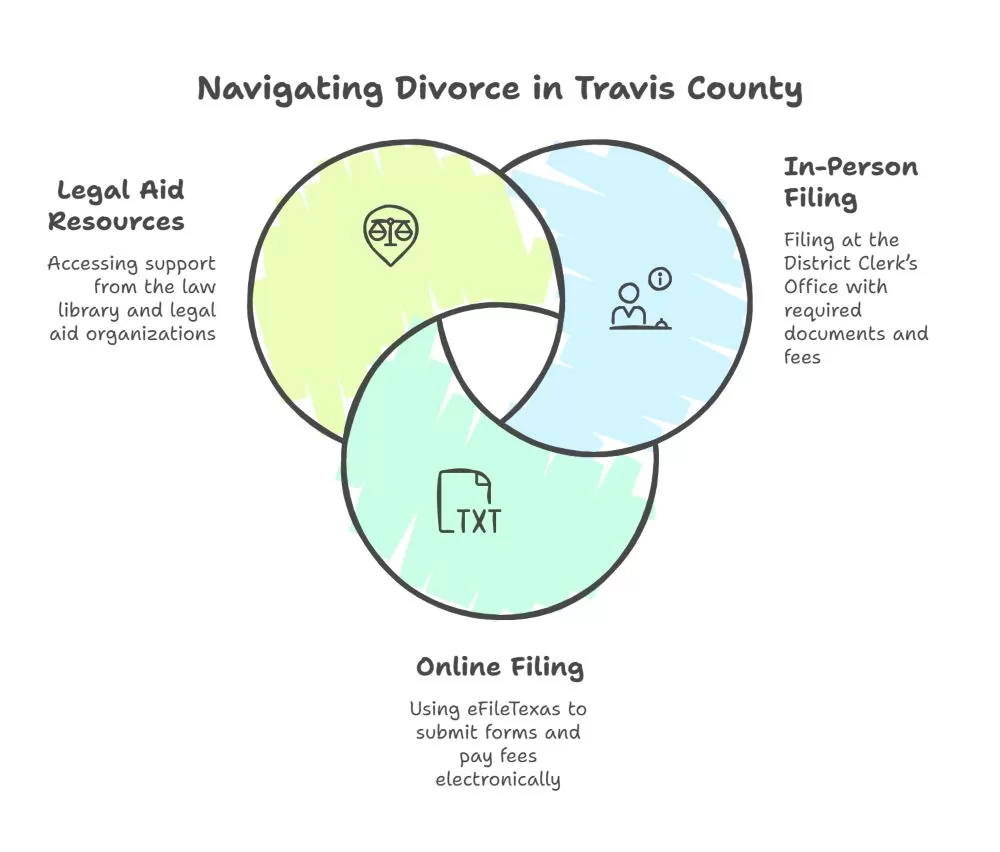
File in person with the Travis County District Clerk or online via eFileTexas; bring required forms, ID, and fees or a fee-waiver request.
Travis County also offers legal aid and support resources for individuals who require guidance throughout the process.
In-person divorce filings in Travis County are handled at the District Clerk’s Office.
The office is located at the Travis County Civil and Family Courts Facility in downtown Austin.
To file, the person must fill out the required divorce forms and bring these documents to the clerk’s office.
The clerk will collect a filing fee, unless the filer qualifies for a fee waiver.
It is essential to bring photo identification and any supporting documentation, such as marriage or child information.
Once the paperwork is submitted, the clerk will provide a case number.
The next steps depend on whether the divorce is contested or uncontested.
If the divorce involves children or property, additional forms may be needed.
The filer should be prepared to follow the clerk’s instructions regarding notifying the other spouse and scheduling court hearings.
Travis County residents can also file for divorce online using eFileTexas.
This system allows users to submit all forms, pay filing fees, and track the case electronically.
To use eFileTexas, filers must first register for an account and gather all required documents in digital format.
After logging in, they select “Travis County” as the filing location and upload the documents.
Payment is made using a credit card or other accepted methods.
If a fee waiver is needed, this must be requested when filing.
eFileTexas is often faster than in-person filing because it avoids courthouse lines.
The system guides filers step by step, but attention to detail is key to avoiding errors that could delay the case.
In certain cases, especially those involving children, additional forms or steps may be required when using the online process.
Some individuals may require assistance in understanding the divorce process in Travis County.
The county provides self-help resources through the law library.
Staff can guide filers in completing forms and answer general procedural questions, though they do not offer legal advice.
Legal aid organizations in Austin can assist low-income residents with advice or representation.
These groups may assist with completing forms, explaining court requirements, and understanding legal options.
Assistance is available in both English and Spanish for many services.
To get started, visit the Travis County Law Library or seek help from local legal clinics.
The Law Library’s website provides access to current resources, including links to printable forms, online filing guides, and hours of operation.
Some nonprofit groups also offer workshops on filing for divorce in Travis County.
Your divorce is final when the judge signs the Final Decree of Divorce after the 60-day wait; later changes require a court-approved modification.
Understanding when the divorce becomes final, how to handle modifications, and the steps to enforce court orders is crucial moving forward.
A divorce in Travis County is not final until a judge signs the final divorce decree.
Before this can happen, Texas requires a 60-day waiting period from the date the divorce petition is filed.
This rule applies to most cases unless there is family violence.
Both spouses may need to attend a short court hearing so the judge can review the agreements and sign the decree.
The hearing provides each spouse with an opportunity to confirm the terms and address any concerns.
Once the judge signs the final divorce decree, the divorce is considered official, and all terms are legally binding.
In Travis County, the court process may also require a review by the Law Library or court staff.
After the divorce is final, specific orders, such as child custody, visitation, and support, may need to be adjusted over time.
If a major life change occurs, such as a parent moving or a change in a child’s needs, either party can file to modify these orders.
The requesting party must show that the change is significant and ongoing.
Common reasons include job relocation, changes in income, or concerns for the child’s safety.
The modification request is filed with the same Travis County civil and family courts that issued the first order.
A judge will hold a hearing, during which both sides can present their evidence.
If the court finds that the change is in the child’s best interests, it may approve a new order.
Legal advice can help parents understand what judges need before issuing a ruling.
Sometimes, one party may not comply with the terms outlined in the final divorce decree.
When this happens, the other party can take steps to enforce the orders through the Travis County family court process.
Ways to enforce a divorce order include:
The court can order fines, change custody arrangements, or even order jail time in serious cases.
It is best to keep clear records of missed payments, denied visits, or other violations.
For guidance, residents may contact the Travis County District Clerk’s office or seek legal counsel if violations occur.
Don’t navigate Travis County divorce procedures alone. Torres Mediation helps Austin residents handle child custody and financial agreements with clarity and control. Schedule your private session today.
How do I file for divorce in Travis County?
To file for divorce in Travis County, submit an Original Petition for Divorce with the District Clerk’s Office at 1700 Guadalupe Street or online via eFileTexas.gov. Include all required forms, pay the filing fee, and follow the clerk’s guidance for serving your spouse.
What is the waiting period for divorce in Texas?
Texas requires a 60-day waiting period after filing before a judge can finalize the divorce. The only exceptions apply to cases involving family violence or protective orders, allowing the process to move faster if safety is a concern.
How much does it cost to file for divorce in Austin?
Filing fees in Travis County typically range from $300 to $350. Those unable to afford the cost may request a fee waiver using the Statement of Inability to Afford Payment of Court Costs, available through the court or online filing system.
Do I need a lawyer to get divorced in Travis County?
Not always. You can represent yourself in an uncontested divorce using official Texas self-help forms. However, if your case involves children, property, or disputes, hiring a mediator or attorney helps prevent costly mistakes and ensures your rights are protected.
Is mediation required in Travis County divorce cases?
Yes. Mediation is often required before a divorce trial, especially when children or property are involved. It gives both spouses a chance to reach an agreement privately, reduce emotional strain, and avoid the time and expense of court hearings.
What happens if my spouse doesn’t respond to the divorce petition?
If your spouse fails to respond within the legal timeframe (typically 20 days plus the following Monday), you can request a default judgment. The court may finalize the divorce in your favor, provided all paperwork and service requirements were completed correctly.
Can I change child custody or support orders after my divorce?
Yes. If major life changes occur—such as relocation, income changes, or a new child’s needs—you can file a petition to modify custody or support. The court will only approve changes that serve the child’s best interests under Texas Family Code standards.
Where can I get help filing for divorce in Travis County?
You can visit the Travis County Law Library in downtown Austin for self-help resources, forms, and workshops. Low-income residents may also qualify for legal aid or mediation support through local nonprofits and family law assistance programs that offer services in English and Spanish.
Kim W. Torres, Esq. is a Florida Supreme Court Certified Mediator in Circuit Civil, Family, County Court, and Appellate matters and a member of The Florida Bar since 1985. Practicing exclusively as a mediator since 2000, she has resolved more than 2,000 cases — from complex multi-party disputes to high-emotion matters with self-represented parties. A past Chair of the Florida Bar’s ADR Section and Brevard County’s Circuit Civil Mediator of the Year, Kim mediates throughout Florida, in person and virtually.