

Originally published: April 2026

Data last verified: March 2026
An uncontested divorce in Florida requires both spouses to agree on asset division, debt allocation, parenting plans, child support, and alimony before filing.
Florida couples who reach a full pre-filing agreement finalize dissolution in four to eight weeks for $500 to $5,000, compared to years and $30,000 or more in contested litigation.
An uncontested divorce in Florida is a no-fault dissolution in which both spouses execute a full written agreement covering all contested terms before the circuit court schedules a final hearing.
Florida Statutes Section 61.052 requires no proof of fault or misconduct. Full pre-filing agreement eliminates contested hearings, compresses the timeline to weeks, and reduces total fees by 60 to 90 percent.
Florida law creates two distinct dissolution tracks for couples seeking to divorce without courtroom litigation.
The simplified dissolution track under Florida Statutes Section 61.103 serves only childless couples with limited shared assets who waive all alimony rights and financial disclosure obligations.
The standard uncontested dissolution track serves Florida couples with minor children, shared real property, retirement accounts, or spousal support obligations, and requires a fully executed marital settlement agreement covering every contested term.
Schedule your uncontested divorce consultation with Torres Mediation. Kim Torres helps Florida couples finalize every term before filing.
If you’re ready to get started, call us now!
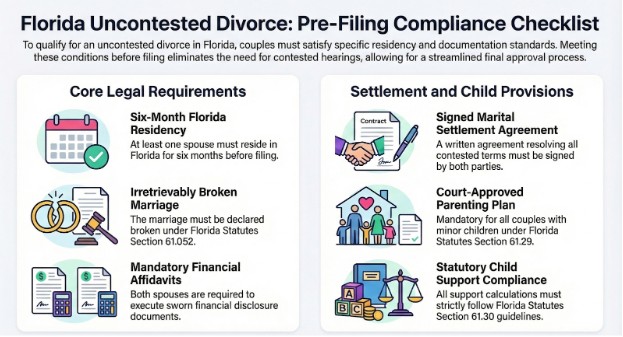
Florida uncontested divorce requires four conditions before a circuit court will schedule a final hearing: six months of Florida residency by at least one spouse, an irretrievably broken marriage, a fully signed marital settlement agreement, and a court-approved parenting plan for all couples with minor children.
Satisfying all four conditions before filing eliminates the need for contested hearings entirely.
| Requirement | Florida Legal Standard |
| Residency | At least one spouse must maintain Florida residency for 6 months before filing |
| Grounds | Marriage must be irretrievably broken under Florida Statutes Section 61.052 |
| Financial disclosure | Both spouses must execute mandatory financial affidavits |
| Marital settlement agreement | Both spouses must sign a written agreement resolving all contested dissolution terms |
| Parenting plan | Mandatory for all couples with minor children under Florida Statutes Section 61.29 |
| Child support | Calculations must comply with Florida Statutes Section 61.30 guidelines |
Florida couples who satisfy all six conditions at the time of filing bypass contested hearings entirely and proceed directly to a brief final approval hearing before a Florida circuit court judge.
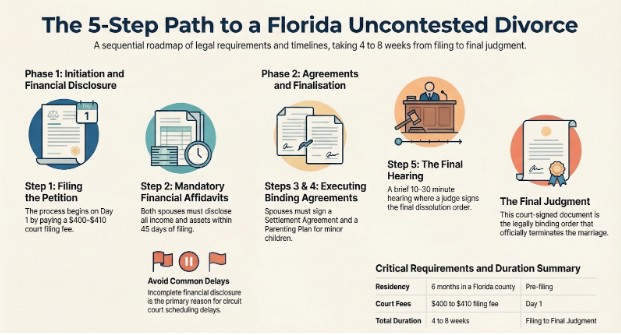
A Florida uncontested divorce follows five sequential steps. Florida couples who complete all required documents before filing reach a signed final judgment of dissolution of marriage in four to eight weeks.
The petitioning spouse files a Petition for Dissolution of Marriage with the Florida circuit court in the county where at least one spouse has maintained residency for six months, as required under Florida Statutes Section 61.021.
Filing the petition opens the dissolution case, assigns a case number, and starts the official court timeline. The petitioning spouse pays the circuit court filing fee of $400 to $410 at the time of submission.
Both spouses must each execute a Mandatory Financial Affidavit disclosing all income, assets, liabilities, and monthly expenses within 45 days of the dissolution petition being filed, as required under Florida Family Law Rule of Procedure 12.285. Florida circuit courts reject dissolution filings that lack complete financial affidavits from both spouses. Incomplete or inaccurate financial disclosure is the most common controllable cause of delays in uncontested divorces in Florida.
Florida couples preparing their financial affidavits can review mandatory financial disclosure requirements before completing their paperwork to avoid submission errors that delay circuit court scheduling.
Both spouses must sign a Marital Settlement Agreement that resolves all contested dissolution terms, including real property division, allocation of retirement accounts, assignment of debts, spousal support obligations, and any child-related financial provisions.
A Florida Marital Settlement Agreement is a legally binding written contract that Florida circuit courts incorporate directly into the final judgment of dissolution of marriage once a judge approves it.
Florida couples who have not yet reached full written agreement on all dissolution terms can resolve outstanding divorce terms through a focused mediation session with Florida Supreme Court Certified Mediator Kim Torres of Torres Mediation before filing, preserving the uncontested dissolution track and avoiding contested court proceedings.
Both parents must jointly submit a court-approved Florida Parenting Plan before the circuit court will schedule a final hearing in any dissolution case involving minor children, as required under Florida Statutes Section 61.29.
A Florida-compliant parenting plan must address the time-sharing schedule, parental responsibility designations for education and healthcare, the school enrollment address, the co-parent communication method, the holiday rotation, and the dispute resolution process.
Florida circuit courts reject parenting plans that omit any required provision under Florida Statutes Section 61.29(3).
Florida parents who want to understand which parenting issues the plan must address before drafting their agreement should avoid submission errors that delay scheduling the final hearing.
Both spouses attend a brief final hearing before a Florida circuit court judge, who reviews the Marital Settlement Agreement and Parenting Plan, confirms that both spouses executed the documents voluntarily, and signs the Final Judgment of Dissolution of Marriage.
Florida uncontested divorce final hearings typically last 10 to 30 minutes because all contested terms have already been resolved before the hearing date.
The signed Final Judgment of Dissolution of Marriage is the legally binding order that terminates the marriage under Florida law.
Florida circuit courts schedule final hearings four to eight weeks after filing when both spouses submit a complete Mandatory Financial Affidavit, a signed Marital Settlement Agreement, and a court-compliant Parenting Plan at the time of filing.
| Step | Responsible Party | Required Document | Typical Timeline |
| 1. File dissolution petition | Petitioning spouse | Petition for Dissolution of Marriage | Day 1 |
| 2. Complete financial disclosures | Both spouses | Mandatory Financial Affidavit | Within 45 days of filing |
| 3. Execute marital settlement agreement | Both spouses | Signed Marital Settlement Agreement | Before the final hearing |
| 4. Submit parenting plan | Both parents if children involved | Court-Approved Parenting Plan | Before final hearing |
| 5. Attend final hearing | Both spouses | Signed Final Judgment of Dissolution | 4 to 8 weeks after filing |
Florida couples who enter the filing process with a fully executed Marital Settlement Agreement and a completed Parenting Plan eliminate the two most common controllable delay factors and advance directly to Florida circuit court scheduling without additional negotiation rounds.
Torres Mediation helps Florida couples complete Steps 3 and 4 before filing. Schedule a dissolution mediation session with Kim Torres today.
If you’re ready to get started, call us now!
Florida circuit courts finalize most uncontested divorces within four to eight weeks of filing when both spouses submit complete financial affidavits, a signed marital settlement agreement, and a compliant parenting plan at the time of filing.
Incomplete financial disclosures, deficiencies in parenting plans under Florida Statutes Section 61.29(3), and circuit court docket backlogs each extend the four-to-eight-week timeline independently.
Florida couples who resolve all outstanding dissolution terms through mediation before filing eliminate both controllable delay factors and advance directly to circuit court scheduling without additional negotiation rounds.
An uncontested divorce in Florida costs $500 to $5,000 in total fees, covering the circuit court filing fee of $400 to $410, document preparation costs, mediator fees if applicable, and independent attorney review fees.
Contested Florida circuit court litigation costs $15,000 to $30,000 per spouse, or more.
Pre-filing full agreement through mediation limits attorney involvement to document review, eliminating courtroom representation fees entirely.
Florida couples who want to reduce total dissolution costs identify pre-filing a full agreement as the single most effective cost-reduction strategy.
Mediation fees for resolving remaining uncontested divorce terms typically total $1,500 to $3,000, substantially less than the cost of converting an uncontested proceeding into contested circuit court litigation.
Florida divorce mediation resolves the specific outstanding terms that block a couple from filing as fully uncontested.
Florida Supreme Court Certified Mediator Kim Torres of Torres Mediation structures negotiation on property division, parenting schedules, child support, and alimony so both spouses execute a complete marital settlement agreement and file jointly on fully agreed terms.
Many Florida couples enter the dissolution process with partial agreement, meaning one or two unresolved terms block the uncontested filing track.
A single contested issue, whether a time-sharing disagreement, one retirement account division, or a transitional alimony amount, converts an otherwise uncontested filing into a contested proceeding requiring separate legal representation and court hearings.
Torres Mediation resolves single-issue and multi-issue partial disagreements in one to two focused sessions.
Florida couples preparing for mediation can clarify mandatory financial disclosure requirements before the first session.
Florida parents can review what parenting issues mediation addresses before scheduling with Torres Mediation.
Torres Mediation resolves the specific terms blocking your uncontested filing. Schedule a mediation session with Kim Torres today.
Uncontested divorce serves Florida couples who can execute full written agreement on all dissolution terms, want to minimize total legal fees, and want to finalize the dissolution within weeks rather than years.
Mediation is the most effective preparation tool for Florida couples who have reached partial agreement but need neutral facilitation to resolve two or three remaining contested terms.
Florida couples with minor children gain the greatest advantage from the uncontested dissolution track because a mediated parenting plan produces higher voluntary compliance rates and lower post-judgment modification petition rates than a parenting plan imposed by a Florida circuit court judge.
Florida couples who want to assess whether their current level of agreement qualifies them for the uncontested track can determine whether mediation is a good fit before deciding how to proceed.
Kim Torres, Florida Supreme Court Certified Mediator, guides Florida couples through every uncontested divorce term. Schedule your confidential consultation with Torres Mediation today.
What qualifies as an uncontested divorce in Florida?
Both spouses must execute a written agreement on asset division, debt allocation, child custody, time-sharing, child support, and alimony. One unresolved term converts the filing to contested dissolution, requiring a circuit court hearing.
How long does an uncontested divorce take in Florida?
Florida circuit courts finalize most uncontested divorces in four to eight weeks when both spouses submit complete financial affidavits and a signed marital settlement agreement at filing.
How much does an uncontested divorce cost in Florida?
Total fees range from $500 to $5,000, covering the circuit court filing fee of $400 to $410, document preparation costs, and any mediation or independent attorney review fees.
Do I need a lawyer for an uncontested divorce in Florida?
Florida law does not require the presence of an attorney. Consulting a Florida family law attorney before signing the marital settlement agreement confirms that the agreement satisfies circuit court approval requirements and protects both spouses’ legal rights.
Can I file for an uncontested divorce in Florida if we have children?
Yes. Florida couples with minor children qualify for uncontested dissolution if both spouses submit a complete, court-approved parenting plan under Florida Statutes Section 61.29 that addresses time-sharing, parental responsibility, and dispute resolution.
What is a marital settlement agreement in Florida?
A Florida marital settlement agreement is a legally binding written contract in which both spouses document agreed-upon terms on asset division, debt allocation, and spousal support. Florida circuit courts incorporate the agreement into the final judgment of dissolution.
What is the difference between an uncontested and a simplified divorce in Florida?
Florida simplified dissolution under Florida Statutes Section 61.103 applies exclusively to childless couples with no significant shared assets who waive alimony rights. Standard uncontested dissolution serves all other Florida couples, including those with children, real property, and retirement accounts.
What happens if we disagree on one issue during an uncontested Florida divorce?
One unresolved term converts the filing to contested dissolution, triggering separate legal representation and circuit court hearings. A single targeted mediation session with Torres Mediation resolves most single-issue disputes and restores the uncontested filing track.
Kim W. Torres, Esq. is a Florida Supreme Court Certified Mediator in Circuit Civil, Family, County Court, and Appellate matters and a member of The Florida Bar since 1985. Practicing exclusively as a mediator since 2000, she has resolved more than 2,000 cases — from complex multi-party disputes to high-emotion matters with self-represented parties. A past Chair of the Florida Bar’s ADR Section and Brevard County’s Circuit Civil Mediator of the Year, Kim mediates throughout Florida, in person and virtually.