575 S. Wickham Rd., Ste F, PMB 334, Melbourne, FL 32904
info@torresmediation.com

Call Now For Service!

Originally published: July 2026
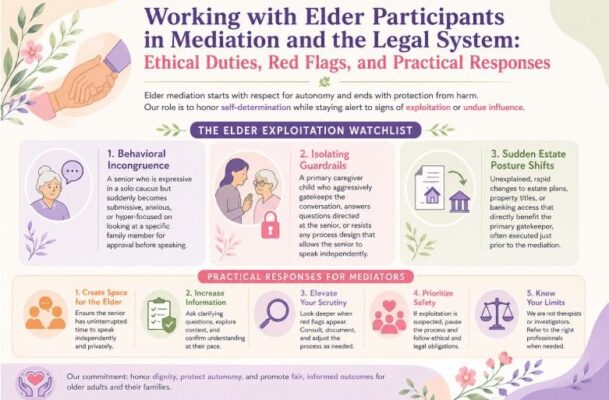
More families are turning to elder mediation to work through disputes involving an aging parent — care decisions, finances, guardianship concerns, and disagreements between siblings about what mom or dad actually wants.
Mediation is built around one core idea: the people in the room make their own decisions, voluntarily and with full understanding of what they’re agreeing to.
Working with an older participant sometimes means paying closer attention to that idea, not less. A parent’s age alone never disqualifies them from mediation.
What matters is whether they can meaningfully understand and participate in the specific decision in front of them — and a trained family mediator knows how to tell the difference between an elder who needs a little extra patience and one who needs real protection.
Older participants sometimes bring challenges to a mediation session that younger participants typically don’t. These can include:
None of these factors automatically mean a parent can’t participate in mediation. They mean a mediator needs to look closely and individually at each person, rather than assuming capacity based on age or a single difficult moment in a session.
Families comparing their options can also look at how mediation differs from guardianship, which takes a very different approach to an elder’s decision-making role.
Mediation only works if every decision made in the room actually belongs to the people making it. That’s called self-determination, and it means:
For an elderly participant, protecting self-determination doesn’t mean lowering the bar or excluding them from the conversation.
It means adding safeguards — more time, simpler language, extra confirmation — so the decision that comes out of mediation is genuinely theirs. A first mediation session is often where families first see these safeguards in action.
If you’re ready to get started, call us now!
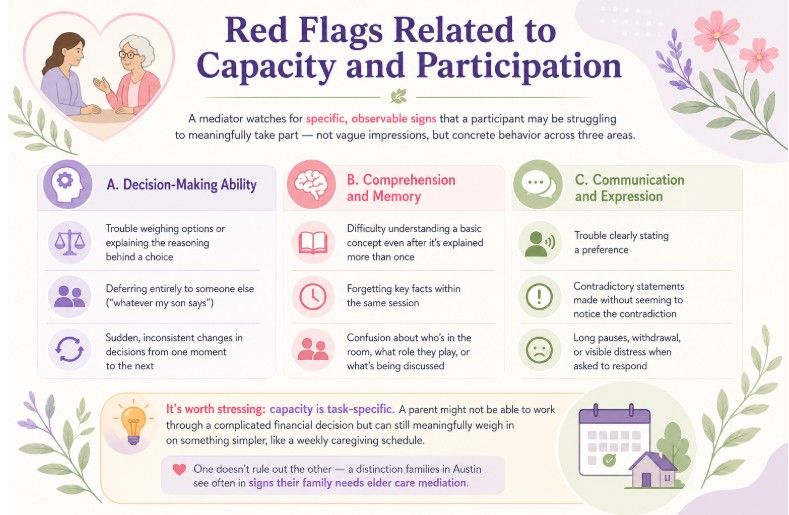
A mediator watches for specific, observable signs that a participant may be struggling to meaningfully take part — not vague impressions, but concrete behavior across three areas.
It’s worth stressing: capacity is task-specific. A parent might not be able to work through a complicated financial decision but can still meaningfully weigh in on something simpler, like a weekly caregiving schedule.
One doesn’t rule out the other — a distinction families in Austin often see in signs that their family needs elder care mediation.
Capacity isn’t the only thing a mediator watches. Sometimes the bigger risk to an elder’s voice comes from the people around them.
None of these signs alone prove wrongdoing. Together, and combined with hesitation from the elder themselves, they tell a mediator it’s time to slow the process down — the same reason ethical issues in online mediation require extra care when sessions move to video.
If you’re ready to get started, call us now!
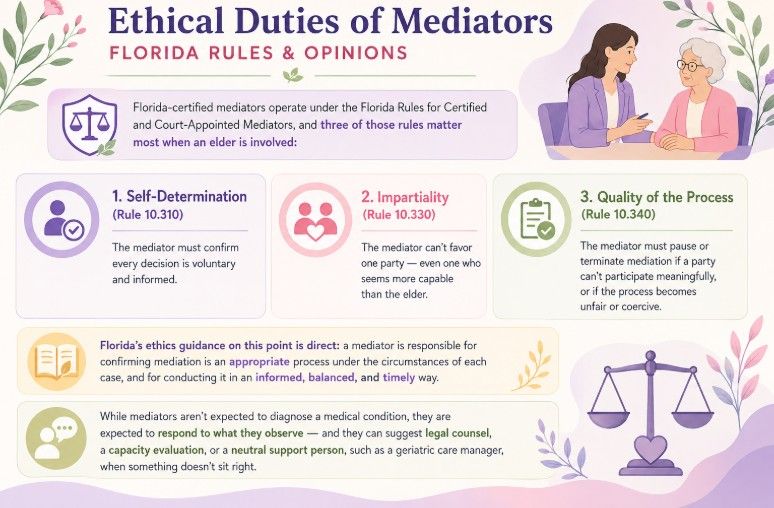
Florida-certified mediators operate under the Florida Rules for Certified and Court-Appointed Mediators, and three of those rules matter most when an elder is involved:
Florida’s ethics guidance on this point is direct: a mediator is responsible for confirming mediation is an appropriate process under the circumstances of each case, and for conducting it in an informed, balanced, and timely way.
While mediators aren’t expected to diagnose a medical condition, they are expected to respond to what they observe — and they can suggest legal counsel, a capacity evaluation, or a neutral support person, such as a geriatric care manager, when something doesn’t sit right.
Mediation communications in Florida are confidential in almost every circumstance — but that protection has real limits, and families should know them going in.
Florida’s mediation confidentiality statute removes confidentiality for communications involving threats of violence, planned or concealed crimes, and — critically — child or elder abuse.
Under Florida’s mandatory reporting law, any person who knows or has reasonable cause to suspect that a vulnerable adult is being abused, neglected, or exploited must report it immediately to the state’s central abuse hotline. That duty applies to mediators just as it applies to everyone else.
Families can reach Florida’s Adult Protective Services program directly at 1-800-96-ABUSE (1-800-962-2873) if they have concerns outside of a mediation session.
Best practice for any family heading into mediation: understand these limits before the session starts, so there are no surprises if a concern comes up mid-conversation. The Torres Mediation FAQs page covers more on how confidentiality works in practice.
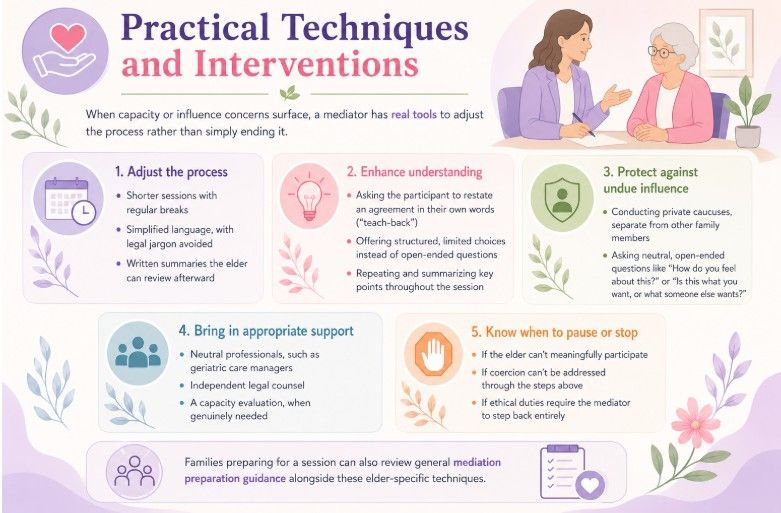
When capacity or influence concerns surface, a mediator has real tools to adjust the process rather than simply ending it.
Families preparing for a session can also review general mediation preparation guidance alongside these elder-specific techniques.
Working with an elderly participant in mediation isn’t about choosing between respecting their independence and keeping them safe — it’s about holding both at once.
A good mediator stays alert to red flags regarding capacity and undue influence while never losing sight of the reason mediation exists in the first place: allowing people to make their own decisions.
The goal was never to exclude elder participants from the process. It’s to make sure their voice is genuinely heard, their decisions are truly their own, and the process itself stays worth trusting.
Read more about how families have navigated this on the Torres Mediation testimonials page, or contact Kim Torres directly with questions about a specific situation.
Does my aging parent need a diagnosis before a mediator can raise capacity concerns?
No. A mediator responds to what they observe in the room — confusion, trouble explaining a decision, visible distress — not a medical diagnosis. If those signs show up, the mediator may suggest a formal capacity evaluation, but it’s never a requirement to start.
Is capacity the same as legal competency?
Not quite. Capacity is specific to the decision at hand and can shift from one topic to the next, or even within the same session. A parent might struggle with a complex financial choice but still meaningfully weigh in on something simpler.
Can a family member answer questions on my parent’s behalf during mediation?
Not as a stand-in for their actual voice. A relative consistently speaking for the elder, or the elder looking to someone else before responding, is one of the clearest signs of undue influence — and a mediator will step in and ask to hear directly from the elder.
What kinds of questions does a mediator actually ask an elderly participant?
Early on, simple orientation questions like “Can you tell me, in your own words, why we’re meeting today?” Later, if concerns come up, more direct questions in private — like whether a decision is truly theirs or something someone else wants.
What happens if mediation gets paused over a capacity or influence concern?
The mediator explains, in neutral terms, that more time or clarity is needed before moving forward. That might mean a short break, a private caucus, or a recommendation to bring in independent legal counsel before the session resumes.
Is everything said in mediation confidential, even if abuse comes up?
No. Florida’s mandatory reporting law requires anyone — including a mediator — who has reasonable cause to suspect elder abuse, neglect, or exploitation to report it to the state’s abuse hotline. That obligation overrides normal mediation confidentiality for that specific concern.
What if my parent relies on a caregiver for everyday support — does that disqualify them from mediation?
No. Needing help with daily tasks isn’t the same as lacking the capacity to make a decision. A mediator looks at whether the parent can understand and meaningfully weigh in on the specific issue being discussed, not their general level of independence.
Can mediation end permanently if concerns can’t be resolved?
It’s possible, but it’s a last resort. A mediator will try to slow down, use private caucus, or bring in outside support first. Termination only happens if the process can’t be made fair and voluntary for everyone involved.
How can our family prepare an elderly parent for mediation?
Explain what will happen in plain terms beforehand, make sure they understand the topics on the table, and think about whether independent legal counsel or a trusted support person should be part of the process. Torres Mediation can walk through this preparation directly with you.
What should we do if we’re worried a sibling or relative is pressuring our parent?
Raise it directly with the mediator before or during the session. Private caucus exists specifically for this — it gives your parent room to speak without anyone else in the room, and gives the mediator a clear read on whether a decision is genuinely theirs.
Kim W. Torres, Esq. is a Florida Supreme Court Certified Mediator in Circuit Civil, Family, County Court, and Appellate matters and a member of The Florida Bar since 1985. Practicing exclusively as a mediator since 2000, she has resolved more than 2,000 cases — from complex multi-party disputes to high-emotion matters with self-represented parties. A past Chair of the Florida Bar’s ADR Section and Brevard County’s Circuit Civil Mediator of the Year, Kim mediates throughout Florida, in person and virtually.