

Originally published: September 2026

Before anything else: if you’re in danger right now, this article isn’t about you skipping protection — contact the Florida Domestic Violence Hotline at 1-800-500-1119 or the National Domestic Violence Hotline at 1-800-799-7233. What follows applies to a different, narrower situation: a high-conflict custody dispute where mediation is already appropriate, and where physical danger isn’t a current concern.
A protective order and a parenting plan aren’t competing solutions to the same problem—they solve different problems on different timelines.
A restraining order addresses immediate safety, and Florida law moves it fast: a temporary injunction can’t stay in effect past 15 days without a full hearing.
A parenting plan addresses something else entirely — the ongoing uncertainty a parent may feel about their future relationship with a child.
Where mediation is the right tool for a case, settling that second question can ease a specific kind of conflict a protective order was never designed to reach.
Working through a high-conflict custody situation? Kim W. Torres has mediated Florida family disputes for over two decades — schedule a confidential consultation to talk through whether mediation fits your circumstances.
If you’re ready to get started, call us now!
Not every instance of controlling behavior in a separation has the same root cause, and mediation isn’t the right response to all of them.
But in the cases Kim W. Torres has mediated where physical safety wasn’t a current concern, she’s observed a specific, recurring pattern: a parent who doesn’t know what their future access to a child will look like sometimes responds to that uncertainty by monitoring the other parent, resisting every request, or trying to control situations they otherwise can’t influence.
That’s a professional observation from a specific category of cases, not a general rule about why people behave abusively.
It doesn’t apply to every controlling dynamic, and it isn’t a framework for explaining or excusing behavior that involves actual danger. Where it does apply, though, it points to something concrete: a documented, agreed schedule removes the specific uncertainty driving that behavior, which can reduce the behavior itself.
The scenario below draws on patterns from Kim W. Torres’s mediation practice. It’s a composite, not an account of any identifiable case, consistent with mediation confidentiality requirements under Chapter 44, Florida Statutes.
A mother was weighing whether to pursue a restraining order before trying mediation first, hoping that settling a parenting plan might ease some of the tension she’d been experiencing.
Her attorney thought mediation was worth trying: clarity on timesharing—what time each parent would actually have, and what each parent’s financial and custodial obligations would be—tends to be central to defusing this kind of standoff.
Once the father had that clarity in writing, his behavior shifted. He no longer needed to guess whether he was being pushed out of his child’s life, and he had a concrete answer about what he’d owe financially. With that specific uncertainty resolved, he stopped putting energy into monitoring the mother.
The takeaway isn’t that a signed agreement fixes every strained co-parenting relationship — it’s that one particular driver of conflict (fear of losing the relationship with a child) can sometimes be addressed directly, and addressing it can reduce the behavior tied to it.
This scenario is also a composite drawn from practice patterns, not a specific case.
A father had been incarcerated following a domestic violence incident, and a resulting protective order interrupted his contact with his toddler for roughly eight months.
The mother wanted a step-up plan that would gradually reintroduce the child to the father while he rebuilt familiarity with the child’s routine. The father wanted to return immediately to the schedule the family had before the incident.
Mediation produced a phased plan instead of either parent’s original request — one that let contact begin building again within the week rather than waiting for the next available court date.
Each phase came with its own conditions, and the schedule expanded as those were met, until the parents reached an agreed 50/50 arrangement. The mother got a structure that let her see the father’s readiness demonstrated in stages before the fuller schedule kicked in.
If you’re ready to get started, call us now!
A restraining order reshapes the practical mechanics of shared parenting, not just the legal relationship between the parents. Exchanges that used to be simple often require a third party—a family member or friend willing to be present—since the parents can’t have direct contact.
Day-to-day updates about the child get harder too, especially when the child is too young to have their own phone.
One point is worth stating plainly: the protected party can’t informally authorize the other party to violate the order.
Even if things seem to be going better and one party tells the other that contact is fine, that statement carries no legal weight — under § 741.30, Florida Statutes, the order remains in force exactly as written until the court that issued it modifies or dissolves it.
Either party can file that motion at any time, but nothing said outside of court changes the order itself.
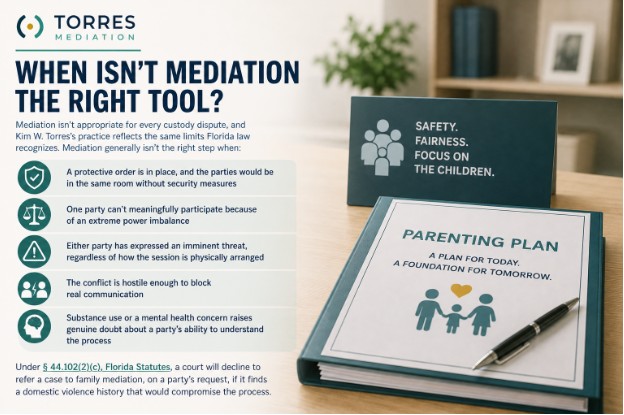
Mediation isn’t appropriate for every custody dispute, and Kim W. Torres’s practice reflects the same limits Florida law recognizes. Mediation generally isn’t the right step when:
Under § 44.102(2)(c), Florida Statutes, a court will decline to refer a case to family mediation, on a party’s request, if it finds a domestic violence history that would compromise the process.
A mediator’s job isn’t to rule on whether abuse happened — it’s to keep assessing, throughout the process, whether both people can participate meaningfully and make their own informed decisions.
How long does a restraining order hearing actually take in Florida?
Not usually a long one. Under Section 741.30(5)(c), Florida Statutes, a temporary injunction can’t exceed 15 days, and the full hearing must be set before it expires. A parenting plan addresses a different, ongoing problem, so comparing the two by speed misses the point.
Can a parenting plan actually stop a co-parent’s controlling behavior?
In some cases, yes — but only where mediation is already appropriate and danger isn’t a live concern. Kim W. Torres has seen this pattern in her own practice: once a parent has certainty about future timesharing, some fear-driven behavior tends to ease.
Should I try mediation instead of getting a restraining order?
No. A protective order addresses immediate physical safety, and Florida courts handle it on an expedited timeline. A parenting plan addresses the ongoing structure of a custody arrangement instead. Neither substitutes for the other, and pursuing one doesn’t require skipping the other.
Can dropping a restraining order be used to smooth things over in mediation?
No — and this should never come up as a bargaining point. A protective order stays in force on the court’s terms, and only the issuing court can change that. Either party may move to modify or dissolve it — nothing said informally changes it.
What is a step-up timesharing plan?
A step-up plan increases a parent’s contact with a child gradually, in stages, often after a period of no contact or supervised contact. Time expands as agreed milestones are met, so a full schedule returns in phases instead of all at once.
How does a court decide a custody case is too high-conflict for mediation?
Florida law lets a court decline to refer a case to mediation, on request, if it finds a domestic violence history that would compromise the process. Beyond that, mediators also watch for an extreme power imbalance, an expressed threat, or an inability to meaningfully participate.
Can a family member or friend supervise custody exchanges?
Often, yes, if both parents agree on the person and that person commits to the schedule. A formal supervision program isn’t always available locally, so many families rely on a relative, close friend, or occasionally a willing counselor.
Do the parents have to be in the same room during mediation if there’s been abuse?
Not necessarily. Mediators can hold sessions with parties in separate rooms, or run them virtually so the parties are never together digitally either. Extra precautions — staggered arrival or departure times, security, separate exits — can be arranged for a specific concern.
If I tell my ex it’s fine to ignore the restraining order, does that hold up?
No court or law enforcement officer treats an informal statement that way. The order stays enforceable exactly as written until the issuing court modifies or dissolves it, regardless of what the parties said to each other outside that process.
How does an active restraining order affect the custody exchange schedule?
It depends on the order’s terms, but direct contact between the parents is usually off the table, so exchanges often route through a third party or family member. Some orders address timesharing specifically — an attorney can explain what a particular order requires.
A restraining order and a parenting plan aren’t racing each other — one is a fast-moving safety remedy, the other is a longer-term custody structure, and Florida law is built to move them on different timelines.
Where mediation is genuinely appropriate, and danger isn’t a current concern, resolving uncertainty about future timesharing has, in Kim W. Torres’s practice, sometimes eased a specific driver of conflict: a parent’s fear of losing contact with their child.
Once a protective order is in place, it stays in force exactly as written — only the court that issued it can change it, and nothing said between the parties informally does.
If you’re trying to figure out whether mediation makes sense for your custody situation, schedule a confidential consultation with Kim W. Torres, or start with Torres Mediation’s guide to preparing for custody mediation if you’re further along in the process.
Kim W. Torres, Esq. is a Florida Supreme Court Certified Mediator in Circuit Civil, Family, County Court, and Appellate matters and a member of The Florida Bar since 1985. Practicing exclusively as a mediator since 2000, she has resolved more than 2,000 cases — from complex multi-party disputes to high-emotion matters with self-represented parties. A past Chair of the Florida Bar’s ADR Section and Brevard County’s Circuit Civil Mediator of the Year, Kim mediates throughout Florida, in person and virtually.