

Originally published: September 2026
If you’ve raised your voice, shut down, or fought back after months or years of being pushed — and then had that moment used as proof that you’re the difficult one — you’re describing a pattern the National Domestic Violence Hotline calls reactive abuse.
Kim W. Torres and some other practitioners use the term reactive defense instead: a victim’s response to sustained pressure, not a new pattern of abuse the victim is now responsible for.
A mediator’s job isn’t to decide who’s “really” the abuser — it’s to keep the process safe enough for the truth to actually come through.
If your calm-vs-defensive dynamic with an ex has ever been used against you, you’re not imagining it. Kim W. Torres has mediated Florida family disputes for over two decades — schedule a confidential consultation to talk through your situation.
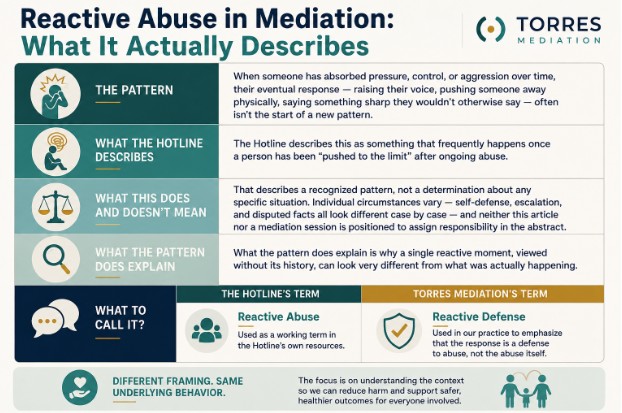
When someone has absorbed pressure, control, or aggression over time, their eventual response — raising their voice, pushing someone away physically, saying something sharp they wouldn’t otherwise say — often isn’t the start of a new pattern.
The Hotline describes this as something that frequently happens once a person has been “pushed to the limit” after ongoing abuse.
That describes a recognized pattern, not a determination about any specific situation. Individual circumstances vary — self-defense, escalation, and disputed facts all look different case by case — and neither this article nor a mediation session is positioned to assign responsibility in the abstract.
What the pattern does explain is why a single reactive moment, viewed without its history, can look very different from what was actually happening.
Current literature doesn’t fully agree on what to call this. The Hotline’s own resources use “reactive abuse” as a working term.
Kim W. Torres’s practice uses “reactive defense” instead, on the reasoning that attaching the word “abuse” to the victim’s response can sound like it’s assigning blame there rather than to the pattern that caused it. Same underlying behavior, different framing about where responsibility sits.
If you’re ready to get started, call us now!
A person who’s genuinely afraid doesn’t always look afraid. Someone who has finally reached a safe, structured environment—a mediation session with a neutral third party present—may let out frustration they’ve been holding back, precisely because it finally feels safe enough to do so.
To an observer without context, that can look like the aggressor in the room, while the calmer party looks reasonable by comparison.
Demeanor in a single session is a poor substitute for pattern over time. A person’s tone in one conversation says very little about who has actually been controlling the relationship — but tone is often exactly what an untrained observer weighs most heavily.
The same dynamic that gets misread can also be used deliberately. Domestic violence advocacy organizations, including the National Network to End Domestic Violence, note that abusers frequently present as charming and reasonable rather than as the person others might expect.
Some documented accounts describe an abuser responding to a domestic violence report by presenting calmly while describing the victim’s defensive reaction as the actual aggression — arriving composed, controlling the room, and framing their partner as the one with the real problem.
This is exactly why a mediator’s job isn’t to render a verdict on who’s the “real” abuser based on how someone comes across in a single session. It’s to stay alert to the broader pattern and keep both people safe enough to participate meaningfully.
If you’re ready to get started, call us now!
A related pattern shows up specifically in custody disputes. One parent sometimes points to the other’s past reactive moment—a raised voice, a defensive outburst during a difficult period—as a reason to limit or withhold contact with a child going forward, without an ongoing safety concern to justify it.
Kim W. Torres uses the term “parental alienation” descriptively for this pattern in her own practice; the term itself is genuinely contested in family law and psychology and isn’t a settled clinical diagnosis.
Under § 61.13(2)(c), Florida Statutes, it’s the state’s stated public policy that a child have frequent and continuing contact with both parents after a separation.
Domestic violence is one of the specific factors a court weighs under § 61.13(3)(m) when deciding what’s in a child’s best interest — but it’s weighed as part of a broader picture, not treated as an automatic bar triggered by a single past incident.
Kim W. Torres puts it plainly: even parents who haven’t handled everything well still generally get to see their children.
That’s not a dismissal of real safety concerns — a documented, ongoing risk genuinely can limit or supervise contact under Florida law. It’s pushback against using one difficult moment from the past as a blanket excuse.
A mediator isn’t investigating who started what, and mediation isn’t the forum for proving a case.
Florida requires family and dependency mediators to complete ongoing interpersonal-violence training as part of certification — four hours every two-year renewal cycle, per the Florida Dispute Resolution Center’s continuing education requirements — which shapes how a mediator approaches a session where this dynamic might be present.
In practice, that means watching the broader pattern across a session rather than one heated moment, and using tools like private caucus to hear each person separately, away from whatever dynamic may be distorting how they’re presenting jointly.
If the environment doesn’t feel safe or balanced enough for both people to participate meaningfully, that’s a signal to adjust the process — not a verdict on either person’s character.
What is reactive abuse?
Reactive abuse describes a defensive or aggressive response from someone who has been abused — yelling back, pushing an abuser away, or lashing out after being pushed past a limit. The National Domestic Violence Hotline describes this as common once a victim reaches that limit.
Why do some practitioners prefer the term “reactive defense” over “reactive abuse”?
Some practitioners, including Kim W. Torres, use “reactive defense” instead, since “reactive abuse” can sound like it labels the victim’s response as its own abuse. The behavior is the same either way — the difference is which term frames who’s responsible for the pattern.
Can a mediator tell who the “real” victim is in a high-conflict session?
No, and that’s not the mediator’s role. A mediator isn’t a judge or investigator and doesn’t rule on who’s “really” the abuser. The job is assessing whether the session is safe and balanced enough for both people to participate meaningfully and decide for themselves.
Is it common for an actual abuser to claim they were the one being abused?
It’s a recognized risk. Advocacy resources, including the National Network to End Domestic Violence, note that abusers can present as calm and charming, and some DV accounts describe an abuser appearing composed while describing the victim’s defensive reaction as the real aggression.
What is parental alienation, and how does it relate to reactive abuse?
The term describes one parent working to damage a child’s relationship with the other without a legitimate safety reason. It’s contested in family law and isn’t a settled diagnosis — Kim W. Torres uses it descriptively for a pattern she sees, not a formal label.
Can a parent withhold a child because of the other parent’s past behavior?
Not automatically. Florida Statute 61.13 sets a policy of frequent contact with both parents, and domestic violence is one factor among several a court weighs — not an automatic bar tied to one incident. An ongoing safety concern carries more weight than past conflict alone.
Does looking calm and reasonable mean someone isn’t the abusive one?
No. Someone who appears composed and reasonable isn’t automatically the party telling the full story, and someone who appears upset or defensive isn’t automatically the one at fault. Demeanor in a session reflects many things, including stress and safety, not just accuracy.
What does a mediator actually do if reactive abuse might be happening?
The mediator watches the broader pattern rather than one moment, and can use private caucus to hear each side separately. Florida requires family mediators to complete ongoing interpersonal-violence training as part of certification, which shapes how sessions like this get handled.
Is “even bad parents get to see their children” always true?
It reflects Florida’s general policy under Section 61.13 — both parents typically remain part of a child’s life, and a past incident alone isn’t automatic grounds to withhold contact. It’s not absolute — a genuine, documented safety concern can still limit or supervise access.
Should you bring up past incidents during mediation caucus?
It can help, particularly in private caucus without the other party present. What matters most is describing what actually happened rather than trying to convince the mediator who the “real” abuser is, since that determination isn’t the mediator’s role.
Reactive abuse — or reactive defense, the term Kim W. Torres and others prefer — describes a victim’s response to sustained pressure, a pattern the National Domestic Violence Hotline recognizes by name.
It gets misread easily, both by outside observers and, per domestic violence advocacy sources, sometimes deliberately by the person who caused the original pressure.
A mediator’s role isn’t to decide who’s the “real” abuser; it’s to keep the process safe and balanced enough for both people to participate meaningfully, informed by Florida’s required interpersonal-violence training for family mediators.
The same caution applies to custody decisions: under Florida Statute § 61.13, a single past moment of defensive behavior isn’t, on its own, grounds to withhold a child from a parent absent a genuine ongoing safety concern.
If this dynamic sounds familiar in your own situation, schedule a confidential consultation with Kim W. Torres to talk through what mediation can look like for you.
Kim W. Torres, Esq. is a Florida Supreme Court Certified Mediator in Circuit Civil, Family, County Court, and Appellate matters and a member of The Florida Bar since 1985. Practicing exclusively as a mediator since 2000, she has resolved more than 2,000 cases — from complex multi-party disputes to high-emotion matters with self-represented parties. A past Chair of the Florida Bar’s ADR Section and Brevard County’s Circuit Civil Mediator of the Year, Kim mediates throughout Florida, in person and virtually.