

Originally published: July 2024 | Updated: August 2026
Florida caps retroactive child support at 24 months before the date a parent files the initial petition, under Florida Statutes § 61.30(17).
The cap applies regardless of how long the parents actually lived apart, and courts apply the same income-sharing guidelines used for ongoing support. While looking at the actual income ratio and timesharing during the retroactive period.
Kim Torres, a Florida Supreme Court Certified Mediator with Torres Mediation’s family mediation practice in Melbourne, Florida, guides parents through retroactive support claims and the required documentation.
Struggling to recover costs you covered alone before a support order existed? Contact Kim Torres to build a documented retroactive support claim.
Florida law limits recoverable retroactive child support to a maximum of 24 months immediately preceding the filing date of the petition, under Florida Statutes § 61.30(17). The 24-month limit applies regardless of how long the parents actually lived apart before the petition was filed.
A parent who separated from the other parent in 2020 but files a petition in 2026 can recover support back only to 2024, not 2020. Florida courts apply the state’s child support guidelines schedule to the retroactive period the same way they apply it to ongoing monthly obligations, using both parents’ income during that period.
Florida Statutes § 61.30(17) also requires the court to credit any payments the obligor already made directly to the other parent, the child, or third parties for the child’s benefit during the retroactive period — including medical bills, childcare, and school costs.
| Feature | Retroactive Child Support | Child Support Arrears |
|---|---|---|
| When it applies | Covers the period before any support order existed | Covers missed payments after a support order was already in place |
| Maximum recoverable period | Capped at 24 months before the petition filing date (F.S. § 61.30(17)) | No statutory cap — accrues for as long as payments go unmade |
| How it’s pursued | Requested as part of the initial child support petition | Collected through enforcement of an existing order |
| Who can seek it | The custodial parent who covered the child’s expenses during that period | The parent owed payments under the existing order |
The 24-month cap balances a custodial parent’s right to reimbursement against a paying parent’s exposure to years of open-ended liability, calculated based on old income and circumstances. Florida added the limitation to Florida Statutes § 61.30 to set a predictable outer boundary on retroactive claims.
Before Florida limited retroactive awards, a parent could wait years — even until a child neared adulthood — before filing a petition and then seek reimbursement for the entire period the other parent contributed nothing.
That structure left paying parents exposed to support obligations calculated on income and circumstances that might no longer reflect their situation, with evidence that had often gone stale. The 24-month cap in Florida Statutes § 61.30(17) removes that open-ended exposure regardless of when the parents’ separation actually occurred.
Consider two parents who separated in January 2022 without a formal support order. If the custodial parent files a retroactive child support petition in August 2026, Florida Statutes § 61.30(17) limits the recoverable period to the 24 months immediately before the filing date — August 2024 through August 2026.
The roughly two and a half years between the January 2022 separation and August 2024 fall outside the statutory window and cannot be recovered, even though the custodial parent covered those costs alone.
If you’re ready to get started, call us now!
Only the custodial parent who provided for the child’s daily needs during the retroactive period may file for reimbursement in Florida. The requesting parent must show that the child lived with them and that they covered the costs of food, shelter, and clothing without any contribution from the other parent.
Florida Statutes § 61.30(17) allows a retroactive award in three types of proceedings: a paternity action, a dissolution of marriage action, or a petition for support filed during an existing marriage.
This requirement often surfaces alongside establishing paternity through a separate petition, since a support order cannot be entered until legal parentage is confirmed.
Courts also review the non-custodial parent’s financial situation during the retroactive window, and disputes over who covered which expenses frequently arise from unresolved co-parenting disagreements predating the formal filing.
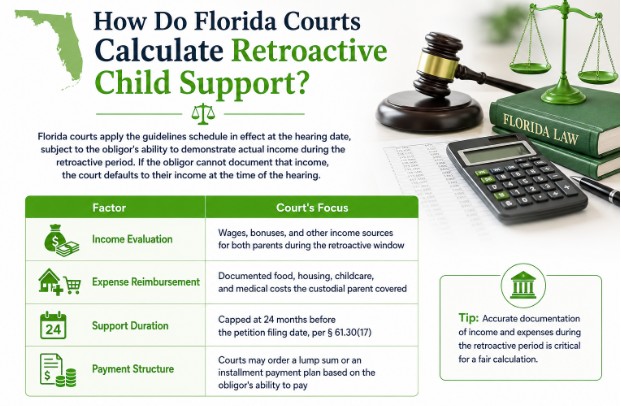
Florida courts apply the guidelines schedule in effect at the hearing date to the retroactive period, based on the obligor’s actual income during that period under Florida Statutes § 61.30(17)(a).
If the obligor cannot document that income, the court defaults to the obligor’s income at the time of the hearing.
If the paying parent was voluntarily unemployed or underemployed during the retroactive period, the court may impute income based on the parent’s recent work history, occupational qualifications, and the prevailing earnings level in the community, under Florida Statutes § 61.30(2)(b).
Florida Statutes § 61.30(17)(b) requires the court to credit all actual payments the obligor already made to the other parent, the child, or third parties for the child’s benefit throughout the retroactive period.
Florida Statutes § 61.30(17)(c) directs the court to consider an installment payment plan for the retroactive award.
Documentation carries significant weight in this calculation. Accurate income documentation, along with receipts, bank statements, and medical bills from the retroactive period, gives the court a factual basis for the award rather than relying on estimates.
Receipts and canceled checks tend to carry more weight than reconstructed estimates, since they tie a specific dollar amount to a specific date within the retroactive period.
Not sure how much you’re owed in retroactive support? Kim Torres can review your documentation and discuss divorce mediation or a direct petition.
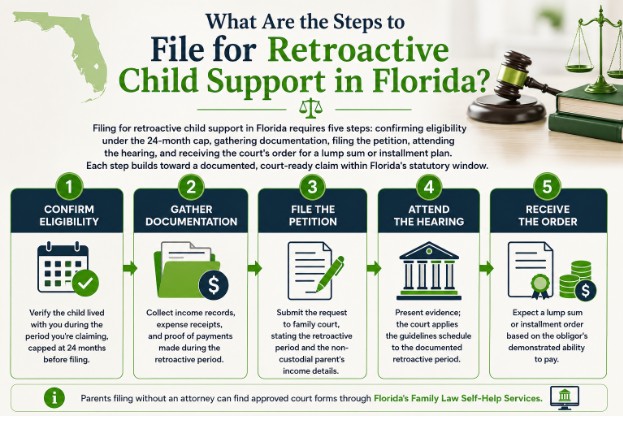
Filing for retroactive child support in Florida requires five steps: confirming eligibility under the 24-month cap, gathering documentation, filing the petition, attending the hearing, and receiving the court’s order for a lump sum or installment plan.
1. Confirm eligibility — Verify the child lived with the requesting parent during the period being claimed, capped at 24 months before filing.
2. Gather documentation — Collect income records, expense receipts (including medical and childcare costs), and proof of any payments already made during the retroactive period.
3. File the petition — Submit the request to family court, stating the retroactive period and the non-custodial parent’s income details.
4. Attend the hearing — Present evidence; the court applies the guidelines schedule to the documented retroactive period.
5. Receive the order — Expect a lump sum or installment order based on the obligor’s demonstrated ability to pay.
Parents filing without an attorney can find approved court forms through Florida’s Family Law Self-Help Services.
Many parents resolve contested amounts before the hearing through a custody mediation session, which narrows the issues a judge ultimately has to decide.
If you’re ready to get started, call us now!
Once a Florida court enters a retroactive support order, it carries the same enforcement weight as any other Florida child support order. The Florida Department of Revenue’s Child Support Program and the circuit courts share responsibility for its collection.
The Florida Department of Revenue Child Support Program can pursue wage garnishment, federal tax refund interception, and driver’s license suspension without a new court hearing in most cases.
Florida Statutes § 61.13016 authorizes suspension of a license once an obligor fails to respond to a delinquency notice. This agency handles the bulk of child support enforcement statewide, including amounts tied to retroactive orders.
If administrative tools don’t resolve the delinquency, the custodial parent can file a motion for civil contempt under Florida Statutes § 61.14.
Florida Statutes § 61.14(5)(a) creates a presumption that the obligor has the present ability to pay, shifting the burden to the obligor to prove otherwise at the contempt hearing.
Under Bowen v. Bowen, 471 So. 2d 1274 (Fla. 1985), a judge cannot jail a parent for civil contempt without first finding the parent has the present ability to pay the purge amount the court sets.
| Enforcement Tool | Handled By | New Court Hearing Required? |
|---|---|---|
| Income withholding order | Florida Department of Revenue Child Support Program | No |
| Driver’s license suspension | Florida Department of Revenue Child Support Program (F.S. § 61.13016) | No, unless the obligor petitions to contest it |
| Federal tax refund interception | Florida Department of Revenue Child Support Program | No |
| Civil contempt/purge order | Circuit court judge | Yes |
Retroactive support disputes often involve disagreements over documentation, income, and timing that a judge would otherwise have to sort out at a contested hearing. Mediation gives both parents a structured, private setting to work through those disagreements with a neutral mediator instead.
A family mediation session lets parents negotiate the retroactive amount and payment structure directly, outside a contested courtroom process.
Parents can reach an agreement on the retroactive amount through mediation, but the court must still review and approve it, and the agreed amount cannot exceed the 24-month statutory cap.
Parents with questions about the broader process can review common concerns on Torres Mediation’s FAQ page before their first session.
How is retroactive child support calculated in Florida?
Florida courts apply the state’s income-shares guidelines to the retroactive period, using both parents’ documented income during that time under Florida Statutes § 61.30(17)(a). If the paying parent cannot demonstrate actual income for that period, the court uses their income as of the hearing date instead. Or may impute income at least at minimum wage.
How far back can retroactive child support go in Florida?
Florida Statutes § 61.30(17) caps retroactive child support at 24 months before the date the initial petition is filed. This cap applies even if the parents separated years earlier — the enforceable maximum never exceeds two years of back support regardless of the separation date.
Who can request retroactive child support in Florida?
In Florida, only the custodial parent who covered the child’s living expenses during the retroactive period can request reimbursement. They must show the child lived with them and that they paid for food, shelter, and clothing without help from the other parent.
What if the custodial parent doesn’t need child support?
The obligation to pay child support is not need-based. One parent’s larger income is considered in the child support amount that is calculated, and may cause the child support obligation of the other parent to be reduced by an amount that eliminates the child support payment. However, child support is based on the incomes and timesharing of the two parents, not on other household expenses, or on the income supplements from others in the household. Make reference to the FS that covers the factors that can be considered in establishing child support.
Does retroactive support apply in both divorce and paternity cases?
Yes. Florida Statutes § 61.30(17) allows a retroactive award in a paternity action, a dissolution of marriage action, or a petition for support filed during an existing marriage. The same 24-month cap and calculation method apply no matter which proceeding brings the request.
What if a parent did not know of the existence of the child, or if the other parent hasn’t allowed the parent to see the child? Does the parent still have to pay retroactive child support? The obligation for child support is owed to the child, not to the other parent. While the court may consider blatant circumstances of refusal to allow a parent to have contact with the child, the obligation to support the child generally still exists, regardless of whether knowledge or contact has been established.
Can retroactive child support be awarded after the child turns 18?
Yes. Florida courts can order retroactive support even after a child reaches 18, provided the petition was filed while the child was still a minor. The award covers expenses incurred during the retroactive period while the child was under 18.
Will child support automatically end when the child turns 18 years? Child support terminates when the child reaches 18 years of age, or upon graduation from high school if the child graduates before she turns 19 years of age. The obligation for child support will also end when a child marries, enters military service or is declared emancipated.
What happens if the paying parent was unemployed during the retroactive period?
If the paying parent was voluntarily unemployed or underemployed, Florida courts may impute income based on recent work history and earning capacity under Florida Statutes § 61.30(2)(b). If actual income cannot be documented, the court defaults to the parent’s income at the hearing or imputes income during that period at minimum wage.
Is a parent still obligated to pay child support if they are in jail?
If child support has been ordered by the court, the obligation continues even while a parent is in jail. The incarcerated parent needs to file a timely petition to modify child support for a change to be made.
Is there a child support obligation if the parents are exercising equal timesharing? It depends. If the income levels of each parent is almost the same, then there is probably no child support obligation. If one parent makes considerably more in income than the other parent, there is likely a child support obligation to be paid by the higher-earning parent.
Can parents agree to a different retroactive support amount instead of going to court?
Yes. Parents can negotiate a retroactive support amount through mediation or direct agreement, but a judge must still review and approve the settlement. The agreed amount cannot exceed the 24-month cap under Florida Statutes § 61.30(17), even when both parents consent to a different figure. Past-due child support amounts can be negotiated, with court overview. The courts are more concerned with supporting the child’s needs going forward, than for sustaining child support for the past.
What happens if the other parent won’t pay retroactive child support?
The Florida Child Support Program can pursue wage garnishment, tax refund interception, and license suspension administratively, without a new court hearing. If those tools fail, the custodial parent can file a motion for contempt, which may result in additional court-ordered remedies.
Can retroactive child support be paid in installments?
Yes. Florida Statutes § 61.30(17)(c) directs courts to consider an installment payment plan when a lump-sum payment would create financial hardship for the paying parent. The court weighs the obligor’s income and expenses before deciding whether to order a single payment or a structured schedule.
How can retroactive child support or arrearages be paid if the payor can’t afford additional payments over the current child support obligation?
Sometimes past due child support payments can begin, or be extended, beyond the term for the current child support obligation. If child support stops when the child graduates from high school, payments for the past due child support can continue to be made, either at a reduced amount or at the full amount of the established child support obligation until the retroactive or arrears balance is paid in full..
Is retroactive child support the same as child support arrears?
No. Retroactive support covers the period before any order existed and is capped at 24 months under Florida Statutes § 61.30(17). Arrears are unpaid amounts that accumulate after a support order is already in place, and Florida law places no statutory cap on how much can accrue.
What documents do I need to request retroactive child support?
Florida courts typically require income records, receipts for child-related expenses — including medical, childcare, and school costs — and proof of any payments already made during the retroactive period. Thorough documentation strengthens the request and gives the court a clear factual basis for the award.
Can a parent get credit for all of the money and purchase of items that have been given to the parent?
Not all expenses, cash assistance, or purchase of supplies can count as being made instead of child support. Child support does not cover every expense of a child, and parents are expected to also buy clothes and cover regular expenditures. When requesting credit for any in-kind or direct cash contributions, the requesting parent should document the transfer of money and purchases to the other parent, and indicate on a receipt that it is for the support of the child.
What if I have overpaid in supporting the child before the court actually ordered child support?
Credit can be given to a parent who has exceeded their legal child support obligation. The payments need to be documented in amount, purpose, and receipt by the other parent. It is best to make some contributions to the other parent and sort out the credits later when the actual amount of the child support obligation is established.
Does establishing paternity affect a retroactive child support claim?
Yes. In Florida, a support order cannot be entered until legal paternity is confirmed, so retroactive claims often follow a paternity determination. Once paternity is established, the retroactive period is still measured back from the petition filing date, not the child’s birth date.
When does the obligation for child support start?
When the parents no longer live in the same household, the obligation for child support begins. If this date is beyond 24 months before the date of filing, the legal responsibility will be limited to 24 months.
If a parent now has other children to support, do they still have to pay retroactive child support?
Existing court orders to pay child support will be considered when determining a parent’s available income to calculate a current child support obligation. The question is whether the prior child support is actually being paid. Supporting children who were born more recently usually does not allow a child support obligation to be reduced or eliminated. However, having additional children may be considered if a request to increase an existing child support obligation is made.
Florida caps retroactive child support at 24 months before the petition filing date, no matter when the parents separated. Only the custodial parent who covered the child’s costs during that period may request it, and the amount is calculated using the same income-shares guidelines as those applied to ongoing support.
Documentation of income and expenses during the retroactive period determines how much a court is willing to award.
Ready to resolve your retroactive child support dispute without a courtroom battle? Schedule a confidential consultation with Kim Torres today to get started.
Kim W. Torres, Esq. is a Florida Supreme Court Certified Mediator in Circuit Civil, Family, County Court, and Appellate matters and a member of The Florida Bar since 1985. Practicing exclusively as a mediator since 2000, she has resolved more than 2,000 cases — from complex multi-party disputes to high-emotion matters with self-represented parties. A past Chair of the Florida Bar’s ADR Section and Brevard County’s Circuit Civil Mediator of the Year, Kim mediates throughout Florida, in person and virtually.