

Originally published: August 2026
Composite scenario. The situation described below is a composite drawn from inquiries Torres Mediation receives from Florida homeowners. It is not an account of any specific client matter, and no identifying details of any actual inquiry appear here.
A homeowner in a Florida community sends the association a written request by certified mail, return receipt requested, asking for the prior fiscal year’s audited financial report. Weeks pass.
Nothing arrives — not the report, not a denial, not an acknowledgment. This kind of dispute falls squarely within HOA financial disclosure disputes, one of the more common categories Torres Mediation handles, and it’s the kind of conflict community association mediation is specifically built to resolve.
The homeowner then calls the CPA firm directly and learns something the association never disclosed: the firm was engaged in mid-January to perform the audit, and it has requested supporting documents from the community’s property management company on three separate occasions. Each time, the documents were not provided.
So the homeowner is now facing a problem different from the one he thought he had. He assumed the association was sitting on a finished report and refusing to hand it over.
The more likely explanation is that the report was never finished because the CPA could not obtain what it needed to complete it. That distinction changes everything about what comes next.
Two different subsections are at work here, and homeowners routinely cite the wrong one.
Section 720.303(7), Florida Statutes, requires an association to prepare and complete the financial report for the preceding fiscal year within 90 days after the end of that fiscal year, or annually on the date provided in the bylaws.
Within 21 days after the report is completed — but no later than 120 days after the end of the fiscal year — the association must give each member either a copy of the report or written notice that a copy is available on request at no charge.
For an association whose fiscal year is the calendar year, that 120-day outside date falls on April 30. Associations using a different fiscal year, or a date set in their bylaws, will have a different deadline. Check the bylaws before relying on any date.
What kind of report is required depends on the association’s size:
| Association’s total annual revenue | Required financial report |
| Less than $150,000 | Report of cash receipts and expenditures |
| $150,000 to less than $300,000 | Compiled financial statements |
| $300,000 to less than $500,000 | Reviewed financial statements |
| $500,000 or more | Audited financial statements |
| Any association with 1,000 or more parcels | Audited financial statements, regardless of revenue |
Under Section 720.303(4)(b), an association with 100 or more parcels must post the financial report on its website or mobile application. If your community is that size, the report should be available to you there without any request.
Section 720.303(5)(a), Florida Statutes, requires the association to make its official records available to a parcel owner for inspection or copying within 10 business days after the board or its designee receives a written request.
Section 720.303(5)(b), Florida Statutes, treats a missed 10-business-day deadline as presumptively willful noncompliance — but only when the homeowner sent the request by certified mail with return receipt requested. That presumption is rebuttable, meaning the association can still contest it.
Section 720.303(5)(c) then sets the financial consequence: a minimum of $50 in damages for each calendar day the association is late, capped at 10 days and $500 total.
The association may not ask why you want the records. Section 720.303(5)(g) prohibits requiring a parcel owner to state a purpose or reason for an inspection.
If you’re ready to get started, call us now!
Section 720.303(5) is a production statute. It obligates an association to make its existing records available. It does not, by its terms, obligate an association to create a document it never completed.
If the audit was never completed — because the CPA could not obtain the underlying records — then a records demand under Section 720.303(5) targets a document that does not exist. The homeowner can be entirely right on the law and still receive nothing, because there is nothing to receive.
That is why the two subsections need to be understood separately, as two distinct causes of action:
The remedies differ for each. A refusal to hand over a finished audit is enforceable through a Section 720.303(5) records demand, backed by the $50-per-day minimum damages remedy under Section 720.303(5)(c). A missing audit cannot be forced through a records demand, since there is no finished document to produce — the practical fix is getting the CPA the documents it needs, exactly the three-way coordination problem county court mediation for community association disputes is designed to solve.
For a records-access dispute, yes. Section 720.311(2)(a), Florida Statutes, lists access to the official records of the association among the categories of dispute that must be the subject of a demand for pre-suit mediation before the dispute is filed in court. This is not a suggestion — it’s a precondition.
A homeowner who skips it and files suit faces dismissal or a stay, and a party who refuses to participate is barred from recovering fees and costs in the subsequent litigation.
The requirement remains in effect and was recently reconsidered by the Legislature. House Bill 657 (2026), which would have eliminated presuit mediation for community associations statewide, passed the Florida House on March 5, 2026, by a vote of 108 to 2 and then died in Senate Rules on March 13, 2026, when the session adjourned. As of July 2026, Section 720.311 stands as written.
A mediator does not validate or “bless” a party’s facts. The parties come to mediation as they are, and the mediator does not confirm what evidence is in place — questions about legal sufficiency or documentation are issues the parties discuss during the mediation itself.
The first step is identifying and contacting the appropriate parties to the mediation. The party requesting mediation handles this step, and the mediator then schedules and confirms the session with the identified parties.
Identifying what records exist happens during the mediation session, not before it. This is part of developing a plan to move forward — pinpointing what is needed and how to obtain it.
Establishing a contact person and method of communication between the parties is part of that plan.
The most common failure in a records dispute is a breakdown in communication — no one takes clear responsibility for following through on the request. The second most common failure involves the steps needed to create the missing documents and meet statutory requirements.
Because most HOA boards are volunteer-run, board composition changes regularly, and each new board faces a learning curve on the procedures and statutory provisions it must follow.
A dispute like this is not primarily about money. It is about information moving between three parties who have each been talking past the other two.
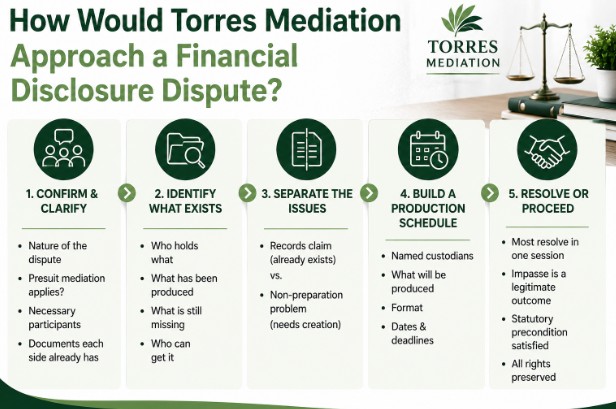
Kim W. Torres assists in assessing the nature of the dispute, whether presuit mediation applies, who the necessary participants are, and what documents each side already has, and confirms a time for all parties to meet, usually through virtual conferencing.
From there, during the mediation session, the process focuses on identifying who holds what — usually the step that breaks the deadlock — separating the records claim from the non-preparation problem, and building a document-production schedule with named custodians and dates rather than arguing toward a damages figure.
Most HOA disputes that reach the pre-suit mediation stage resolve in a single session. Some do not, and an impasse is a legitimate outcome — the homeowner has satisfied the statutory precondition and retains every right to proceed.
What does a mediator report after the mediation?
At the end of the mediation session, the mediator prepares a Mediation Report and provides a copy to each party. The report indicates whether a resolution was reached or no agreement could be obtained; partial outcomes are also possible and can be reported. Due to the confidentiality of the mediation, the report does not identify the terms of the outcome unless both parties agree, and it does not note what arguments were made or what position anyone took.
Because the matter has not been filed in court as a pre-suit process, there is no court file to include the Mediation Report in, so the court is not notified of any outcome or that mediation took place. The parties retain the Mediation Report as evidence of compliance with the statutory mediation requirement if a party later proceeds with a lawsuit.
A mediator is a neutral facilitator, not an advocate and not anyone’s lawyer. Torres Mediation will not advise you on whether your association violated the statute, calculate damages, draft your pre-suit mediation demand, represent your interests, or decide the dispute.
A mediator also will not collect documentation or validate any evidence that either party wishes to present. If there is a question of complete or legally sufficient documentation, that will be discussed at the mediation as one of the disagreements between the parties.
If you need any of that, you need a Florida attorney experienced in community association law. If you suspect funds have been misappropriated, mediation is the wrong first call — speak with an attorney.
While hiring a lawyer is not necessary to participate in mediation, consulting legal counsel is advisable to ensure that a party presents their strongest argument and does not expect unrealistic outcomes.
Legal counsel can be consulted either prior to a mediation for preparation, or after the mediation before signing an agreement. Community Association law is a specialty with provisions that interrelate. It is important that the hired lawyer is well-versed in this area of practice.
If you’re ready to get started, call us now!
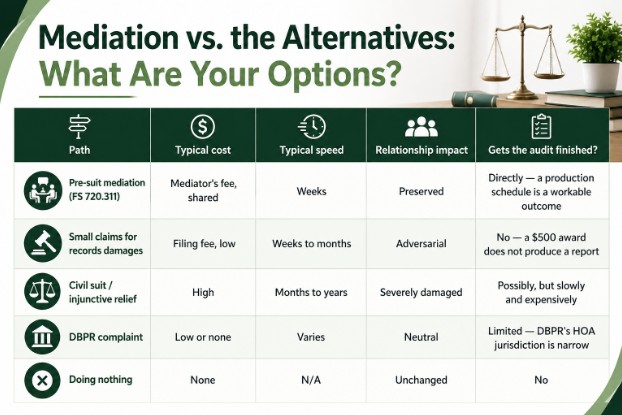
| Path | Typical cost | Typical speed | Relationship impact | Gets the audit finished? |
| Pre-suit mediation (FS 720.311) | Mediator’s fee, shared | Weeks | Preserved | Directly — a production schedule is a workable outcome |
| Small claims for records damages | Filing fee, low | Weeks to months | Adversarial | No — a $500 award does not produce a report |
| Civil suit / injunctive relief | High | Months to years | Severely damaged | Possibly, but slowly and expensively |
| DBPR complaint | Low or none | Varies | Neutral | Limited — DBPR’s HOA jurisdiction is narrow |
| Doing nothing | None | N/A | Unchanged | No |
Time is a Significant Factor to consider: Delay can escalate tensions and prolong the dispute. Unresolved HOA disputes carry costs beyond the immediate dispute — drawn-out conflicts between homeowners and boards can strain a community and, in visible cases, affect property values across the neighborhood.
Addressing the problems immediately and formulating a plan to avoid them in the future has tremendous value beyond fixing the problem itself.
That’s part of why the statute pushes these disputes toward mediation before litigation rather than after.
Based on Kim Torres’s experience, more matters are resolved through mediation than through court processes.
Mediation works:
My HOA won’t give me the financial report. What can I do in Florida?
Send a written request by certified mail, return receipt requested, under Section 720.303(5)(a), Florida Statutes; the association has 10 business days to provide access. If it does not, you may be entitled to minimum damages of $50 per day up to $500, and a records dispute must go to pre-suit mediation before court.
How long does a Florida HOA have to provide the annual financial report?
Section 720.303(7) requires the report to be prepared within 90 days after fiscal year end, and delivered to members — or notice of availability sent — within 21 days of completion but no later than 120 days after fiscal year end. For a calendar fiscal year, that outside date is April 30.
What is the penalty if my HOA doesn’t provide records in 10 days?
Under Section 720.303(5)(c), Florida Statutes, the clock on minimum damages starts on the 11th business day after the association receives your request — from there, the association owes $50 for each calendar day it stays noncompliant, up to 10 days, for a $500 ceiling. Beyond that statutory minimum, you may also be able to recover actual damages if you can show them.
Does every Florida HOA have to get an audit?
No. Under Section 720.303(7)(a), audited financial statements are required only when total annual revenue is $500,000 or more, or when the association has 1,000 or more parcels. Smaller associations owe reviewed statements, compiled statements, or a report of cash receipts and expenditures.
Can I file a complaint with the DBPR against my HOA for withholding records?
No. DBPR’s own guidance confirms the Division of Florida Condominiums, Timeshares, and Mobile Homes has no statutory authority to investigate complaints against homeowners’ associations under Chapter 720 — that authority applies to condominiums under Chapter 718 instead. An HOA records dispute routes to pre-suit mediation under Section 720.311.
Do I have to mediate before suing my HOA in Florida?
For most records disputes, yes. Section 720.311(2)(a) lists access to official records among the disputes requiring a demand for pre-suit mediation before filing in court. Refusing to participate bars you from recovering fees and costs in later litigation. Failing to follow the process can result in unnecessary delays and even dismissal of a suit that is filed.
What if the audit was never completed at all?
Then a records request cannot compel production of records that do not exist — Section 720.303(5) compels production of records that exist, not the creation of ones that do not. The failure would fall under Section 720.303(7) instead. Mediation is often more effective here, because a negotiated production schedule can actually get the audit finished.
Does my HOA have to tell me why I want to see records?
The reverse. Section 720.303(5)(g) prohibits an association from requiring a parcel owner to demonstrate a proper purpose or state any reason for an inspection, and it cannot limit your inspection rights to less than one eight-hour business day per month.
How much does HOA mediation cost in Florida?
Mediator fees for HOA disputes typically run $300 to $500 per hour, often with a two- to four-hour minimum, split equally between the parties regardless of how many people attend. Payment is due at the session, or the minimum charge is due beforehand.
Do I need a lawyer for a mediation with a community association?
No. Florida law doesn’t require legal representation to participate in mediation. If mediation is unsuccessful, a homeowner may then hire an attorney to pursue litigation. Consulting a lawyer before signing any settlement agreement can still help a homeowner present a stronger case.
Is a settlement reached at a pre-suit mediation enforceable?
Yes. A signed mediated settlement agreement is enforceable like any contract. If a related lawsuit is later filed, the agreement can be produced as evidence, and a court can adopt its terms as an order, giving it the same enforceability as any other court judgment.
Are the discussions and results of a pre-suit mediation confidential?
Yes. Under Chapter 44, Florida Statutes (the Mediation Confidentiality and Privilege Act, Section 44.405), mediation communications stay confidential and generally cannot be used in court. Settlement terms can also remain private between the homeowner and the board unless both parties agree to disclose them.
Do I have to identify the correct person to contact at the HOA?
No. The association must maintain a mailing address for records requests and other demands. Whichever board member is designated to respond will handle it — the homeowner doesn’t need to know that person’s name in advance.
How do I ask for a mediation?
Under Section 720.311, Florida Statutes, the homeowner serves the association with a written statutory demand for presuit mediation, using the form set out in the statute, naming the dispute and listing five certified mediators the homeowner proposes, and sends it by certified mail. The association then has 20 days to respond in writing, agree to one of the proposed mediators, and pay half the mediator’s fee — or the homeowner may proceed to file suit and seek those costs.
How do I find a mediator who is knowledgeable about community associations?
Look for a Florida Supreme Court certified mediator whose practice specifically covers Chapter 720 community association disputes, not just general civil mediation. Community association attorneys and property managers can often recommend one directly, and Florida’s Alternative Dispute Resolution program at flcourts.gov lists certification requirements as a starting point for verifying credentials. Because the statutory demand requires five proposed names, it helps to have several in hand in advance.
Should mediation be held in person or virtually, and is virtual mediation just as effective?
Either can work; it depends on what the parties agree to. Most mediators now default to virtual conferencing since it avoids the scheduling and space logistics of an in-person session. Florida court-program data shows settlement rates in virtual mediation match or exceed in-person sessions, partly because keeping parties in separate virtual rooms reduces the tension in-person proximity can create.
What can mediation accomplish that a lawsuit can’t?
Mediation lets both sides voluntarily agree to remedies a judge can’t order — a payment plan a court can’t force someone to actually pay, or a document-production schedule when no document currently exists. Because the outcome is voluntary rather than imposed, compliance with it tends to run higher than with a court judgment.
Official records — The documents an association must maintain under Section 720.303(4)(a), Florida Statutes, including financial and accounting records, tax returns, financial statements, contracts, minutes, and insurance policies.
Audited financial statements — Financial statements examined by a CPA who expresses an opinion on them. Required under Section 720.303(7)(a) when annual revenue reaches $500,000, or the association has 1,000 or more parcels.
Pre-suit mediation — The mandatory pre-litigation process under Chapter 720, Florida Statutes, for specified association disputes including access to official records.
Rebuttable presumption of willful failure — The legal effect under Section 720.303(5)(b) when an association does not provide access within 10 business days of a certified-mail records request.
Kim W. Torres, Esq. is a Florida Supreme Court Certified Mediator in Circuit Civil, Family, County Court, and Appellate matters, a member of The Florida Bar since 1985, and a past Chair of the Florida Bar’s ADR Section.
Practicing exclusively as a mediator since 2000, she has resolved thousands of disputes across Brevard, Orange, Seminole, and Indian River Counties and statewide across Florida, as well as HOA disputes in the Austin, Cedar Park, and Round Rock area of Central Texas.
Read what past clients have said in Torres Mediation’s testimonials, or browse the full FAQ page for more on how mediation works generally.
If you are a homeowner who cannot obtain financial records from your association, mediation may resolve matters in weeks that litigation would take a year to address.
Schedule a confidential consultation with Torres Mediation.
Torres Mediation provides neutral dispute resolution services. Kim W. Torres is a mediator, not your attorney, and nothing on this page is legal advice or creates a mediator-party relationship. For advice about your specific situation, consult a Florida attorney.
Kim W. Torres, Esq. is a Florida Supreme Court Certified Mediator in Circuit Civil, Family, County Court, and Appellate matters and a member of The Florida Bar since 1985. Practicing exclusively as a mediator since 2000, she has resolved more than 2,000 cases — from complex multi-party disputes to high-emotion matters with self-represented parties. A past Chair of the Florida Bar’s ADR Section and Brevard County’s Circuit Civil Mediator of the Year, Kim mediates throughout Florida, in person and virtually.