

Originally published: June 2026
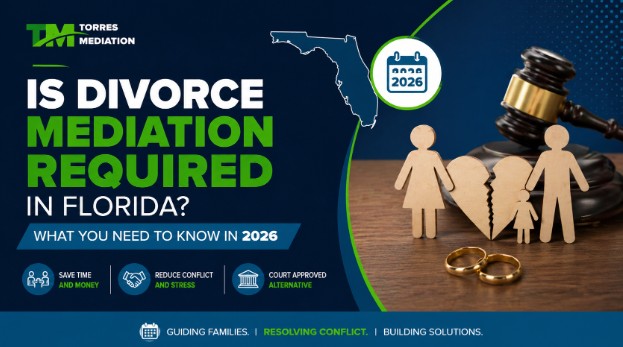
In Florida, divorce mediation is required in nearly every contested family law case before a judge will schedule a trial date, under Florida Family Law Rules of Procedure Rule 12.740.
Florida requires 6-month residency under Fla. Stat. § 61.021 and a 20-day minimum between filing and final judgment.
Private divorce mediation in Florida costs $3,000 to $8,000 total, split between the spouses, and most mediated divorces are resolved in 2 to 6 months.
Florida divorce mediation is required in every contested family law case under Rule 12.740 of the Florida Family Law Rules of Procedure. Every Florida judicial circuit applies this rule routinely — if either spouse contests property division, alimony, time-sharing, or child support, the court will order mediation before setting a trial date.
Uncontested divorces where both spouses have already signed a Marital Settlement Agreement skip mediation entirely and proceed directly to a brief final hearing. Outside of that narrow exception, contested divorces in Florida go through mediation. Judges may excuse mediation where documented domestic violence exists, but the default assumption is that contested cases mediate.
The practical effect of Rule 12.740 is that most Florida spouses who disagree on any divorce issue will attend at least one mediation session before they see a courtroom.
Understanding what that process involves — and what it costs — determines how efficiently a Florida divorce resolves.
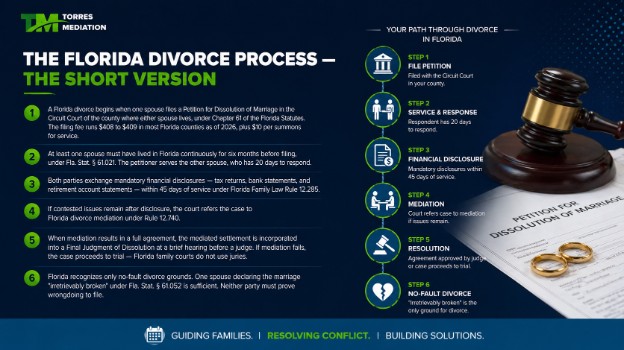
A Florida divorce begins when one spouse files a Petition for Dissolution of Marriage in the Circuit Court of the county where either spouse lives, under Chapter 61 of the Florida Statutes.
The filing fee runs $408 to $409 in most Florida counties as of 2026, plus $10 per summons for service.
At least one spouse must have lived in Florida continuously for six months before filing, under Fla. Stat. § 61.021. The petitioner serves the other spouse, who has 20 days to respond.
Both parties exchange mandatory financial disclosures — tax returns, bank statements, and retirement account statements — within 45 days of service under Florida Family Law Rule 12.285.
If contested issues remain after disclosure, the court refers the case to Florida divorce mediation under Rule 12.740.
When mediation results in a full agreement, the mediated settlement is incorporated into a Final Judgment of Dissolution at a brief hearing before a judge. If mediation fails, the case proceeds to trial — Florida family courts do not use juries.
Florida recognizes only no-fault divorce grounds. One spouse declaring the marriage “irretrievably broken” under Fla. Stat. § 61.052 is sufficient. Neither party must prove wrongdoing to file.
If you’re ready to get started, call us now!
Private divorce mediation in Florida costs $3,000 to $8,000 total for a typical case, split equally between both spouses. Florida Supreme Court Certified Family Mediators charge $200 to $400 per hour, with most experienced mediators in the $250 to $350 range.
Most Florida divorce mediations require 4 to 10 hours of session time, spread across 2 to 4 sessions.
| Cost Factor | Range |
| Mediator hourly rate | $200 to $400 per hour |
| Typical session hours | 4 to 10 hours |
| Total mediation cost (private) | $3,000 to $8,000 split |
| Court-connected mediation | $60 to $120 per hour |
| Fully litigated divorce (per spouse) | $15,000 to $50,000+ |
Florida also operates a court-connected family mediation program through the Florida Courts system that charges based on combined household income. Families earning under $50,000 annually pay as little as $60 per hour. Higher-income households pay up to approximately $120 per hour.
Every Florida judicial circuit runs its own variation of this program, and some counties require parties to attempt court-connected mediation before engaging a private mediator.
Compare those figures to full litigation. Contested Florida divorces typically cost $15,000 to $30,000 per spouse, and high-asset or high-conflict cases routinely exceed $50,000 per spouse. Mediation is consistently 60 to 80 percent cheaper than litigation for comparable cases.
Florida imposes no lengthy mandatory waiting period — only a 20-day minimum between filing and final judgment. A cooperative couple who engages a mediator early in the process can finalize a Florida divorce in 60 to 90 days. Scheduling a first mediation session early in the case is the highest-leverage move to reduce the total timeline.
| Divorce Path | Typical Timeline |
| Uncontested (no mediation needed) | 30 to 60 days |
| Mediated divorce, straightforward issues | 2 to 4 months |
| Mediated divorce, complex finances, or custody | 4 to 8 months |
| Fully litigated divorce | 12 to 24 months |
Most mediated Florida divorces resolve in 2 to 6 months total from filing to final judgment. Contested cases involving business valuations, real estate appraisals, or parenting plan disputes can require multiple mediation sessions and stretch to 6 to 12 months.
A fully litigated Florida divorce that proceeds to trial typically takes 12 to 24 months in most circuits.
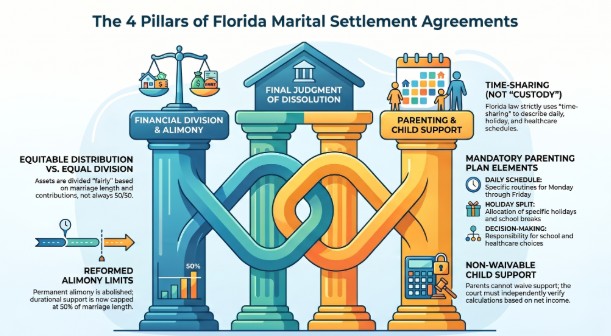
Florida courts require a complete Marital Settlement Agreement before a judge enters a Final Judgment of Dissolution. Mediation must resolve every contested issue the court needs to sign off on.
Florida is an equitable distribution state under Fla. Stat. § 61.075. Marital property divides “fairly,” starting from a presumption of equal division but adjusted for factors including length of marriage, each spouse’s contributions, and dissipation of assets. Equitable does not automatically mean equal.
Florida recognizes bridge-the-gap, rehabilitative, durational, and permanent alimony for long-duration marriages. The 2023 amendments to Fla. Stat. § 61.08 eliminated permanent alimony for new petitions filed after July 1, 2023, and capped durational alimony at 50 percent of the marriage length for marriages under 20 years.
Florida uses the term time-sharing rather than “custody” under Fla. Stat. § 61.13. Every Florida parenting plan must address daily schedule, holidays, school decisions, and healthcare decisions.
Agreements that use the word “custody” instead of “time-sharing” may be returned to the court for revision.
Florida calculates child support under the Florida Child Support Guidelines at Fla. Stat. § 61.30, based on both parents’ net incomes and the time-sharing split. Parties cannot waive child support in mediation — the court reviews the child support calculation independently.
Three rules make Florida divorce mediation materially different from most other states.
Florida operates the most structured family mediator certification program in the country. Certification requires a defined number of supervised mediations, training hours, and ongoing continuing education. Consumers can verify any mediator’s certification status directly on the Florida Courts mediator search.
An attorney who holds Florida Supreme Court family mediator certification is the strongest option for cases involving complex marital estates or disputed business valuations.
The Florida legislature eliminated the word “custody” from family statutes in 2008. Every mediated parenting plan must use the statutory terminology — parental responsibility and time-sharing — or risk a revision request from the court.
Writers of Marital Settlement Agreements who rely on generic national templates frequently produce documents that the Florida court system flags for correction.
Florida does not recognize legal separation as a distinct legal status, unlike many other states. Spouses who want to formalize financial separation without divorcing use a post-marital agreement or proceed directly to divorce mediation.
There is no middle-ground status that a Florida court will enforce as “separated.”
If you’re ready to get started, call us now!
Florida courts may excuse mediation — and affected spouses should actively request that excuse — in four situations.
In any of these situations, a Florida family law attorney should be the first call, not a mediator. Mediation works when both parties can participate voluntarily and in good faith.
A qualified Florida divorce mediator carries Florida Supreme Court Certified Family Mediator status, verifiable on the Florida Courts website.
That credential separates trained, supervised, continuing-education-current mediators from individuals who have taken only a weekend training course.
Ask any candidate mediator these questions before engaging:
Mediation confidentiality under § 44.405 means neither party can compel the mediator to testify in court about what was said during sessions.
Understanding this protection helps both spouses speak candidly during the process. Torres Mediation serves Florida clients seeking a certified divorce mediator with experience across family, elder, and commercial disputes.
Is mediation mandatory before a divorce trial in Florida?
Mediation is mandatory in every contested Florida divorce before trial under Florida Family Law Rules of Procedure Rule 12.740. Every Florida judicial circuit applies this rule routinely before scheduling a trial date. Uncontested divorces with a signed Marital Settlement Agreement bypass mediation and proceed to a short final hearing.
How much does a divorce mediator cost in Florida?
Florida divorce mediators charge $200 to $400 per hour, and most cases require 4 to 10 hours of session time. Total private mediation costs range from $3,000 to $8,000, split between the spouses. Court-connected mediation through the Florida Courts system charges $60 to $120 per hour based on the combined household income.
Is a Florida mediated settlement agreement legally binding?
A Florida Marital Settlement Agreement becomes legally binding once both spouses sign it and the court incorporates it into the Final Judgment of Dissolution. The agreement carries the full enforcement weight of a Florida court order. Courts set aside mediated agreements only on grounds of fraud, duress, coercion, or material non-disclosure of assets.
How long after mediation until my Florida divorce is final?
Most Florida courts schedule an uncontested final hearing within 4 to 8 weeks of both spouses signing the Marital Settlement Agreement. The final hearing itself typically lasts 10 to 15 minutes. The total time from the mediation agreement to the signed final judgment depends on each circuit’s docket.
Can I skip mediation if my spouse refuses to participate?
A spouse who refuses court-ordered mediation in a contested Florida divorce can be held in contempt of court. Florida courts will not bypass mediation because one party objects. The only recognized exception is documented domestic violence, which allows the affected spouse to request a waiver under Florida Family Law Rule 12.740.
Do I still need a lawyer if I use a mediator in Florida?
Florida does not require an attorney for divorce mediation. Having an independent attorney review the Marital Settlement Agreement before signing is strongly recommended — a review typically costs $500 to $1,500 and identifies terms the neutral mediator cannot advise on.
What does Florida mean by “time-sharing” instead of custody?
Florida eliminated the word “custody” from family statutes in 2008. Time-sharing refers to the physical schedule by which each parent spends time with the children. Parental responsibility covers decision-making authority over education, healthcare, and religious upbringing. Both are addressed in every mediated divorce involving children.
What happens if mediation fails in Florida?
When Florida divorce mediation produces no agreement, the mediator files a report with the court, noting the impasse. The court then schedules the case for trial. Partial agreements reached during mediation can still be submitted to reduce the issues the judge must decide, lowering litigation costs even when full resolution is not achieved.
This guide is informational and is not legal advice. Florida statutes and court rules change — verify current fees and procedures with your local Clerk of the Circuit Court before filing. Last updated: April 2026.
Kim W. Torres, Esq. is a Florida Supreme Court Certified Mediator in Circuit Civil, Family, County Court, and Appellate matters and a member of The Florida Bar since 1985. Practicing exclusively as a mediator since 2000, she has resolved more than 2,000 cases — from complex multi-party disputes to high-emotion matters with self-represented parties. A past Chair of the Florida Bar’s ADR Section and Brevard County’s Circuit Civil Mediator of the Year, Kim mediates throughout Florida, in person and virtually.