1600 Sarno Road, Ste. 9 Melbourne, FL 32935
info@torresmediation.com

Call Now For Service!
Originally published: November 2025 | Reviewed by Kim Torres

Divorce mediation doesn’t always wrap up with a signed agreement. When couples in Brevard County can’t settle their differences during mediation, it’s easy to feel like court is the only path left—stressful, expensive, the works.
But here’s the thing: hitting a wall in mediation doesn’t mean the whole divorce process is doomed or that you’re guaranteed a drawn-out legal battle.
If you don’t reach an agreement during divorce mediation in Florida, your case keeps moving through the court system. Still, you have several options before trial—like more negotiation, another mediation session, or letting a judge decide only what’s left unresolved.
About 80% of people who enter mediation leave with an agreement. If you don’t, knowing what comes next can really help reduce stress and make planning easier.
Sometimes you resolve a few issues, leaving others unresolved. Even partial progress can make things smoother and cheaper than starting everything over in court.

Suppose you don’t reach an agreement in Florida divorce mediation. In that case, the mediator reports “no agreement” or an impasse to the court, your case moves back onto the litigation track, and a judge in Brevard County ultimately decides unresolved issues—unless you settle later by negotiation, another mediation, or a collaborative process.
Immediate Next Steps
Many couples feel discouraged when mediation doesn’t work. But since about 80% of people do reach an agreement, you’re not alone if it doesn’t go your way.
If the Florida divorce mediation process reaches a dead end, spouses can try collaborative divorce. In this setup, attorneys negotiate on behalf of their clients in a less combative manner. It’s more hands-on than standard mediation.
When mediation fails, your case follows the usual litigation route. Each spouse presents their side to the judge, who reviews evidence and testimony, then decides on property, alimony, child custody, and whatever else you couldn’t settle.
Court proceedings take more time and cost more than mediation. They also take the final say out of your hands. The judge makes decisions based on Florida law, not your preferences.

A divorce mediation officially counts as “no agreement” when you can’t resolve one or more big issues by the end of your sessions. The mediator then reports to the court that you didn’t reach an agreement.
Typical scenarios for no agreement:
The process needs both sides to participate and negotiate in good faith. If you only agree on some things, the unresolved stuff still counts as “no agreement” for those parts.
Mediation stays voluntary, and nothing is binding unless both people sign off. No one can force you to sign a settlement you don’t want.
The mediator notes the issues you discussed and, if you made progress, files a report with the court stating that mediation occurred but no agreement was reached.
Sometimes someone agrees to a settlement during mediation but later won’t sign the final paperwork. That also counts as a failed mediation, and the case keeps moving through the courts for a judge to decide the rest.
If you’re ready to get started, call us now!
When divorce mediation doesn’t result in a full agreement, many people worry they’ve just wasted time or money. It’s usually not as bad as it sounds.
A mediation that doesn’t give you a complete settlement isn’t a total failure. Couples often agree on some issues and get stuck on others.
You may settle asset division, but you can’t agree on spousal support. Or you figure out time-sharing but not the details of parenting plans.
Partial agreements still help. Courts in Brevard County will recognize and enforce what you do agree on. That means the judge has less to decide later.
Here’s what usually stays unresolved:
If you can’t reach a full divorce settlement, your case goes to litigation. The judge will rule on whatever’s left.
Some couples give mediation another try after a break. A little time away sometimes helps you see things differently. Others bring in attorneys to help sort out the really tough parts through informal talks.
The process after failed mediation means you file or keep up with court proceedings. But you don’t lose the progress you’ve already made. Any agreements you reach can be included in your final divorce decree.
Mediation that ends without full agreement just means you need more help to make decisions. It’s normal in divorce cases.
Avoid getting trapped in Florida’s litigation schedule; get clarity on your next legal steps with Torres Mediation before your case accelerates toward trial. Schedule your appointment now.
If you’re ready to get started, call us now!
In Brevard County, a mediation impasse usually leads to the mediator filing a report, the court setting deadlines or hearings, and your case progressing toward trial unless you settle sooner.
Under the Eighteenth Judicial Circuit Courts (Brevard County & Seminole) “Family Mediation Program”, once mediation is concluded, the mediator must submit a report to the court that outlines whether the parties reached full agreement, partial agreement, or no agreement.
If an impasse is reported, the mediation is documented, but the mediator does not disclose the content of negotiations—only the outcome.
After the mediator’s report is filed, the court may take the following actions:
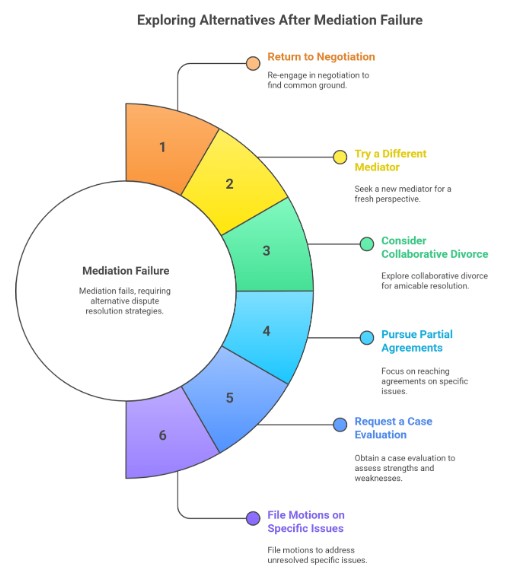
When mediation doesn’t work, many people think they have to go straight to trial. But you’ve got other options before diving into a full-blown court battle.
You can try negotiating again with your attorneys outside of formal mediation. Sometimes, a little break and a fresh look help people find common ground. This usually costs less than going to court.
A new mediator might bring a different approach or a better communication style. Some mediators even specialize in high-conflict or complicated financial cases.
In collaborative divorce, both sides agree to work together without going to court. Each person gets their own attorney, and you meet in structured sessions. If collaboration doesn’t work, both attorneys have to step away from the case.
You don’t have to solve everything at once. You can agree on things like child custody or property division and let the judge decide the rest. This narrows the litigation and saves money.
Some courts offer case evaluations where neutral attorneys review your case and give opinions on likely outcomes. Sometimes, hearing a realistic perspective helps people settle.
Instead of a full trial, you can ask the judge to rule on just the toughest disputes. This targeted approach addresses urgent concerns without the hassle and expense of a complete trial.
Many couples wonder if trying mediation again after reaching an impasse makes sense. It depends on what caused things to fall apart in the first place.
When a Second Attempt Makes Sense:
Time changes how people see things. What felt impossible last month might seem less daunting after everyone cools off a bit.
Some couples really do benefit from stepping back and giving mediation another shot with a fresh mindset.
Sometimes, switching to a different mediator or approach helps. If the first mediator’s style just didn’t click, trying someone new can shake things up.
Other couples try out different alternative dispute resolution methods alongside mediation. That can work, too.
Collaborative divorce is another route. Both parties work with trained professionals to reach agreements outside of court, and honestly, it offers more support than traditional mediation.
But let’s be real—endless mediation sessions can get frustrating. If the same arguments keep popping up and nobody budges, it might be time to consider other dispute-resolution methods or even head to court.
Florida courts want people to try settling, but they know when mediation has run its course.
The trick is staying honest about whether things have actually changed enough to make a second attempt worth it.
Torres Mediation knows that not every divorce issue is resolved in a single session. The team takes a practical approach when couples can’t agree on everything.
Mediators focus on settling whatever issues both parties can agree on, even if it’s not everything. This might include:
Every resolved item means less for a judge to decide later.
If the first session doesn’t cover all the issues, Torres Mediation offers more sessions. Sometimes, couples just need time to review documents or take a breather.
Coming back to the same mediator, who already knows the case, can really help.
When mediation fails to reach a settlement, the mediator points out which issues remain unresolved. This makes it easier for attorneys to prepare for court.
The process often uncovers each party’s priorities and concerns, which becomes useful in litigation.
If a mediation impasse has you worried about court costs, delays, and losing control of the outcome, take action now and protect your future with Torres Mediation. Contact us today.