

Originally published: July 2026
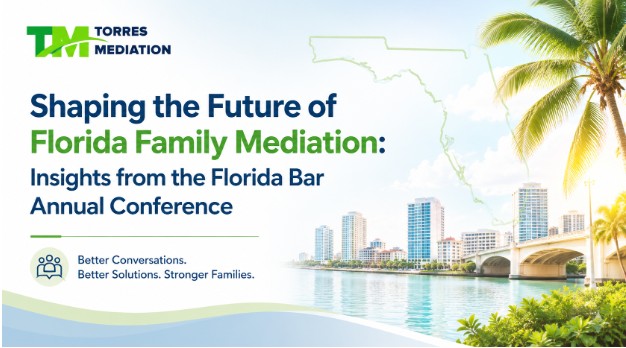
Florida family mediation is shifting toward virtual sessions, more detailed parenting plans, and earlier pre-suit resolution.
Kim Torres, a Florida Supreme Court Certified Mediator in Brevard County, tracks these shifts in part through statewide involvement, including attending this year’s Florida Bar Annual Conference, where she appears in a video recap the Florida Bar released from the event.
Schedule a Mediation — if a recent family law trend has you wondering whether mediation is right for your situation, a short call with Kim can clarify your timeline and options.
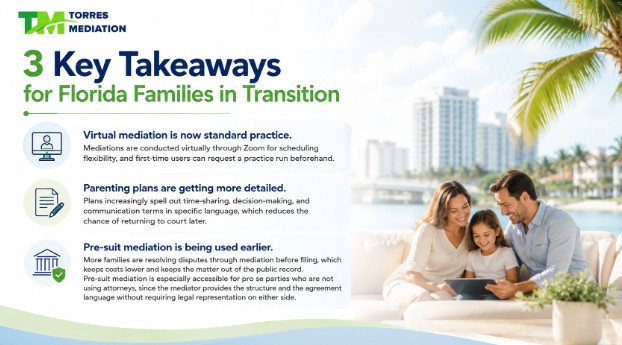
Florida family law has undergone several real shifts in recent years: virtual mediation sessions are now routine rather than exceptional, parenting plans include more specific day-to-day details, and more disputes are resolved before anyone files in court, including by pro se parties who are navigating the process without attorneys.
A mediator who stays involved with statewide organizations tends to track these shifts earlier, which matters when a court’s local rules or expectations change mid-case.
Kim has been a member of the Florida Bar since 1985 and has practiced exclusively as a mediator for more than 20 years, with current memberships including the Florida Academy of Professional Mediators and the Brevard County Bar Association.
If you’re ready to get started, call us now!
Most people considering mediation have never been through the process before, which makes the structure itself part of the decision. A free initial consultation comes first, where both parties speak with Kim by phone to understand the steps involved and review fees before scheduling anything.
The process works the same whether both parties have attorneys, one does, or neither does — pro se parties who are representing themselves without counsel use mediation regularly and benefit from the same structured, neutral process.
From there, the mediator does not make any decision for either party — the session is a facilitated negotiation, not a hearing. There is no risk that either party will be stuck with an unwanted outcome or terms they did not choose — an agreement is reached only when both sides decide the terms are acceptable.
The mediation session itself typically runs two to four hours, billed in quarter-hour increments with a two-hour minimum for virtual sessions, and most disputes resolve in a single session rather than requiring a second.
If the parties reach an agreement, Kim prepares a settlement agreement or parenting plan and sends a draft within two weeks, giving both sides time for an attorney or financial professional to review it before signing.
If the parties do not reach an agreement, no settlement document is prepared, and no charge applies to that portion of the work.
Choosing a mediator usually comes down to a short list of factors: training, experience, subject-matter familiarity, and neutrality.
A mediator’s statewide involvement — through organizations like the Florida Bar’s ADR Section — adds a layer beyond local practice, as it provides exposure to how mediators and judges across Florida interpret the same rules that a Brevard County court applies.
This matters most in disputes that don’t fit a standard template, such as elder care coordination or high-conflict parenting cases, where a mediator’s familiarity with how other Florida courts have handled similar disputes can shape the options presented at the table.
Kim’s prior role as Chair of the Florida Bar’s ADR Section reflects this kind of ongoing statewide engagement, separate from her day-to-day Brevard County caseload.
The ADR Section of The Florida Bar provides a forum for lawyers interested in alternative dispute resolution and for the discussion and exchange of ideas leading to an improvement of individual ADR skills and abilities.
With nearly 1,300 members, the Section keeps Florida Bar members informed about legislation, rules, and policies affecting mediation, arbitration, and other ADR processes while providing high-quality continuing legal education programs.
At this year’s Annual Conference, Kim interviewed Sherry, the ADR Section’s incoming president, who outlined three priorities for the year ahead: strengthening community among Florida ADR practitioners, expanding professional development opportunities, and advancing credentialing standards across the state.
Active participation at the statewide level keeps a mediator connected to the broader direction of the profession rather than operating in isolation.
Attending annual conferences, contributing to section leadership, and engaging with practitioners from other circuits all sharpen the judgment a mediator brings to each individual session.
These priorities reflect the same commitment to professional rigor that shapes Kim’s own practice.
If you’re ready to get started, call us now!
Schedule a Mediation — waiting until a dispute escalates costs both families and businesses time and money that early mediation often avoids.
A parenting plan that holds up over time covers more than custody and a visitation schedule. Florida parenting plans increasingly spell out holiday and summer schedules, communication expectations between parents, decision-making authority for school and medical choices, and a clear process for future modifications.
The more specific the plan, the less likely either parent is to need to return to court to resolve a disagreement over an ambiguous term.
This trend toward specificity reflects a broader shift in family mediation: plans written in general language tend to generate disputes later, while plans that name the actual schedule, the actual decision-maker, and the actual process for changes tend to hold.
Kim’s process, fees, and approach to each case stay the same regardless of conference activity. Mediation is a valuable alternative for people who already know they’re moving toward a resolution but need a structured, neutral conversation to get there.
Sessions run two to four hours; fees are $350/hour with a two-hour minimum for virtual sessions and a three-hour minimum in-person, and every case follows the same approach she’s used for over 3,000 mediations: no pressure toward any particular outcome, full confidentiality, and an agreement only the parties — not the mediator — control. No one leaves a mediation session bound to terms they did not choose.
What does the future of family mediation in Florida look like?
Florida family mediation is moving toward more virtual sessions, more detailed parenting plans, and earlier pre-suit resolution before either side files in court, reducing both cost and time for families working through disputes.
Does attending the Florida Bar conference change how Kim Torres runs mediation sessions?
No. Conference attendance keeps Kim current on statewide trends in family law and alternative dispute resolution, but her process, fees, and approach to each individual case remain consistent regardless of which conferences she attends.
What is pre-suit mediation, and why are more Florida families using it?
Pre-suit mediation means resolving a dispute through mediation before either side files a lawsuit, which typically reduces legal costs for both parties and keeps the matter entirely out of the public court record.
How detailed do Florida parenting plans need to be?
Current practice favors parenting plans that spell out time-sharing schedules, holiday arrangements, and decision-making responsibilities in specific terms, which reduces the ambiguity that often leads to future parenting disputes.
Does virtual mediation work as well as in-person mediation for divorce cases?
Yes. Virtual mediation conducted through a secure platform like Zoom offers the same structure and confidentiality as in-person sessions, while also providing scheduling flexibility for both parties.
What does a Florida Supreme Court Certified Mediator credential mean?
It indicates the mediator has met the Florida Supreme Court’s training, experience, and ethics requirements for a specific certification area, such as family mediation, circuit civil mediation, or appellate mediation.
How much does mediation cost compared to litigation?
Mediation costs are typically limited to the mediator’s hourly rate and any document preparation fees, while litigation involves attorney fees, court costs, and a longer timeline, often making mediation the lower-cost path overall.
What happens if both parties cannot reach an agreement during mediation?
If the parties do not reach an agreement, the mediator does not prepare a settlement document and does not charge for that portion of the session, and either party remains free to pursue litigation instead.
Can mediation be used for disputes outside of divorce, like HOA or elder care conflicts?
Yes. Mediation applies to a range of disputes, including HOA conflicts, elder care decisions, small business disagreements, and consumer debt matters, not only divorce and family law cases.
Is mediation legally binding?
A mediated agreement becomes legally binding once both parties sign it and, where applicable, the court approves the agreement as part of a final order in the case.
We have already agreed on our parenting plan and property distribution — do we still need mediation?
Yes, and many couples in that situation still benefit from working with an experienced mediator. A mediator with years of experience can review the terms both parties have agreed to, confirm that the language used is sufficiently specific for court enforcement, and raise topics or options the parties may not have considered on their own. Even when there is no active dispute, mediation adds a layer of thoroughness that helps the agreement hold up over time.
Do both parties need an attorney to mediate?
No. Parties can mediate without attorneys through a pro se process, though either party may choose to have an attorney or financial professional review the final agreement.
Schedule a Mediation — if a recent conference update or a parenting plan question has you weighing your next step, talk to Kim directly about your county, timeline, and what’s still in dispute.
Kim W. Torres, Esq. is a Florida Supreme Court Certified Mediator in Circuit Civil, Family, County Court, and Appellate matters and a member of The Florida Bar since 1985. Practicing exclusively as a mediator since 2000, she has resolved more than 2,000 cases — from complex multi-party disputes to high-emotion matters with self-represented parties. A past Chair of the Florida Bar’s ADR Section and Brevard County’s Circuit Civil Mediator of the Year, Kim mediates throughout Florida, in person and virtually.