

Originally published: September 2026
A Florida mediator is legally required to report suspected abuse, neglect, or exploitation of a child or vulnerable adult — that’s a mandatory report to Florida’s Abuse Hotline, and it goes to the Department of Children and Families, not the judge in your case.
A threat of violence between adults works differently: the mediator may disclose it, but Florida law doesn’t say the mediator must, or specify exactly where that disclosure has to go. If you’re weighing what to say in mediation, this distinction matters most.
Weighing what’s safe to say in mediation? Kim W. Torres has mediated Florida family disputes for over two decades — schedule a confidential consultation to talk through your situation.
Florida law draws a hard line between the two, and it’s worth stating plainly: an exception that allows disclosure is not the same thing as a duty to report. A mandatory report is one the mediator has no choice about — the law requires it once the reporting trigger is met, and it directs the report to a specific place. A discretionary disclosure is one the mediator is legally permitted to make without violating mediation confidentiality, but nothing in Florida law forces it, and nothing specifies exactly who receives it.
The distinction usually confuses people because both situations involve breaking the general rule that what’s said in mediation stays private.
The difference is what happens next: a mandatory report sets a specific, required process in motion, with a designated recipient.
A discretionary disclosure is the mediator’s judgment call about what’s necessary for someone’s safety, without a statutory roadmap for where it goes.
If you’re ready to get started, call us now!
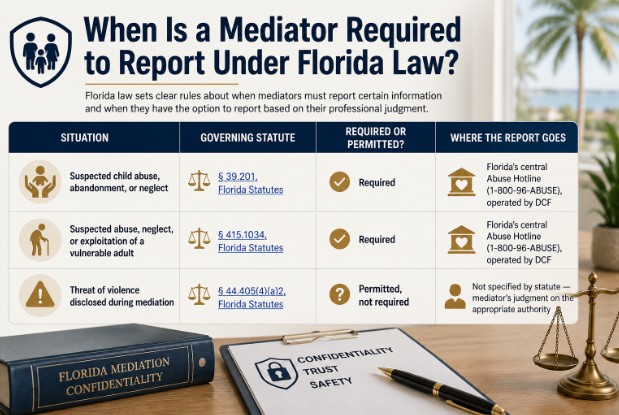
| Situation | Governing Statute | Required or Permitted? | Where the Report Goes |
| Suspected child abuse, abandonment, or neglect | § 39.201, Florida Statutes | Required | Florida’s central Abuse Hotline (1-800-96-ABUSE), operated by DCF |
| Suspected abuse, neglect, or exploitation of a vulnerable adult | § 415.1034, Florida Statutes | Required | Florida’s central Abuse Hotline (1-800-96-ABUSE), operated by DCF |
| Threat of violence disclosed during mediation | § 44.405(4)(a)2, Florida Statutes | Permitted, not required | Not specified by statute — mediator’s judgment on the appropriate authority |
Both mandatory statutes use the same threshold: knowledge or reasonable cause to suspect that abuse has occurred. That word — “occurred” — matters: the duty isn’t limited to abuse happening right now.
The mediator doesn’t need proof, a confession, or a police report either — a reasonable basis to suspect is enough to trigger the duty, whether the suspected abuse is ongoing or in the past.
A threat of violence made during mediation sits in genuinely different territory. Under § 44.405(4)(a)2, Florida Statutes, a communication “willfully used to plan a crime, commit or attempt to commit a crime, conceal ongoing criminal activity, or threaten violence” simply isn’t protected by mediation confidentiality in the first place.
That removes the legal barrier to disclosure — it doesn’t create a legal duty to disclose, and it doesn’t say who the mediator should tell.
Florida’s Mediator Ethics Advisory Committee has addressed this gap directly. In Opinion 2012-007, MEAC confirmed that a mediator “may disclose to an appropriate authority” a communication that falls under this exception — but the opinion doesn’t identify a required recipient, and the underlying statute is silent on where such a disclosure should go.
In practice, this gives a mediator hearing a credible threat room to act—ending the session, contacting law enforcement, or taking other protective steps—as a matter of professional judgment, not because a specific statute compels that response.
If you’re ready to get started, call us now!
For the mandatory category — suspected child or vulnerable-adult abuse — the answer is clear and specific. These reports go to the Department of Children and Families’ Abuse Hotline, a track that runs independently of your family law case.
A mediator is also affirmatively barred from reporting the substance of mediation to the judge; a mediator can generally confirm only that mediation happened, whether it ended in agreement, and who attended.
For a discretionary threat-of-violence disclosure, the answer is less fixed. Nothing in § 44.405 or the MEAC guidance interpreting it guarantees the disclosure could never reach a court or law enforcement — the statute simply doesn’t dictate where the mediator directs it.
If you’re weighing what a mediator might do with a specific disclosure, ask the mediator directly before mediation begins, rather than assume a categorical answer either way.
Florida’s Mediation Confidentiality and Privilege Act sets confidentiality as the default, not the exception.
| Exception to Confidentiality | Statute | What It Covers |
| Written waiver | § 44.405(4)(a)1 | All parties agree in writing to waive confidentiality |
| Crime or threat of violence | § 44.405(4)(a)2 | Planning, committing, or concealing a crime, or threatening violence |
| Mandatory abuse report | § 44.405(4)(a)3 | Child or vulnerable-adult abuse under Chapters 39 and 415 |
| Mediator malpractice | § 44.405(4)(a)4 | Disclosure limited to a malpractice claim against the mediator |
| Voiding a settlement | § 44.405(4)(a)5 | Fraud, duress, or mutual mistake in a signed agreement |
The mediator’s own ethical duty tracks the same line. Rule 10.360, Florida Rules for Certified and Court-Appointed Mediators, requires a mediator to maintain confidentiality “except where disclosure is required or permitted by law or is agreed to by all parties” — and Rule 10.420(a)(3) requires the mediator to say exactly that during the opening orientation, so this isn’t something disclosed only after the fact.
If what you share meets the threshold for a mandatory report — reasonable cause to suspect a child or vulnerable adult has been or is being abused, neglected, or exploited — the report gets made to the Abuse Hotline regardless of whether the abuse is past or ongoing. The mediator isn’t evaluating your credibility or deciding whether you’re telling the truth; the reasonable-suspicion standard means the report is made, and DCF determines what happens next.
If what you share doesn’t meet the mandatory-report threshold, that doesn’t mean it’s irrelevant to the conversation — it can still shape how a parenting plan or settlement gets structured going forward.
If you’re in immediate danger, mediation isn’t the right first step — contact the Florida Domestic Violence Hotline at 1-800-500-1119 (available 24/7) or the National Domestic Violence Hotline at 1-800-799-7233.
Does a mediator have to report domestic violence in Florida? No, not for everything. A mediator must report suspected abuse, neglect, or exploitation of a child or vulnerable adult to Florida’s Abuse Hotline. A threat of violence between adults is different — the mediator may disclose it, but isn’t required to report it anywhere specific.
What’s the difference between mandatory and discretionary reporting for a mediator? Mandatory reporting applies to suspected child or vulnerable-adult abuse under Chapters 39 and 415, Florida Statutes — the mediator must report it. Discretionary disclosure covers a threat of violence: the mediator may disclose it under Section 44.405, but isn’t required to report it anywhere specific.
Who does a mandatory report go to — the court or somewhere else? A mandatory report goes to Florida’s Abuse Hotline, run by the Department of Children and Families — never to the judge handling your case. The mediator can only confirm to the court that mediation occurred, whether it settled, and who attended.
Will the judge in my case find out what I said in mediation? Generally no. Under Section 44.405, Florida Statutes, mediation communications stay confidential and inadmissible in court, with narrow exceptions for mandatory abuse reports, threats of violence, planning a crime, professional malpractice claims, or challenging a signed agreement for fraud or duress.
Does a mediator have to report a threat of violence made during mediation? No, not to a specific agency. Section 44.405(4)(a)2, Florida Statutes, removes confidentiality protection from a threat of violence, meaning the mediator may disclose it. Florida’s Mediator Ethics Advisory Committee has noted the statute doesn’t specify where that disclosure should go.
Does mandatory reporting only apply to current or ongoing abuse? No. Florida Statute 39.201 requires a report when a person knows or has reasonable cause to suspect child abuse, abandonment, or neglect “has occurred” — including past abuse, not only abuse that’s currently happening. The same principle applies under Chapter 415 for a vulnerable adult.
Can mediation communications ever be used against me in court? Only in narrow circumstances. Mediation communications can be used if all parties waive confidentiality in writing, in a malpractice claim against the mediator, or to challenge a signed settlement for fraud, duress, or mutual mistake — not simply because one party wants to introduce them.
Does dropping a restraining order stop a mandatory report from being made? No. A mandatory report is based on the mediator’s own knowledge or reasonable suspicion at the time, not on whether a protective order is later dropped. Ending a restraining order doesn’t retroactively undo a report already made, and doesn’t prevent a new one if warranted.
What is the Florida Abuse Hotline, and who answers it? It’s Florida’s statewide hotline for reporting suspected abuse, neglect, or exploitation of a child or vulnerable adult, staffed by the Department of Children and Families. Reports can be made by phone at 1-800-96-ABUSE (1-800-962-2873) or through the department’s online reporting system.
Do I need to bring proof of abuse to have it taken seriously in mediation? No. A mediator’s mandatory-report duty is based on reasonable cause to suspect abuse, not on documentary proof. Bringing relevant records or details can help the broader mediation process, but it isn’t a precondition for a mediator taking a disclosure seriously.
Florida mediators must report suspected child or vulnerable-adult abuse to the state Abuse Hotline — that’s mandatory, under Chapters 39 and 415, Florida Statutes, and it applies whether the abuse is past or ongoing. Reporting a threat of violence between adults is legally permitted under § 44.405(4)(a)2 but not required, and the statute doesn’t specify where that disclosure goes.
Mandatory reports go to the Department of Children and Families, a separate track from your family law matter, and never to the judge. Everything else said in mediation stays confidential under Chapter 44, Florida Statutes, with a short, specific list of exceptions.
If you’re navigating a parenting plan or family mediation where past or ongoing abuse is part of the picture, schedule a confidential consultation with Kim W. Torres to talk through what mediation can — and can’t — do for your situation.
Kim W. Torres, Esq. is a Florida Supreme Court Certified Mediator in Circuit Civil, Family, County Court, and Appellate matters and a member of The Florida Bar since 1985. Practicing exclusively as a mediator since 2000, she has resolved more than 2,000 cases — from complex multi-party disputes to high-emotion matters with self-represented parties. A past Chair of the Florida Bar’s ADR Section and Brevard County’s Circuit Civil Mediator of the Year, Kim mediates throughout Florida, in person and virtually.