

Originally published: September 2026
Florida Statute § 720.311 requires many HOA covenant and enforcement disputes to go through pre-suit mediation before either side can sue — but the statute explicitly excludes collection of any assessment, fine, or other financial obligation, and excludes election and recall disputes.
Where it applies, the demanding party lists five certified mediators and their hourly rates, and the responding party has 20 days to select one and pay half the cost. Refusing to mediate blocks a party from recovering attorney’s fees later, even if that party wins.
Facing an HOA dispute that won’t budge? Kim W. Torres mediates Florida community association conflicts full-time — schedule a confidential consultation today.
Read this section first. Confirm the dispute actually qualifies before drafting a demand. Florida Statute § 720.311(2)(a) expressly states that disputes subject to presuit mediation shall not include the collection of any assessment, fine, or other financial obligation, including attorney’s fees and costs, claimed to be due, or any action to enforce a prior mediation settlement agreement. Election disputes and recall disputes are also excluded —those are routed to binding arbitration through the state’s condominium and HOA regulator, or to court.
| Status | Dispute Type | Example |
| Excluded | Collection of a financial obligation | An HOA suing or demanding payment for unpaid assessments, an unpaid fine already levied, or attorney’s fees and costs claimed to be due |
| Excluded | Election disputes | A challenge to how a board election was conducted or its result |
| Excluded | Recall disputes | A member-initiated effort to recall a board member |
| Excluded | Enforcing a prior mediation settlement | A party seeking to enforce an agreement already reached in a previous mediation |
| Covered | Covenant enforcement (the underlying conduct, not fine collection) | Whether an owner’s fence, driveway, or exterior change actually violates the Declaration |
| Covered | Architectural Review Committee decisions | An ARC denial of a fence, sidewalk, or addition request |
| Covered | Notice, recordkeeping, and records access | A missed annual meeting notice, an excluded agenda item, or a withheld financial report |
| Covered | Common element use and maintenance disputes | Disagreement over storage on common property or uneven allocation of shared repair costs |
| Covered | Neighbor disputes routed through the association | Noise, lighting, drainage, or an overhanging tree the association is asked to address |
Pre-suit mediation is a dispute-resolution step under Chapter 720, Florida Statutes, that requires an HOA and a member to meet with a neutral third party before certain disputes—the covered ones described above—can be filed in court.
The Legislature added this requirement to reduce the volume of community-association cases in Florida’s civil dockets, on the reasoning that many covenant and enforcement disputes involve a single disputed fact or a communication breakdown rather than a genuine legal conflict requiring a judge.
The mediator’s role is narrow by design. A mediator doesn’t decide who is right, rule on whether a covenant was violated, or award damages.
The mediator’s only job is to facilitate a conversation structured enough that both sides can actually hear each other’s position. If the parties reach an agreement, it becomes a binding contract.
If they don’t, the mediator declares an impasse, and the case can proceed to court exactly as if mediation had never happened, except that both sides have now satisfied the statutory precondition to file.
If you’re ready to get started, call us now!
Can you bullet these items?
The statute is specific about what counts against a party: not responding to the demand within 20 days, not agreeing to one of the five listed mediators, not paying or prepaying the required share of the mediator’s fee within the time the mediator sets, or not appearing for the scheduled session without the mediator’s approval.
Any of those failures can cost that party the right to recover attorney’s fees later, even if that party ultimately wins the underlying dispute in court.
Can you bullet this list of steps?
You send a written demand naming the specific dispute, the Declaration or Covenant provision at issue, and five certified mediators with their hourly rates, mailed by certified mail with return receipt requested and by first-class mail to the address on file with the association.
The demand must confirm the dispute is one which is prescribed for presuit mediation covers and identify the statutory authority—the specific Chapter 720 section—supporting the claimed violation.
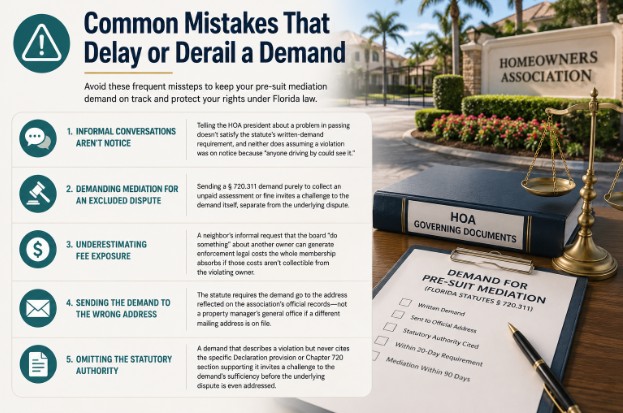
The most frequent mistake is treating an informal conversation as notice — telling the HOA president about a problem in passing doesn’t satisfy the statute’s written-demand requirement, and neither does assuming a violation was on notice because “anyone driving by could see it.” Beyond that:
Florida Statute § 720.311(2)(d) requires the mediator to be certified by the Florida Supreme Court as a circuit court civil mediator. Look for that specific certification, plus practical familiarity with community-association disputes — not just general civil mediation experience.
A listed mediator can usually recommend others who handle this type of dispute. When you need to include the names of five mediators in your request.
A mediator’s past involvement with a particular large community isn’t a conflict — it typically reflects the mediator’s experience and standing with the association-side firms that work in that area, and any mediator who genuinely can’t act neutrally is ethically obligated to decline the engagement. Mediators are trained to remain impartial and are adept at working equally and fairly with both parties in a dispute.
Florida’s Dispute Resolution Center mediator search lets you confirm a mediator’s certification and county coverage before listing them in a demand.
???That’s the full section, ready to drop in as a replacement for the old “How to Choose the Five Mediators” heading and text.
Only the heading changed — the body content was already accurate and didn’t need rewording. Let me know if you’d also like the body simplified/shortened, or if this is good as-is.
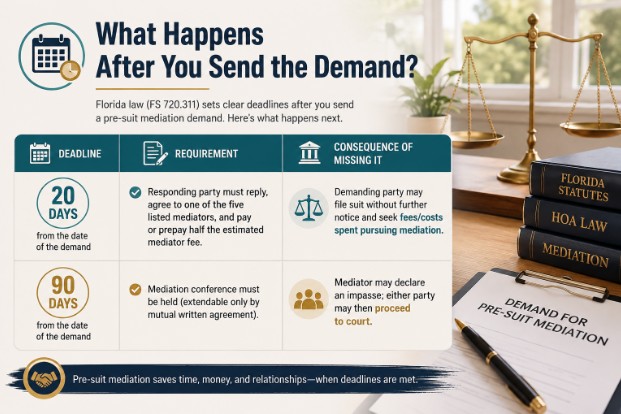
| Deadline | Requirement | Consequence of Missing It |
| 20 days from the date of the demand | Responding party must reply, agree to one of the five listed mediators, and pay or prepay half the estimated mediator fee | Demanding party may file suit without further notice and seek fees/costs spent pursuing mediation |
| 90 days from the date of the demand | Mediation conference must be held (extendable only by mutual written agreement) | Mediator may declare an impasse; either party may then proceed to court |
An impasse is not itself a bad outcome for either side: it simply means both parties fulfilled the statutory requirement and remain free to pursue the dispute in court on the same terms as if mediation had never happened.
If you’re ready to get started, call us now!
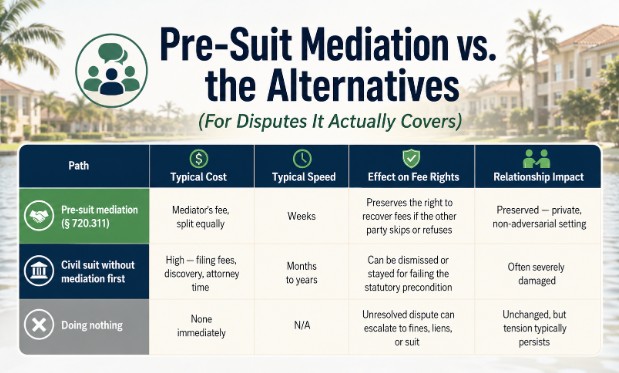
| Path | Typical Cost | Typical Speed | Effect on Fee Rights | Relationship Impact |
| Pre-suit mediation (§ 720.311) | Mediator’s fee, split equally | Weeks | Preserves the right to recover fees if the other party skips or refuses | Preserved — private, non-adversarial setting |
| Civil suit without mediation first | High — filing fees, discovery, attorney time | Months to years | Can be dismissed or stayed for failing the statutory precondition | Often severely damaged |
| Doing nothing | None immediately | N/A | Unresolved dispute can escalate to fines, liens, or suit | Unchanged, but tension typically persists |
Unless the parties agree otherwise, § 720.311(2)(b), Florida Statutes, requires the parties to split the mediator’s fee equally for a dispute the statute covers.
An average HOA mediation runs three to four hours including preparation time, and each side also covers its own attorney’s fees if it chooses to use one — an attorney is optional, not required.
The mediator may require advance payment before scheduling; any deposit collected beyond the actual share owed is returned.
Because assessment collection itself is excluded from § 720.311, an association pursuing both a covenant issue and unpaid assessments against the same owner may need to treat them as two separate tracks — the covenant dispute through presuit mediation, and the assessment collection through the separate lien and foreclosure process under § 720.3085, Florida Statutes.
Under that section, unpaid assessments accrue interest at the rate stated in the declaration or bylaws — or, absent a stated rate, a default simple rate of 18% per year Bob, where did you get this interest rate? Statutory? Under collections, or HOA statute?— plus late charges, costs, and the association’s reasonable attorney’s fees.
An attorney can advise on how to sequence the two tracks correctly.
Kim W. Torres mediates Florida HOA disputes governed by Chapter 720 — schedule a consultation to find out whether your dispute qualifies for presuit mediation.
A mediator schedules the session, facilitates the conversation, helps both sides identify what’s actually in dispute, and — if the parties reach terms — reduces the agreement to writing.
That’s the scope of the role, and it’s worth being explicit about what falls outside it, because misunderstanding this is a common source of frustration at HOA mediations.
As a neutral professional, A mediator generally does not evaluate which side is legally correct or tell either party what argument to make. That boundary applies uniformly, regardless of how a party prepared its position — including material drafted with AI tools. During mediation, the mediator will assist the parties to work through their arguments for the parties to determine which ones are the strongest and the practical ramifications that should be considered. It is expected that facts and understandings will differ between the parties, and that is what the mediation session is designed to address.
A mediator facilitates the discussion between the parties; the mediator does not review AI-generated arguments or any other prepared material for legal validity or relevance to the dispute. Parties are expected to bring their own arguments to the session, which can be based on their own research and relevant facts. A party should parse through various approaches and options for the most applicable arguments based on the facts of their matter.
Each party remains responsible for structuring its own arguments and organizing its own supporting evidence before the session. If a party is unsure as to whether certain documents are necessary, the party should be prepared to present them, usually be pulling up on Screen Sharing, for review. When documents and photographs have been scanned and created as an electronic file, the documents can be shared with all participants, regardless of location.
If a dispute turns out to involve a genuine legal question — whether a covenant was properly adopted, whether a fine followed the correct procedure, whether a dispute actually qualifies for presuit mediation at all — that’s a conversation for an attorney, not the mediator. Conflicting interpretations of the law are questions that can be mediated, but will not be decided by the mediator. Discussions during a mediation session will focus on the strengths of each side’s arguments, and possible outcomes based on both perceptions. People can decide on a resolution without actually knowing what a court would do, and base their decisions on what is reasonable and likely as an alternative outcome.
Consulting counsel before a session, or before signing any agreement reached at one, is available to either party and doesn’t require the mediator’s involvement.
Two sample demand forms are available below, built to the statutory format in § 720.311, and updated to flag the assessment/fine exclusion directly on the form.
Both are provided for reference only for disputes the statute covers, and are not a substitute for legal advice—a dispute involving a large dollar amount, multiple alleged violations, or a contested fact pattern is worth having an attorney review before the demand goes out.
This version is written from the association’s letterhead, addressed to the responding homeowner, and includes all statutory elements: the demand language, the five-mediator listing (with the circuit court civil mediator certification requirement noted), the cost-sharing terms, and the signature/agreement block.
It’s the appropriate starting point when the association initiates a covered dispute—for example, a covenant-compliance disagreement, an ARC denial the owner has ignored, or a records/notice failure. [Download: HOA-to-Homeowner Sample Demand]
Florida law doesn’t require an attorney to send this demand — a homeowner can use the same statutory process to demand mediation from the association directly, for a covered dispute.
This version is addressed to the association’s registered agent or property manager and mirrors the same deadlines and cost-sharing terms.
It’s the right starting point when the board has been unresponsive to a records request or has denied an ARC application without adequate written explanation.
[Download: Homeowner-to-HOA Sample Demand]
A financial-records dispute follows a related but distinct path — see what to do if a Florida HOA won’t release its audited financial report for that specific process, including the separate 10-business-day and $50-per-day remedies under § 720.303(5) that apply to records requests specifically.
Kim W. Torres, Esq., a Florida Supreme Court Certified Circuit Civil Mediator and Florida Bar member since 1985, mediates HOA disputes throughout Brevard, Orange, Seminole, and Indian River Counties and statewide.
A typical HOA mediation session runs about four hours — more attendees generally means more time, so if a group plans to attend on one side, naming a single spokesperson keeps the session on schedule and gives everyone’s concerns a clear channel to be heard.
Bring the specific Declaration, Covenant, or Bylaw provision at issue and any proposed remedy.
You don’t need to know every governing document in detail — the board or its representative typically brings the relevant provisions, and the mediator works from what each side presents at the table, including document review conducted without an in-person meeting when needed.
Representation by an attorney is never required to participate in mediation, but it’s always available.
If a homeowner or board member wants a referral to an attorney experienced in Florida community-association law — either to consult before the session or to review an agreement before signing — Kim can provide names.
Consulting counsel at either point doesn’t change the mediator’s neutral role or require the mediator’s involvement in that conversation.
Kim’s office is at 575 S. Wickham Rd., Ste F, PMB 334, Melbourne, FL 32904, and sessions are available virtually or in person depending on the parties’ preference.
For more on how mediation works generally, see Torres Mediation’s FAQ page, or read what past clients have said in Torres Mediation’s testimonials.
Pre-suit mediation — A dispute-resolution process under Chapter 720, Florida Statutes, requiring an HOA and a member to attempt mediation with a neutral third party before certain covered disputes can be filed in court.
Presuit mediation demand — The written statutory notice, sent by certified and first-class mail, that starts the § 720.311 process and lists five proposed mediators and their hourly rates.
Collection of a financial obligation — A demand or action seeking payment of an assessment, fine, or other amount due, including attorney’s fees and costs; expressly excluded from the § 720.311 presuit mediation requirement.
Impasse — The mediator’s formal declaration that the parties could not reach agreement, which satisfies the statutory mediation requirement and allows either party to proceed to court on the unresolved dispute.
Parcel owner — The record owner of legal title to a lot or unit within a community governed by a homeowners association, as defined in § 720.301, Florida Statutes.
Declaration of covenants — The recorded governing document that creates an HOA’s authority to regulate a property and establishes the restrictions binding every parcel owner in the community.
Does presuit mediation apply to a dispute over unpaid assessments or a fine?
No. Florida Statute § 720.311 explicitly excludes collection of any assessment, fine, or other financial obligation, including attorney’s fees and costs, from the presuit mediation requirement. A dispute over whether a fine was properly imposed may still qualify; collecting the money itself does not.
Can a homeowner request presuit mediation from an HOA?
Yes, for disputes the statute actually covers. Florida Statute § 720.311 does not limit who may send a qualifying demand — a homeowner can serve the association using the statutory process, and does not need an attorney to do so.
Can an HOA request mediation with a homeowner, not just the reverse?
Yes, for disputes the statute actually covers. An association can serve a homeowner with a statutory demand under § 720.311, typically after a covenant enforcement dispute, an ARC denial, or a notice or recordkeeping issue—not a simple unpaid-assessment collection.
How long does the responding party have to reply to a mediation demand?
The responding party has 20 days from the date of the demand to reply, agree to one of the five listed mediators, and pay or prepay half the estimated mediator fee. Missing this deadline lets the demanding party file suit without further notice.
How long do the parties have to actually hold the mediation once it’s agreed to?
The mediation conference must be held within 90 days of the demand date, unless both parties agree in writing to extend that deadline. This 90-day window runs separately from the 20-day response deadline that starts the process.
What happens if the parties reach an impasse at HOA mediation?
The mediator declares an impasse, and either party may proceed to court on the unresolved disputes. Reaching impasse satisfies the statutory requirement, so a party that responded, agreed to a mediator, paid its share, and attended keeps the right to pursue fees.
What happens if a party refuses to participate in presuit mediation?
A party who refuses to participate loses the right to recover attorney’s fees later, even after winning in court. The other party may also proceed straight to filing suit and can seek fees and costs already spent trying to obtain mediation.
Do you need an attorney for HOA presuit mediation in Florida?
No. Florida law does not require an attorney to participate in HOA pre-suit mediation. Either party may bring one at their own cost, but self-represented homeowners and association representatives routinely mediate directly, with the neutral mediator facilitating the discussion between both sides.
How do you find a mediator qualified to handle HOA disputes specifically?
Look for a Florida Supreme Court Certified Circuit Civil Mediator whose practice specifically covers Chapter 720 community-association disputes, not just general civil mediation. Florida’s Dispute Resolution Center maintains a searchable directory by county and certification type, so you can verify a mediator’s credentials before naming them in a demand.
Is an agreement reached at HOA mediation enforceable in court?
Yes. Once both parties sign a mediated agreement, it becomes a binding, enforceable contract. If a later dispute reaches court, either party can present the signed agreement as evidence, and a judge can incorporate its terms into an enforceable order.
Should HOA mediation be held in person or virtually?
Either can work, and the choice is up to the parties and the selected mediator. Many Florida mediators now default to virtual sessions to avoid travel and scheduling conflicts; confirm format preferences with the mediator when agreeing on a date.
Are HOA mediation sessions and their outcome confidential?
Yes, in most circumstances. Under Chapter 44, Florida Statutes, mediation communications are confidential and generally cannot be used in court. If a settlement affects official HOA business or records, confirm with counsel whether any part of it must still be disclosed to the membership.
Does the HOA’s full board have to attend the mediation session?
Not necessarily. The association typically designates one or two board members or a property manager to represent it, rather than requiring every director to attend. The association’s governing documents and its own internal decision generally determine who represents it at the table.
Who has to attend an HOA mediation, and can other homeowners attend?
Attendance depends on the association’s governing documents and who each side designates as its representative. Other homeowners are not automatically included; if several people plan to attend on one side, naming a single spokesperson keeps the session focused and on schedule.
Can the board make an exception at mediation for work already completed without ARC approval?
Mediation cannot undo work already completed, but it can produce a negotiated outcome the board’s original decision did not offer, such as a retroactive approval, a modification requirement, or a cost-sharing arrangement, without the delay and expense of litigation.
Why won’t the HOA just make an exception for one owner, even for a minor violation?
Owners sometimes argue that a one-time informal exception opens the board to unequal treatment claims from other residents, which can complicate future enforcement of the same rule. Boards usually decline case-by-case exceptions because consistent enforcement, not the severity of one violation, matters.
Can a homeowner see the HOA’s books and records during mediation?
Mediation itself doesn’t create a right to inspect records — that right already exists separately under § 720.303(5), Florida Statutes. A homeowner with an unrelated records dispute should send a separate written records request rather than relying on mediation to produce documents.
Should you rely on AI-drafted arguments at HOA mediation?
No. A mediator facilitates discussion between the parties and does not evaluate any party’s arguments or evidence, including AI-drafted material, for legal validity or relevance. Each party must structure its own arguments and gather supporting evidence before the session.
Can an HOA classify a pickup truck or work vehicle as a prohibited commercial vehicle?
Yes, if the declaration defines a commercial vehicle broadly enough to cover it — many Florida declarations restrict vehicles by signage, exposed equipment, or vehicle class rather than by the owner’s occupation. The declaration’s exact language, not the vehicle’s everyday use, controls the outcome.
Does the HOA have to enforce violations against a neighbor if a homeowner asks?
Most declarations give the board discretion, not an absolute duty, to pursue every reported violation. Consistent, undocumented non-enforcement across similar violations can still expose the board to a fairness challenge, part of why boards handle neighbor complaints cautiously and consistently.
Can homeowners change a covenant or restriction if everyone agrees?
Amending a covenant or restriction generally requires the approval percentage set out in the association’s governing documents, not unanimous informal agreement among neighbors. An attorney familiar with Chapter 720, Florida Statutes, can confirm the exact amendment procedure for a specific association.
Florida Statute § 720.311 requires a written demand before many HOA covenant and enforcement disputes can be filed in court — but the statute explicitly excludes collection of assessments, fines, or other financial obligations, along with election and recall disputes.
Where it applies: the demand goes by certified and first-class mail, names five Florida Supreme Court Certified Circuit Civil Mediators, and gives the other side 20 days to respond and 90 days from the date of the demand to reach the mediation table.
Either an association or a homeowner can send it, without an attorney. The parties split the mediator’s cost, and failing to respond, agree to a mediator, pay, or attend carries a real financial penalty — forfeiting the right to recover fees later, even after winning in court.
Don’t let an HOA dispute drag into litigation. Schedule a confidential consultation with Kim W. Torres to find out whether your dispute qualifies for presuit mediation.
Kim W. Torres, Esq. is a Florida Supreme Court Certified Mediator in Circuit Civil, Family, County Court, and Appellate matters and a member of The Florida Bar since 1985. Practicing exclusively as a mediator since 2000, she has resolved more than 2,000 cases — from complex multi-party disputes to high-emotion matters with self-represented parties. A past Chair of the Florida Bar’s ADR Section and Brevard County’s Circuit Civil Mediator of the Year, Kim mediates throughout Florida, in person and virtually.